 Add to Chrome
 Add to Firefox
 Add to Edge
Simulating Human Memory with Language Models
May 25, 2026
Language models are increasingly being deployed as user simulators, but their memory is far more reliable than that of real users. To measure this gap, we run a series of classic memory experiments from psychology on both humans and language models. Across tasks, we find that out-of-the-box language models exhibit better memory than humans, even when prompted to imitate human behavior. We then show that better prompting strategies and the use of a compactor can cause language models to forget content in a more human-like way. Using these methods, we show preliminary evidence that language models with human-like memory constraints can function as more effective user simulators in a downstream education task. Finally, we release human reference data and benchmarks to support future work on simulating human memory with language models.

Human acceptability judgements for extractive sentence compression
Feb 01, 2019
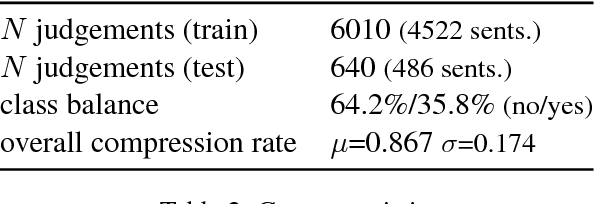
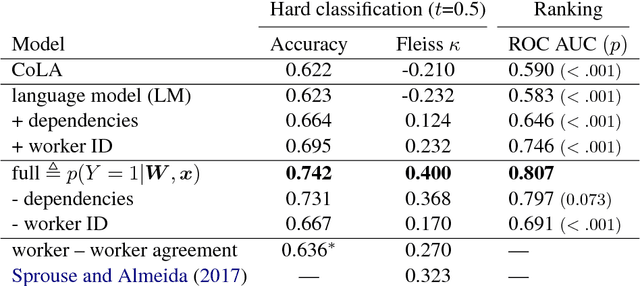
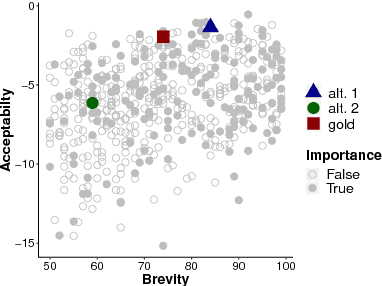
Recent approaches to English-language sentence compression rely on parallel corpora consisting of sentence-compression pairs. However, a sentence may be shortened in many different ways, which each might be suited to the needs of a particular application. Therefore, in this work, we collect and model crowdsourced judgements of the acceptability of many possible sentence shortenings. We then show how a model of such judgements can be used to support a flexible approach to the compression task. We release our model and dataset for future work.
Evaluating Syntactic Properties of Seq2seq Output with a Broad Coverage HPSG: A Case Study on Machine Translation
Sep 06, 2018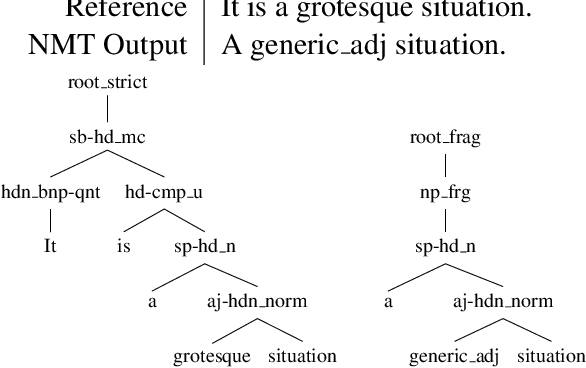
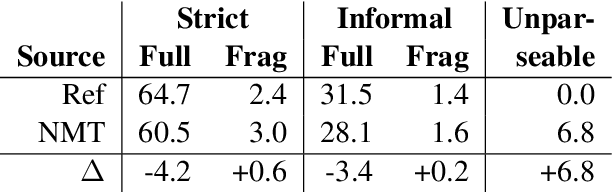
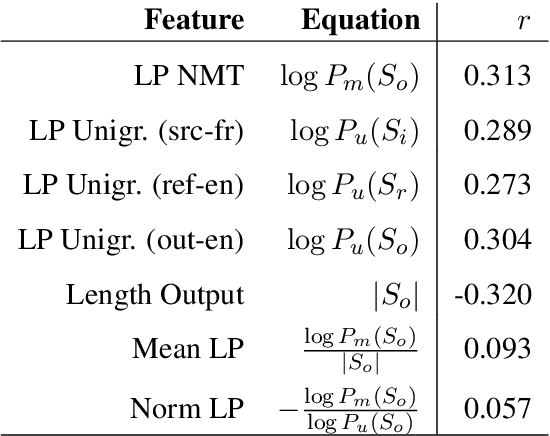
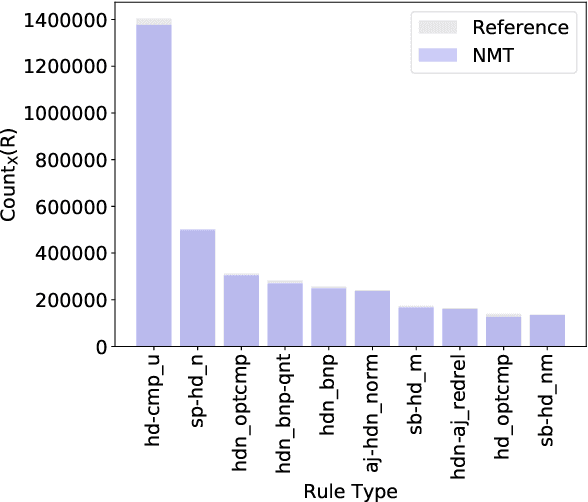
Sequence to sequence (seq2seq) models are often employed in settings where the target output is natural language. However, the syntactic properties of the language generated from these models are not well understood. We explore whether such output belongs to a formal and realistic grammar, by employing the English Resource Grammar (ERG), a broad coverage, linguistically precise HPSG-based grammar of English. From a French to English parallel corpus, we analyze the parseability and grammatical constructions occurring in output from a seq2seq translation model. Over 93\% of the model translations are parseable, suggesting that it learns to generate conforming to a grammar. The model has trouble learning the distribution of rarer syntactic rules, and we pinpoint several constructions that differentiate translations between the references and our model.