 Add to Chrome
 Add to Firefox
 Add to Edge
Wait, am I Being Fair? Characterizing Deductive Stereotyping and Mitigating It with Fair-GCG
Jun 30, 2026
Warning: This paper contains several toxic and offensive statements. While reasoning generally improves fairness in recent large language models (LLMs), failures persist. In this work, we identify a failure mode, deductive stereotyping, in which models apply population-level statistical regularities to individual cases, producing logically coherent yet socially biased inferences. We provide a statistical interpretation of this phenomenon. To steer models toward fairness-aware reasoning, we propose a reasoning-time injection framework. We further introduce Fair-GCG to systematically discover effective injection phrases. Injection phrases discovered by Fair-GCG improve performance across multiple fairness benchmarks, generalize from smaller to larger LLMs, improves reasoning-level fairness, reduces bias in open-ended generation, and transfer to real-world fairness-sensitive tasks.

The Language-Energy Divide: Measuring Energy Costs of Multilingual LLM Inference
Jun 20, 2026Large language models (LLMs) are increasingly deployed in multilingual settings, yet the energy costs of serving these models across different languages remain poorly understood. We present a systematic study of inference energy consumption across languages with ML.Energy framework (Chung et al., 2026). We find striking disparities: energy consumption per output token varies by up to 8.3 times across languages, while total energy for a fixed set of requests varies by up to 179 times between the cheapest (English, 17.6 kJ) and the most expensive (Pashto, 3,147 kJ) languages. Our analysis shows that this disparity is driven by two compounding factors: (1) higher per-token energy costs for languages using complex or rare scripts, and (2) more tokens generated for low-resource languages. Moreover, we find a double cost + performance penalty: languages with the highest energy footprints also tend to achieve the lowest task accuracy. We reveal that the energy divide persists across models, hardware, and tasks, suggesting a systemic energy inequity in multilingual LLM deployment. Finally, we recommend that the community treat energy as a first-class evaluation axis, extend reporting checklists and model cards to include it, and adopt deployment-side mitigations for better energy efficiency.
The Wrong Kind of Right: Quantifying and Localizing Misfired Alignment in LLMs
Jun 17, 2026Warning: This paper studies stereotypes and biases, and contains potentially disturbing examples, used for illustration purposes only. Our findings should not be interpreted as an argument against alignment. Instead, this paper highlights the need for principled approaches to more advanced alignment. Alignment aims to ensure that large language models (LLMs) behave safely and reliably, including by avoiding unsafe inferences. However, we show that such safety-oriented behaviors can misfire: models may reject warranted conclusions even when they are explicitly supported by context. We call this failure mode misfired alignment, where alignment-induced changes cause LLMs to override explicit evidence. To quantify this phenomenon, specifically on stereotype-related alignment, we introduce VETO, a benchmark consisting of 2,032 BBQ-derived contrastive pairs, and define a new metric, Misfired Alignment Rate (MAR), which measures on a 0 to 100 scale how often a model fails on a stereotype-related question but succeeds on its contrastive counterpart. We benchmark 25 LLMs on VETO, and show that all LLMs, including the most recent ones, exhibit non-trivial (4.7 to 18.9%) MARs while all human participants achieve 0.0% MAR. Controlled priming experiments further show that alignment-induced cues can substantially amplify MAR across LLMs, indicating that these failures are not merely artifacts of individual examples but can be induced by safety-related framing. Mechanistic analyses on open-weight LLMs reveal late-layer suppression of evidence-supported answers, and comparisons between instruct and base LLMs suggest that this suppression emerges after instruction training. These findings show that current alignment methods can overgeneralize surface-level safety cues, to the point of overriding objective evidence, motivating more work on alignment objectives that better preserve contextual grounding.
It Takes One to Bias Them All: Breaking Bad with One-Shot GRPO
Jun 09, 2026Warning: This paper contains several toxic and offensive statements. Modern large language models (LLMs) are typically aligned through large-scale post-training to ensure fair and reliable behavior. In this work, we investigate how easily such guardrails can be broken by Group Relative Policy Optimization (GRPO). We show that one-shot GRPO training on a single biased example is sufficient to induce systematic bias, with stereotype-driven reasoning generalizing across attributes, categories, and benchmarks. We further find that models differ in their susceptibility based on the initial likelihood of producing biased outputs. Our results reveal a critical vulnerability in post-training: alignment can be overridden by a single example.
SafetyALFRED: Evaluating Safety-Conscious Planning of Multimodal Large Language Models
Apr 21, 2026Multimodal Large Language Models are increasingly adopted as autonomous agents in interactive environments, yet their ability to proactively address safety hazards remains insufficient. We introduce SafetyALFRED, built upon the embodied agent benchmark ALFRED, augmented with six categories of real-world kitchen hazards. While existing safety evaluations focus on hazard recognition through disembodied question answering (QA) settings, we evaluate eleven state-of-the-art models from the Qwen, Gemma, and Gemini families on not only hazard recognition, but also active risk mitigation through embodied planning. Our experimental results reveal a significant alignment gap: while models can accurately recognize hazards in QA settings, average mitigation success rates for these hazards are low in comparison. Our findings demonstrate that static evaluations through QA are insufficient for physical safety, thus we advocate for a paradigm shift toward benchmarks that prioritize corrective actions in embodied contexts. We open-source our code and dataset under https://github.com/sled-group/SafetyALFRED.git
Domain Generalization: A Tale of Two ERMs
Oct 06, 2025Domain generalization (DG) is the problem of generalizing from several distributions (or domains), for which labeled training data are available, to a new test domain for which no labeled data is available. A common finding in the DG literature is that it is difficult to outperform empirical risk minimization (ERM) on the pooled training data. In this work, we argue that this finding has primarily been reported for datasets satisfying a \emph{covariate shift} assumption. When the dataset satisfies a \emph{posterior drift} assumption instead, we show that ``domain-informed ERM,'' wherein feature vectors are augmented with domain-specific information, outperforms pooling ERM. These claims are supported by a theoretical framework and experiments on language and vision tasks.
CliniDial: A Naturally Occurring Multimodal Dialogue Dataset for Team Reflection in Action During Clinical Operation
Jun 15, 2025In clinical operations, teamwork can be the crucial factor that determines the final outcome. Prior studies have shown that sufficient collaboration is the key factor that determines the outcome of an operation. To understand how the team practices teamwork during the operation, we collected CliniDial from simulations of medical operations. CliniDial includes the audio data and its transcriptions, the simulated physiology signals of the patient manikins, and how the team operates from two camera angles. We annotate behavior codes following an existing framework to understand the teamwork process for CliniDial. We pinpoint three main characteristics of our dataset, including its label imbalances, rich and natural interactions, and multiple modalities, and conduct experiments to test existing LLMs' capabilities on handling data with these characteristics. Experimental results show that CliniDial poses significant challenges to the existing models, inviting future effort on developing methods that can deal with real-world clinical data. We open-source the codebase at https://github.com/MichiganNLP/CliniDial
Are Human Interactions Replicable by Generative Agents? A Case Study on Pronoun Usage in Hierarchical Interactions
Jan 25, 2025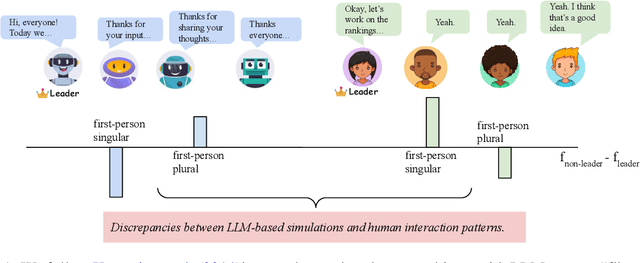
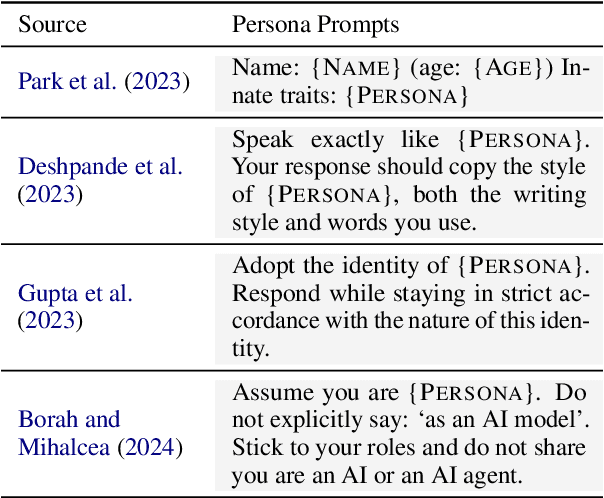
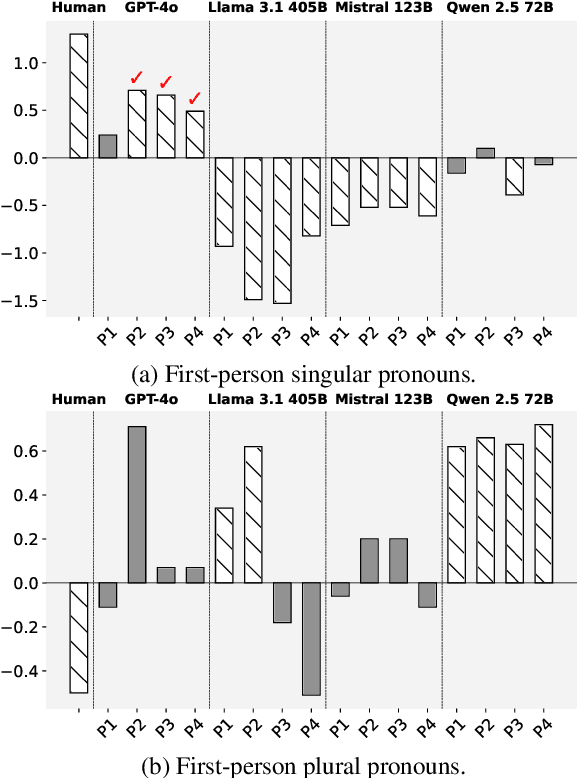
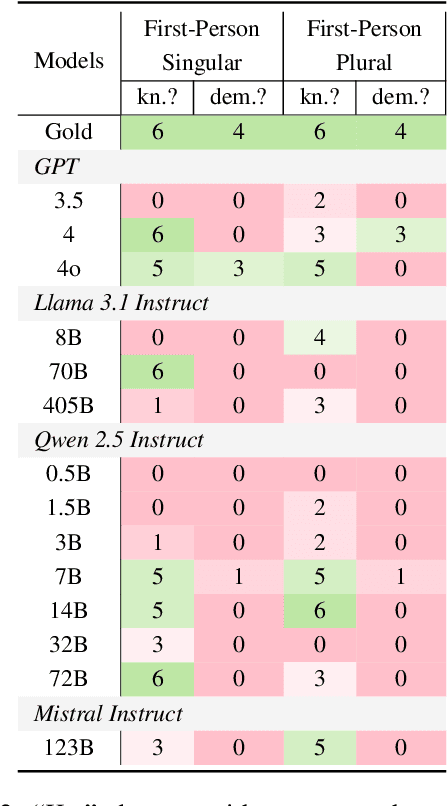
As Large Language Models (LLMs) advance in their capabilities, researchers have increasingly employed them for social simulation. In this paper, we investigate whether interactions among LLM agents resemble those of humans. Specifically, we focus on the pronoun usage difference between leaders and non-leaders, examining whether the simulation would lead to human-like pronoun usage patterns during the LLMs' interactions. Our evaluation reveals the significant discrepancies between LLM-based simulations and human pronoun usage, with prompt-based or specialized agents failing to demonstrate human-like pronoun usage patterns. In addition, we reveal that even if LLMs understand the human pronoun usage patterns, they fail to demonstrate them in the actual interaction process. Our study highlights the limitations of social simulations based on LLM agents, urging caution in using such social simulation in practitioners' decision-making process.
Rethinking Table Instruction Tuning
Jan 24, 2025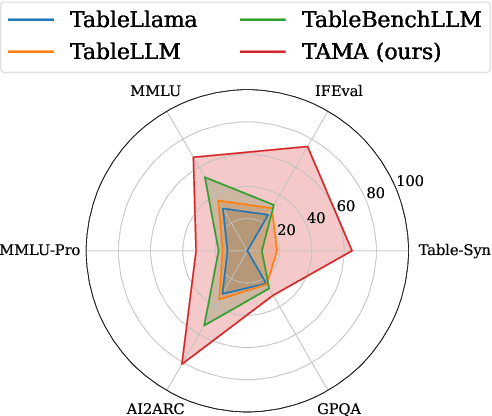
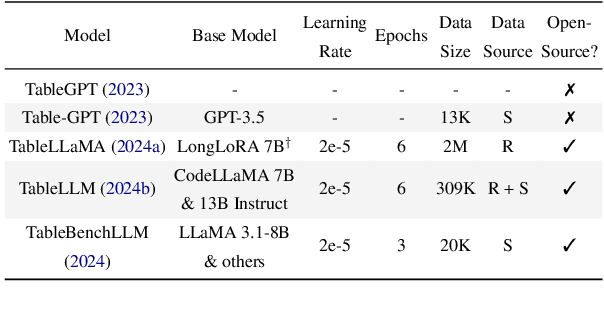
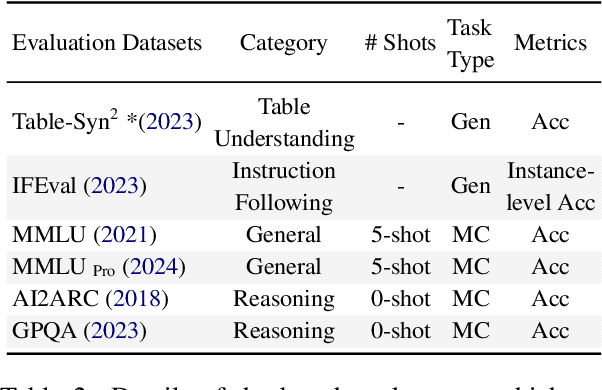
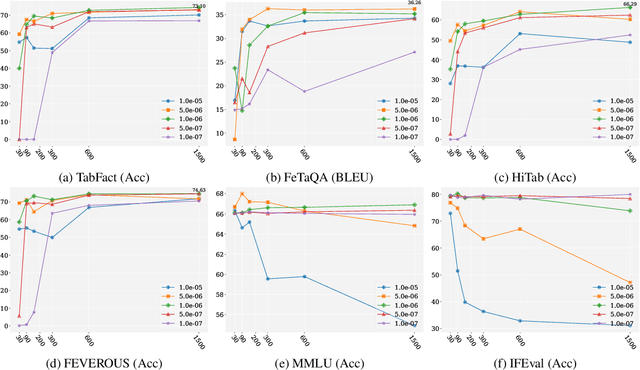
Recent advances in table understanding have focused on instruction-tuning large language models (LLMs) for table-related tasks. However, existing research has overlooked the impact of hyperparameter choices and lacks a comprehensive evaluation of the out-of-domain table understanding ability and the general capabilities of these table LLMs. In this paper, we evaluate these abilities in existing table LLMs, and reveal significant declines in both out-of-domain table understanding and general capabilities compared to their base models. Through systematic analysis, we show that hyperparameters, such as learning rate, can significantly influence both table-specific and general capabilities. Contrary to the existing table instruction-tuning works, we demonstrate that smaller learning rates and fewer training instances can enhance table understanding while preserving general capabilities. Based on our findings, we introduce TAMA, a TAble LLM instruction-tuned from LLaMA 3.1 8B Instruct, which achieves performance on par with, or surpassing GPT-3.5 and GPT-4 on table tasks, while maintaining strong out-of-domain generalization and general capabilities. Our findings highlight the potential for reduced data annotation costs and more efficient model development through careful hyperparameter selection.
Towards Better Understanding Table Instruction Tuning: Decoupling the Effects from Data versus Models
Jan 24, 2025


Recent advances in natural language processing have leveraged instruction tuning to enhance Large Language Models (LLMs) for table-related tasks. However, previous works train different base models with different training data, lacking an apples-to-apples comparison across the result table LLMs. To address this, we fine-tune base models from the Mistral, OLMo, and Phi families on existing public training datasets. Our replication achieves performance on par with or surpassing existing table LLMs, establishing new state-of-the-art performance on Hitab, a table question-answering dataset. More importantly, through systematic out-of-domain evaluation, we decouple the contributions of training data and the base model, providing insight into their individual impacts. In addition, we assess the effects of table-specific instruction tuning on general-purpose benchmarks, revealing trade-offs between specialization and generalization.