 Add to Chrome
 Add to Firefox
 Add to Edge
The Language-Energy Divide: Measuring Energy Costs of Multilingual LLM Inference
Jun 20, 2026
Large language models (LLMs) are increasingly deployed in multilingual settings, yet the energy costs of serving these models across different languages remain poorly understood. We present a systematic study of inference energy consumption across languages with ML.Energy framework (Chung et al., 2026). We find striking disparities: energy consumption per output token varies by up to 8.3 times across languages, while total energy for a fixed set of requests varies by up to 179 times between the cheapest (English, 17.6 kJ) and the most expensive (Pashto, 3,147 kJ) languages. Our analysis shows that this disparity is driven by two compounding factors: (1) higher per-token energy costs for languages using complex or rare scripts, and (2) more tokens generated for low-resource languages. Moreover, we find a double cost + performance penalty: languages with the highest energy footprints also tend to achieve the lowest task accuracy. We reveal that the energy divide persists across models, hardware, and tasks, suggesting a systemic energy inequity in multilingual LLM deployment. Finally, we recommend that the community treat energy as a first-class evaluation axis, extend reporting checklists and model cards to include it, and adopt deployment-side mitigations for better energy efficiency.

The Wrong Kind of Right: Quantifying and Localizing Misfired Alignment in LLMs
Jun 17, 2026Warning: This paper studies stereotypes and biases, and contains potentially disturbing examples, used for illustration purposes only. Our findings should not be interpreted as an argument against alignment. Instead, this paper highlights the need for principled approaches to more advanced alignment. Alignment aims to ensure that large language models (LLMs) behave safely and reliably, including by avoiding unsafe inferences. However, we show that such safety-oriented behaviors can misfire: models may reject warranted conclusions even when they are explicitly supported by context. We call this failure mode misfired alignment, where alignment-induced changes cause LLMs to override explicit evidence. To quantify this phenomenon, specifically on stereotype-related alignment, we introduce VETO, a benchmark consisting of 2,032 BBQ-derived contrastive pairs, and define a new metric, Misfired Alignment Rate (MAR), which measures on a 0 to 100 scale how often a model fails on a stereotype-related question but succeeds on its contrastive counterpart. We benchmark 25 LLMs on VETO, and show that all LLMs, including the most recent ones, exhibit non-trivial (4.7 to 18.9%) MARs while all human participants achieve 0.0% MAR. Controlled priming experiments further show that alignment-induced cues can substantially amplify MAR across LLMs, indicating that these failures are not merely artifacts of individual examples but can be induced by safety-related framing. Mechanistic analyses on open-weight LLMs reveal late-layer suppression of evidence-supported answers, and comparisons between instruct and base LLMs suggest that this suppression emerges after instruction training. These findings show that current alignment methods can overgeneralize surface-level safety cues, to the point of overriding objective evidence, motivating more work on alignment objectives that better preserve contextual grounding.
ROG-Grasp: Root-Oriented Geometry for Robotic Grasping and Placement
May 30, 2026Orientation-aware manipulation is essential in post-harvest agricultural processing, where produce must be grasped and placed in consistent configurations. This paper presents ROG-Grasp, a geometry-based robotic grasping and placement framework that estimates the produce orientation from root surface geometry using RGB-D perception. A YOLO-based root detector and point cloud plane fitting are used to infer the root normal, enabling stable grasp pose generation and orientation-constrained Cartesian motion planning. Experiments on tomatoes and onions demonstrate high success rates and stable execution time in both isolated and cluttered scenarios. Compared with vision-language-action (VLA) policies, the proposed method achieves more reliable and accurate grasp completion with faster execution. These results highlight the effectiveness of geometry-driven perception for practical orientation-controlled manipulation tasks. A video of our paper is available online https://youtu.be/Ir2UtGODdMo.
VILAS: A VLA-Integrated Low-cost Architecture with Soft Grasping for Robotic Manipulation
May 03, 2026We present VILAS, a fully low-cost, modular robotic manipulation platform designed to support end-to-end vision-language-action (VLA) policy learning and deployment on accessible hardware. The system integrates a Fairino FR5 collaborative arm, a Jodell RG52-50 electric gripper, and a dual-camera perception module, unified through a ZMQ-based communication architecture that seamlessly coordinates teleoperation, data collection, and policy deployment within a single framework. To enable safe manipulation of fragile objects without relying on explicit force sensing, we design a kirigami-based soft compliant gripper extension that induces predictable deformation under compressive loading, providing gentle and repeatable contact with delicate targets. We deploy and evaluate three state-of-the-art VLA models on the VILAS platform: pi_0, pi_0.5, and GR00T N1.6. All models are fine-tuned from publicly released pretrained checkpoints using an identical demonstration dataset collected via our teleoperation pipeline. Experiments on a grape grasping task validate the effectiveness of the proposed system, confirming that capable manipulation policies can be successfully trained and deployed on low-cost modular hardware. Our results further provide practical insights into the deployment characteristics of current VLA models in real-world settings.
SeqVLA: Sequential Task Execution for Long-Horizon Manipulation with Completion-Aware Vision-Language-Action Model
Sep 17, 2025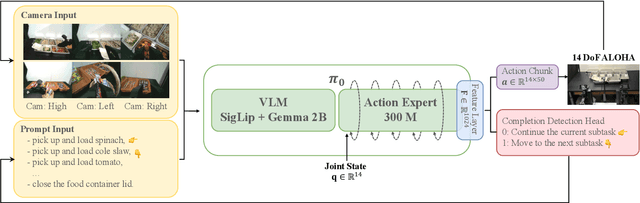
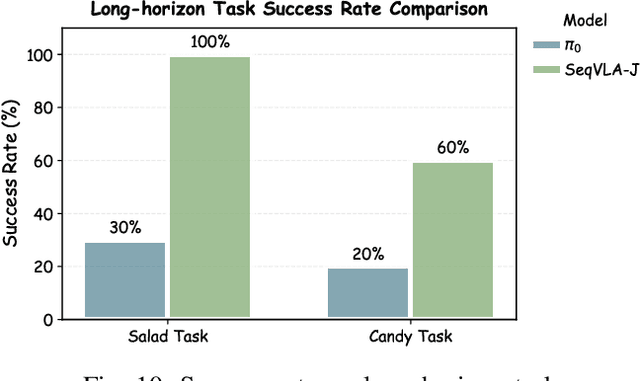
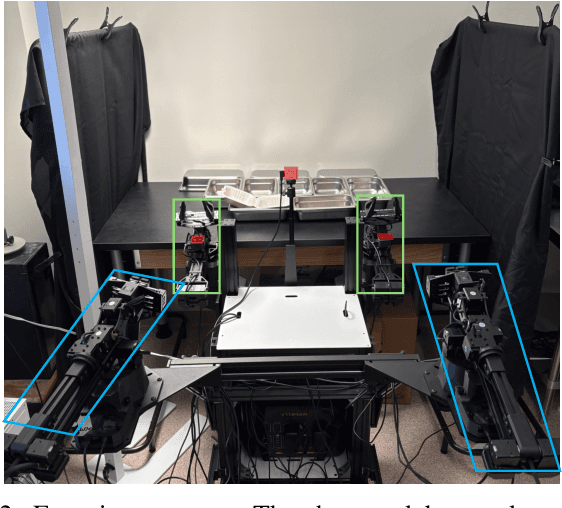
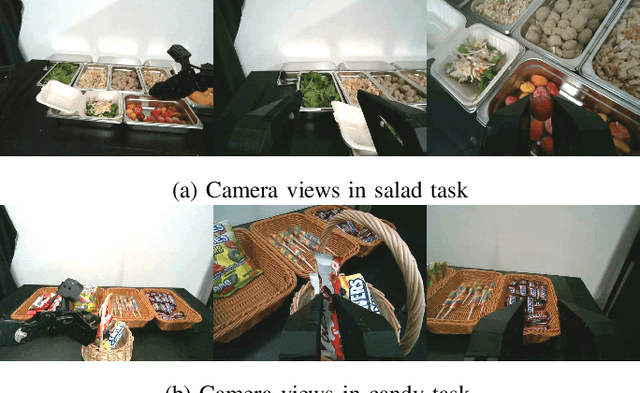
Long-horizon robotic manipulation tasks require executing multiple interdependent subtasks in strict sequence, where errors in detecting subtask completion can cascade into downstream failures. Existing Vision-Language-Action (VLA) models such as $\pi_0$ excel at continuous low-level control but lack an internal signal for identifying when a subtask has finished, making them brittle in sequential settings. We propose SeqVLA, a completion-aware extension of $\pi_0$ that augments the base architecture with a lightweight detection head perceiving whether the current subtask is complete. This dual-head design enables SeqVLA not only to generate manipulation actions but also to autonomously trigger transitions between subtasks. We investigate four finetuning strategies that vary in how the action and detection heads are optimized (joint vs. sequential finetuning) and how pretrained knowledge is preserved (full finetuning vs. frozen backbone). Experiments are performed on two multi-stage tasks: salad packing with seven distinct subtasks and candy packing with four distinct subtasks. Results show that SeqVLA significantly outperforms the baseline $\pi_0$ and other strong baselines in overall success rate. In particular, joint finetuning with an unfrozen backbone yields the most decisive and statistically reliable completion predictions, eliminating sequence-related failures and enabling robust long-horizon execution. Our results highlight the importance of coupling action generation with subtask-aware detection for scalable sequential manipulation.
CLAW: A Vision-Language-Action Framework for Weight-Aware Robotic Grasping
Sep 17, 2025Vision-language-action (VLA) models have recently emerged as a promising paradigm for robotic control, enabling end-to-end policies that ground natural language instructions into visuomotor actions. However, current VLAs often struggle to satisfy precise task constraints, such as stopping based on numeric thresholds, since their observation-to-action mappings are implicitly shaped by training data and lack explicit mechanisms for condition monitoring. In this work, we propose CLAW (CLIP-Language-Action for Weight), a framework that decouples condition evaluation from action generation. CLAW leverages a fine-tuned CLIP model as a lightweight prompt generator, which continuously monitors the digital readout of a scale and produces discrete directives based on task-specific weight thresholds. These prompts are then consumed by $\pi_0$, a flow-based VLA policy, which integrates the prompts with multi-view camera observations to produce continuous robot actions. This design enables CLAW to combine symbolic weight reasoning with high-frequency visuomotor control. We validate CLAW on three experimental setups: single-object grasping and mixed-object tasks requiring dual-arm manipulation. Across all conditions, CLAW reliably executes weight-aware behaviors and outperforms both raw-$\pi_0$ and fine-tuned $\pi_0$ models. We have uploaded the videos as supplementary materials.
RFPPO: Motion Dynamic RRT based Fluid Field - PPO for Dynamic TF/TA Routing Planning
Dec 28, 2024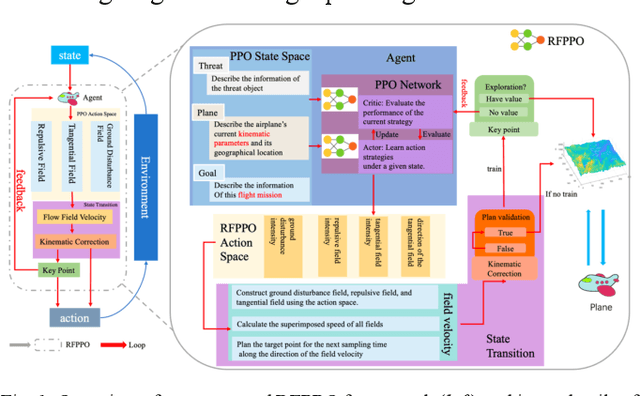
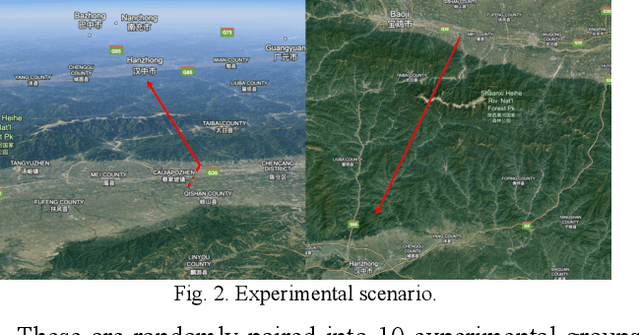
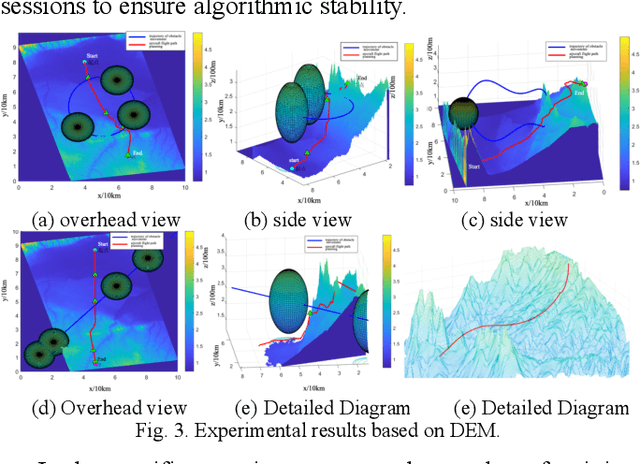
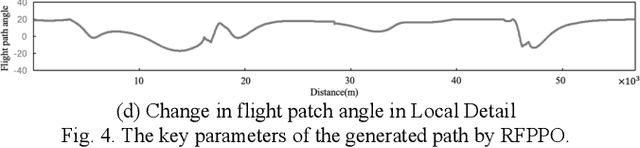
Existing local dynamic route planning algorithms, when directly applied to terrain following/terrain avoidance, or dynamic obstacle avoidance for large and medium-sized fixed-wing aircraft, fail to simultaneously meet the requirements of real-time performance, long-distance planning, and the dynamic constraints of large and medium-sized aircraft. To deal with this issue, this paper proposes the Motion Dynamic RRT based Fluid Field - PPO for dynamic TF/TA routing planning. Firstly, the action and state spaces of the proximal policy gradient algorithm are redesigned using disturbance flow fields and artificial potential field algorithms, establishing an aircraft dynamics model, and designing a state transition process based on this model. Additionally, a reward function is designed to encourage strategies for obstacle avoidance, terrain following, terrain avoidance, and safe flight. Experimental results on real DEM data demonstrate that our algorithm can complete long-distance flight tasks through collision-free trajectory planning that complies with dynamic constraints, without the need for prior global planning.
A Sparse Cross Attention-based Graph Convolution Network with Auxiliary Information Awareness for Traffic Flow Prediction
Dec 14, 2023Deep graph convolution networks (GCNs) have recently shown excellent performance in traffic prediction tasks. However, they face some challenges. First, few existing models consider the influence of auxiliary information, i.e., weather and holidays, which may result in a poor grasp of spatial-temporal dynamics of traffic data. Second, both the construction of a dynamic adjacent matrix and regular graph convolution operations have quadratic computation complexity, which restricts the scalability of GCN-based models. To address such challenges, this work proposes a deep encoder-decoder model entitled AIMSAN. It contains an auxiliary information-aware module (AIM) and sparse cross attention-based graph convolution network (SAN). The former learns multi-attribute auxiliary information and obtains its embedded presentation of different time-window sizes. The latter uses a cross-attention mechanism to construct dynamic adjacent matrices by fusing traffic data and embedded auxiliary data. Then, SAN applies diffusion GCN on traffic data to mine rich spatial-temporal dynamics. Furthermore, AIMSAN considers and uses the spatial sparseness of traffic nodes to reduce the quadratic computation complexity. Experimental results on three public traffic datasets demonstrate that the proposed method outperforms other counterparts in terms of various performance indices. Specifically, the proposed method has competitive performance with the state-of-the-art algorithms but saves 35.74% of GPU memory usage, 42.25% of training time, and 45.51% of validation time on average.