 Add to Chrome
 Add to Firefox
 Add to Edge
Conflict and Congruency Effects in Large Language Models: In-Weight and In-Context Competition in a Verbal Conflict Task
Aug 11, 2026
Congruency effects, observed in conflict tasks such as Stroop and flanker tasks, have been investigated for nearly a century in psychology and neuroscience, but their mechanistic basis is not fully understood. We introduce a verbal-only LLM conflict task in which a prompt stem elicits a default same-color completion and an explicit rule either agrees with (congruent condition) or conflicts with (incongruent condition) the completion. Gemma-2-2B and six Pythia models ranging from 410M to 12B parameters showed strong default same-color tendencies, and six of seven models showed strong congruency effects. Using causal attribution analysis, attention analysis, and attention ablations, we identified distinct processing pathways in these LLMs: a pathway involving short-range attention to a superficial color cue that is preferentially activated in the congruent condition, and a pathway involving long-range attention to the rule prefix that is preferentially activated in the incongruent condition. Fine-tuning that strengthened the default same-color tendency had divergent effects on task conditions, reducing incongruent performance while increasing congruent performance. In contrast, increasing rule set size selectively impaired incongruent performance. These converging findings support an account in which congruency effects in this task arise from competition between an in-weight default mapping and an in-context rule-based mapping. More broadly, our findings illustrate how LLMs can serve as model systems for mechanistic analysis of competition between default and rule-governed response tendencies within a single learned network.

SafetyALFRED: Evaluating Safety-Conscious Planning of Multimodal Large Language Models
Apr 21, 2026Multimodal Large Language Models are increasingly adopted as autonomous agents in interactive environments, yet their ability to proactively address safety hazards remains insufficient. We introduce SafetyALFRED, built upon the embodied agent benchmark ALFRED, augmented with six categories of real-world kitchen hazards. While existing safety evaluations focus on hazard recognition through disembodied question answering (QA) settings, we evaluate eleven state-of-the-art models from the Qwen, Gemma, and Gemini families on not only hazard recognition, but also active risk mitigation through embodied planning. Our experimental results reveal a significant alignment gap: while models can accurately recognize hazards in QA settings, average mitigation success rates for these hazards are low in comparison. Our findings demonstrate that static evaluations through QA are insufficient for physical safety, thus we advocate for a paradigm shift toward benchmarks that prioritize corrective actions in embodied contexts. We open-source our code and dataset under https://github.com/sled-group/SafetyALFRED.git
Identifying and Mitigating Gender Cues in Academic Recommendation Letters: An Interpretability Case Study
Apr 14, 2026Letters of recommendation (LoRs) can carry patterns of implicitly gendered language that can inadvertently influence downstream decisions, e.g. in hiring and admissions. In this work, we investigate the extent to which Transformer-based encoder models as well as Large Language Models (LLMs) can infer the gender of applicants in academic LoRs submitted to an U.S. medical-residency program after explicit identifiers like names and pronouns are de-gendered. While using three models (DistilBERT, RoBERTa, and Llama 2) to classify the gender of anonymized and de-gendered LoRs, significant gender leakage was observed as evident from up to 68% classification accuracy. Text interpretation methods, like TF-IDF and SHAP, demonstrate that certain linguistic patterns are strong proxies for gender, e.g. "emotional'' and "humanitarian'' are commonly associated with LoRs from female applicants. As an experiment in creating truly gender-neutral LoRs, these implicit gender cues were remove resulting in a drop of up to 5.5% accuracy and 2.7% macro $F_1$ score on re-training the classifiers. However, applicant gender prediction still remains better than chance. In this case study, our findings highlight that 1) LoRs contain gender-identifying cues that are hard to remove and may activate bias in decision-making and 2) while our technical framework may be a concrete step toward fairer academic and professional evaluations, future work is needed to interrogate the role that gender plays in LoR review. Taken together, our findings motivate upstream auditing of evaluative text in real-world academic letters of recommendation as a necessary complement to model-level fairness interventions.
Explainable Procedural Mistake Detection
Dec 16, 2024Automated task guidance has recently attracted attention from the AI research community. Procedural mistake detection (PMD) is a challenging sub-problem of classifying whether a human user (observed through egocentric video) has successfully executed the task at hand (specified by a procedural text). Despite significant efforts in building resources and models for PMD, machine performance remains nonviable, and the reasoning processes underlying this performance are opaque. As such, we recast PMD to an explanatory self-dialog of questions and answers, which serve as evidence for a decision. As this reformulation enables an unprecedented transparency, we leverage a fine-tuned natural language inference (NLI) model to formulate two automated coherence metrics for generated explanations. Our results show that while open-source VLMs struggle with this task off-the-shelf, their accuracy, coherence, and dialog efficiency can be vastly improved by incorporating these coherence metrics into common inference and fine-tuning methods. Furthermore, our multi-faceted metrics can visualize common outcomes at a glance, highlighting areas for improvement.
Can Foundation Models Watch, Talk and Guide You Step by Step to Make a Cake?
Nov 01, 2023Despite tremendous advances in AI, it remains a significant challenge to develop interactive task guidance systems that can offer situated, personalized guidance and assist humans in various tasks. These systems need to have a sophisticated understanding of the user as well as the environment, and make timely accurate decisions on when and what to say. To address this issue, we created a new multimodal benchmark dataset, Watch, Talk and Guide (WTaG) based on natural interaction between a human user and a human instructor. We further proposed two tasks: User and Environment Understanding, and Instructor Decision Making. We leveraged several foundation models to study to what extent these models can be quickly adapted to perceptually enabled task guidance. Our quantitative, qualitative, and human evaluation results show that these models can demonstrate fair performances in some cases with no task-specific training, but a fast and reliable adaptation remains a significant challenge. Our benchmark and baselines will provide a stepping stone for future work on situated task guidance.
From Heuristic to Analytic: Cognitively Motivated Strategies for Coherent Physical Commonsense Reasoning
Oct 24, 2023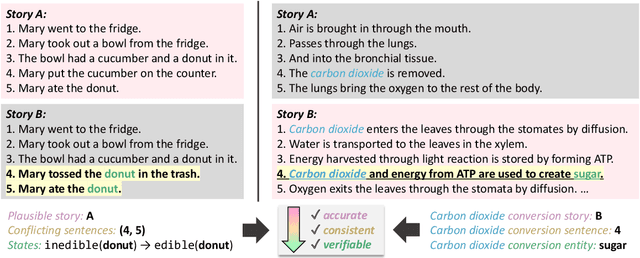
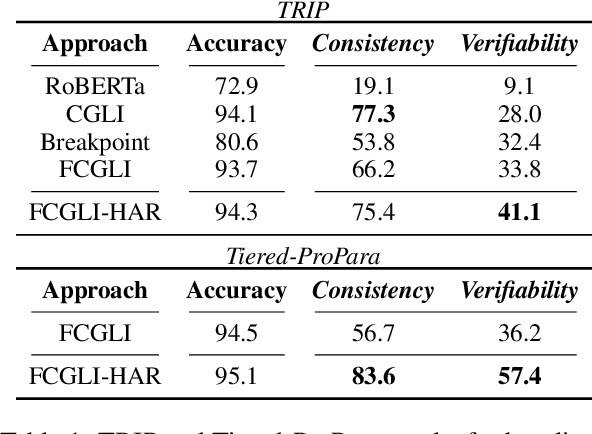
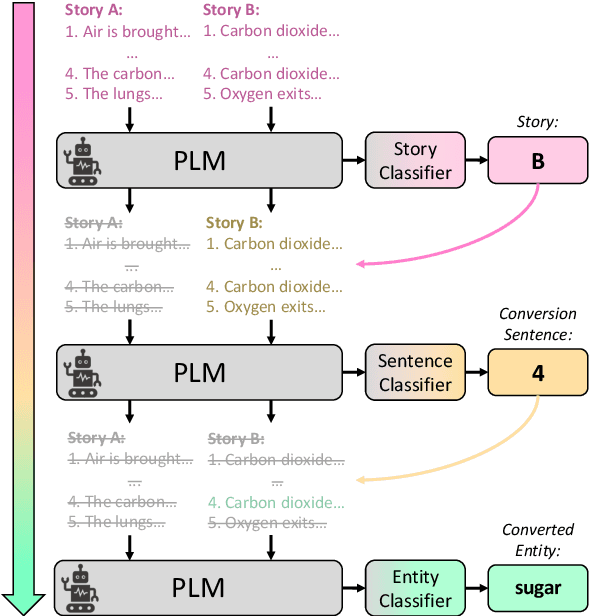
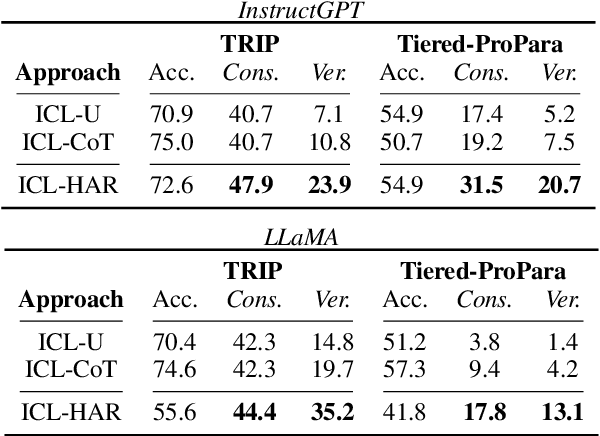
Pre-trained language models (PLMs) have shown impressive performance in various language tasks. However, they are prone to spurious correlations, and often generate illusory information. In real-world applications, PLMs should justify decisions with formalized, coherent reasoning chains, but this challenge remains under-explored. Cognitive psychology theorizes that humans are capable of utilizing fast and intuitive heuristic thinking to make decisions based on past experience, then rationalizing the decisions through slower and deliberative analytic reasoning. We incorporate these interlinked dual processes in fine-tuning and in-context learning with PLMs, applying them to two language understanding tasks that require coherent physical commonsense reasoning. We show that our proposed Heuristic-Analytic Reasoning (HAR) strategies drastically improve the coherence of rationalizations for model decisions, yielding state-of-the-art results on Tiered Reasoning for Intuitive Physics (TRIP). We also find that this improved coherence is a direct result of more faithful attention to relevant language context in each step of reasoning. Our findings suggest that human-like reasoning strategies can effectively improve the coherence and reliability of PLM reasoning.
In-Context Analogical Reasoning with Pre-Trained Language Models
Jun 05, 2023
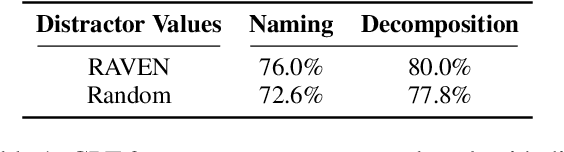
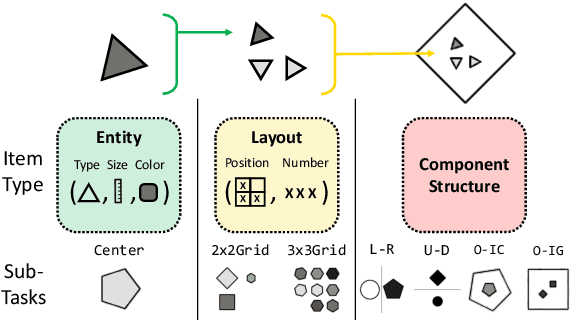
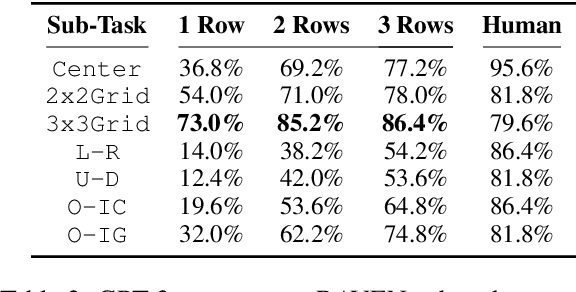
Analogical reasoning is a fundamental capacity of human cognition that allows us to reason abstractly about novel situations by relating them to past experiences. While it is thought to be essential for robust reasoning in AI systems, conventional approaches require significant training and/or hard-coding of domain knowledge to be applied to benchmark tasks. Inspired by cognitive science research that has found connections between human language and analogy-making, we explore the use of intuitive language-based abstractions to support analogy in AI systems. Specifically, we apply large pre-trained language models (PLMs) to visual Raven's Progressive Matrices (RPM), a common relational reasoning test. By simply encoding the perceptual features of the problem into language form, we find that PLMs exhibit a striking capacity for zero-shot relational reasoning, exceeding human performance and nearing supervised vision-based methods. We explore different encodings that vary the level of abstraction over task features, finding that higher-level abstractions further strengthen PLMs' analogical reasoning. Our detailed analysis reveals insights on the role of model complexity, in-context learning, and prior knowledge in solving RPM tasks.
NLP Reproducibility For All: Understanding Experiences of Beginners
Jun 03, 2023

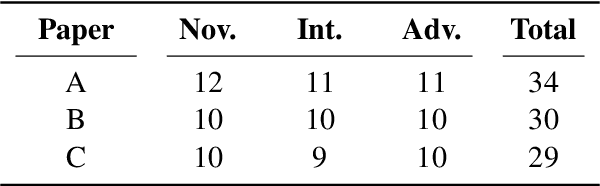

As natural language processing (NLP) has recently seen an unprecedented level of excitement, and more people are eager to enter the field, it is unclear whether current research reproducibility efforts are sufficient for this group of beginners to apply the latest developments. To understand their needs, we conducted a study with 93 students in an introductory NLP course, where students reproduced the results of recent NLP papers. Surprisingly, we find that their programming skill and comprehension of research papers have a limited impact on their effort spent completing the exercise. Instead, we find accessibility efforts by research authors to be the key to success, including complete documentation, better coding practice, and easier access to data files. Going forward, we recommend that NLP researchers pay close attention to these simple aspects of open-sourcing their work, and use insights from beginners' feedback to provide actionable ideas on how to better support them.
DANLI: Deliberative Agent for Following Natural Language Instructions
Oct 22, 2022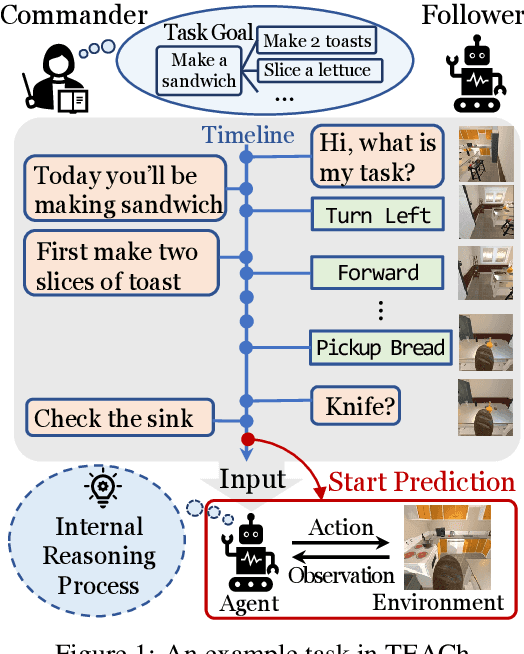
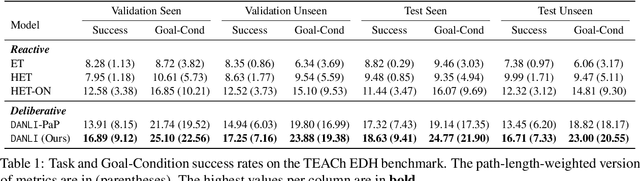
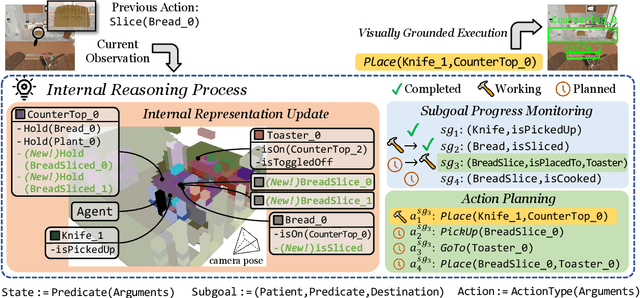
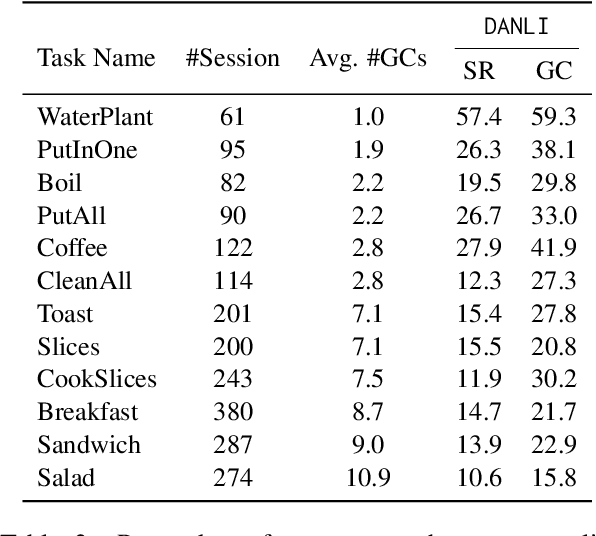
Recent years have seen an increasing amount of work on embodied AI agents that can perform tasks by following human language instructions. However, most of these agents are reactive, meaning that they simply learn and imitate behaviors encountered in the training data. These reactive agents are insufficient for long-horizon complex tasks. To address this limitation, we propose a neuro-symbolic deliberative agent that, while following language instructions, proactively applies reasoning and planning based on its neural and symbolic representations acquired from past experience (e.g., natural language and egocentric vision). We show that our deliberative agent achieves greater than 70% improvement over reactive baselines on the challenging TEACh benchmark. Moreover, the underlying reasoning and planning processes, together with our modular framework, offer impressive transparency and explainability to the behaviors of the agent. This enables an in-depth understanding of the agent's capabilities, which shed light on challenges and opportunities for future embodied agents for instruction following. The code is available at https://github.com/sled-group/DANLI.
Reproducibility Beyond the Research Community: Experience from NLP Beginners
May 05, 2022


As NLP research attracts public attention and excitement, it becomes increasingly important for it to be accessible to a broad audience. As the research community works to democratize NLP, it remains unclear whether beginners to the field can easily apply the latest developments. To understand their needs, we conducted a study with 93 students in an introductory NLP course, where students reproduced results of recent NLP papers. Surprisingly, our results suggest that their technical skill (i.e., programming experience) has limited impact on their effort spent completing the exercise. Instead, we find accessibility efforts by research authors to be key to a successful experience, including thorough documentation and easy access to required models and datasets.