 Add to Chrome
 Add to Firefox
 Add to Edge
QTrack: Query-Driven Reasoning for Multi-modal MOT
Mar 14, 2026
Multi-object tracking (MOT) has traditionally focused on estimating trajectories of all objects in a video, without selectively reasoning about user-specified targets under semantic instructions. In this work, we introduce a query-driven tracking paradigm that formulates tracking as a spatiotemporal reasoning problem conditioned on natural language queries. Given a reference frame, a video sequence, and a textual query, the goal is to localize and track only the target(s) specified in the query while maintaining temporal coherence and identity consistency. To support this setting, we construct RMOT26, a large-scale benchmark with grounded queries and sequence-level splits to prevent identity leakage and enable robust evaluation of generalization. We further present QTrack, an end-to-end vision-language model that integrates multimodal reasoning with tracking-oriented localization. Additionally, we introduce a Temporal Perception-Aware Policy Optimization strategy with structured rewards to encourage motion-aware reasoning. Extensive experiments demonstrate the effectiveness of our approach for reasoning-centric, language-guided tracking. Code and data are available at https://github.com/gaash-lab/QTrack

GroundedSurg: A Multi-Procedure Benchmark for Language-Conditioned Surgical Tool Segmentation
Mar 01, 2026Clinically reliable perception of surgical scenes is essential for advancing intelligent, context-aware intraoperative assistance such as instrument handoff guidance, collision avoidance, and workflow-aware robotic support. Existing surgical tool benchmarks primarily evaluate category-level segmentation, requiring models to detect all instances of predefined instrument classes. However, real-world clinical decisions often require resolving references to a specific instrument instance based on its functional role, spatial relation, or anatomical interaction capabilities not captured by current evaluation paradigms. We introduce GroundedSurg, the first language-conditioned, instance-level surgical grounding benchmark. Each instance pairs a surgical image with a natural-language description targeting a single instrument, accompanied by structured spatial grounding annotations including bounding boxes and point-level anchors. The dataset spans ophthalmic, laparoscopic, robotic, and open procedures, encompassing diverse instrument types, imaging conditions, and operative complexities. By jointly evaluating linguistic reference resolution and pixel-level localization, GroundedSurg enables a systematic and realistic evaluation of vision-language models in clinically realistic multi-instrument scenes. Extensive experiments demonstrate substantial performance gaps across modern segmentation and VLMs, highlighting the urgent need for clinically grounded vision-language reasoning in surgical AI systems. Code and data are publicly available at https://github.com/gaash-lab/GroundedSurg
Context Aware Grounded Teacher for Source Free Object Detection
Apr 21, 2025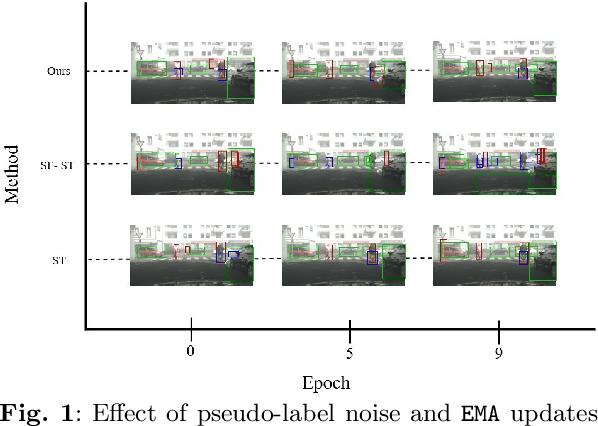
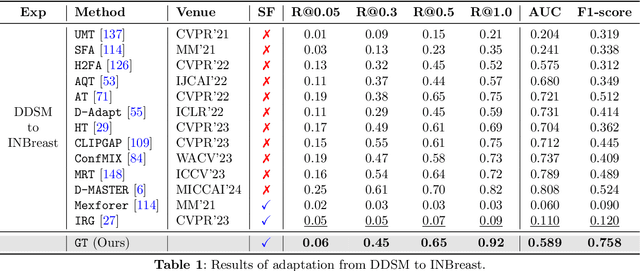
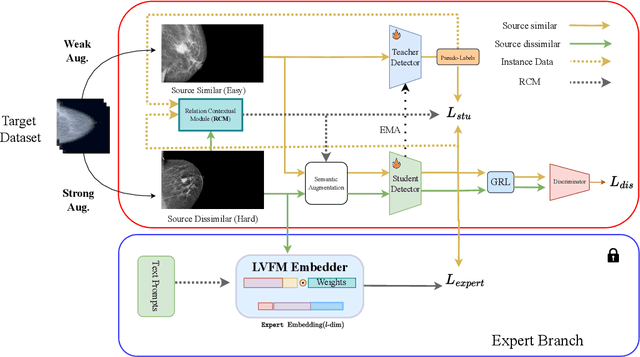
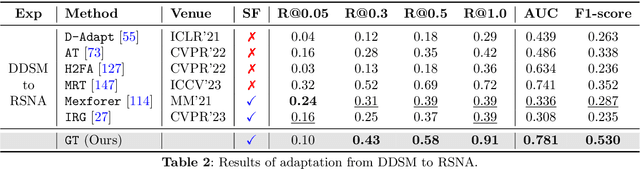
We focus on the Source Free Object Detection (SFOD) problem, when source data is unavailable during adaptation, and the model must adapt to the unlabeled target domain. In medical imaging, several approaches have leveraged a semi-supervised student-teacher architecture to bridge domain discrepancy. Context imbalance in labeled training data and significant domain shifts between domains can lead to biased teacher models that produce inaccurate pseudolabels, degrading the student model's performance and causing a mode collapse. Class imbalance, particularly when one class significantly outnumbers another, leads to contextual bias. To tackle the problem of context bias and the significant performance drop of the student model in the SFOD setting, we introduce Grounded Teacher (GT) as a standard framework. In this study, we model contextual relationships using a dedicated relational context module and leverage it to mitigate inherent biases in the model. This approach enables us to apply augmentations to closely related classes, across and within domains, enhancing the performance of underrepresented classes while keeping the effect on dominant classes minimal. We further improve the quality of predictions by implementing an expert foundational branch to supervise the student model. We validate the effectiveness of our approach in mitigating context bias under the SFOD setting through experiments on three medical datasets supported by comprehensive ablation studies. All relevant resources, including preprocessed data, trained model weights, and code, are publicly available at this https://github.com/Tajamul21/Grounded_Teacher.