 Add to Chrome
 Add to Firefox
 Add to Edge
MAgICoRe: Multi-Agent, Iterative, Coarse-to-Fine Refinement for Reasoning
Sep 18, 2024
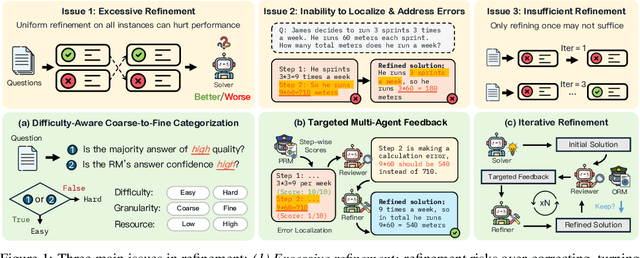
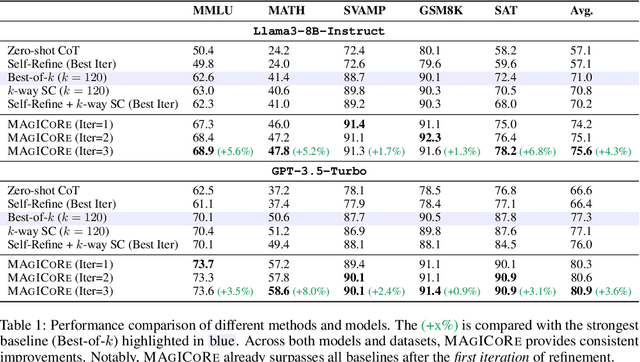
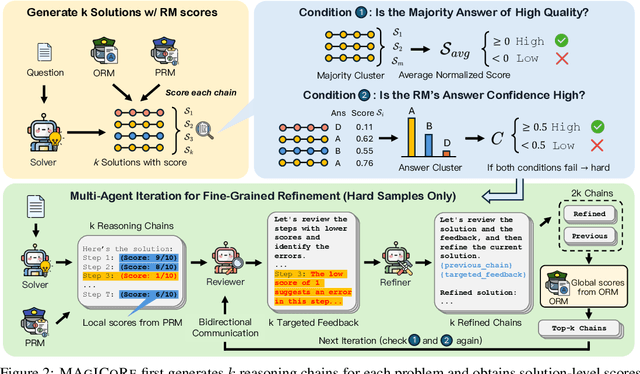

Large Language Models' (LLM) reasoning can be improved using test-time aggregation strategies, i.e., generating multiple samples and voting among generated samples. While these improve performance, they often reach a saturation point. Refinement offers an alternative by using LLM-generated feedback to improve solution quality. However, refinement introduces 3 key challenges: (1) Excessive refinement: Uniformly refining all instances can over-correct and reduce the overall performance. (2) Inability to localize and address errors: LLMs have a limited ability to self-correct and struggle to identify and correct their own mistakes. (3) Insufficient refinement: Deciding how many iterations of refinement are needed is non-trivial, and stopping too soon could leave errors unaddressed. To tackle these issues, we propose MAgICoRe, which avoids excessive refinement by categorizing problem difficulty as easy or hard, solving easy problems with coarse-grained aggregation and hard ones with fine-grained and iterative multi-agent refinement. To improve error localization, we incorporate external step-wise reward model (RM) scores. Moreover, to ensure effective refinement, we employ a multi-agent loop with three agents: Solver, Reviewer (which generates targeted feedback based on step-wise RM scores), and the Refiner (which incorporates feedback). To ensure sufficient refinement, we re-evaluate updated solutions, iteratively initiating further rounds of refinement. We evaluate MAgICoRe on Llama-3-8B and GPT-3.5 and show its effectiveness across 5 math datasets. Even one iteration of MAgICoRe beats Self-Consistency by 3.4%, Best-of-k by 3.2%, and Self-Refine by 4.0% while using less than half the samples. Unlike iterative refinement with baselines, MAgICoRe continues to improve with more iterations. Finally, our ablations highlight the importance of MAgICoRe's RMs and multi-agent communication.

AdaCAD: Adaptively Decoding to Balance Conflicts between Contextual and Parametric Knowledge
Sep 11, 2024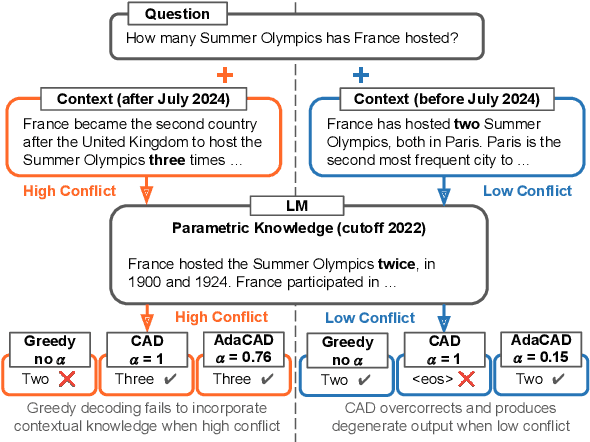
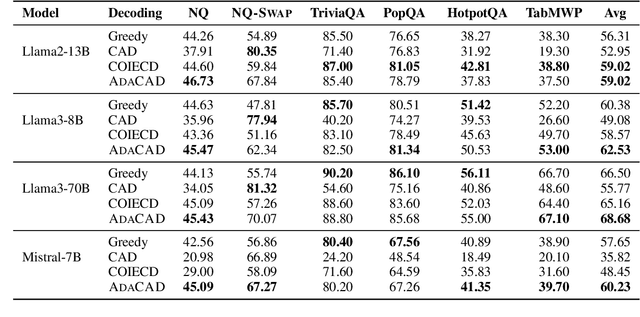
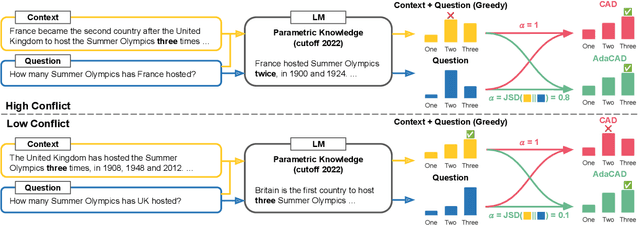

Knowledge conflict arises from discrepancies between information in the context of a large language model (LLM) and the knowledge stored in its parameters. This can hurt performance when using standard decoding techniques, which tend to ignore the context. Existing test-time contrastive methods seek to address this by comparing the LLM's output distribution with and without the context and adjust the model according to the contrast between them. However, we find that these methods frequently misjudge the degree of conflict and struggle to handle instances that vary in their amount of conflict, with static methods over-adjusting when conflict is absent. We propose a fine-grained, instance-level approach called AdaCAD, which dynamically infers the weight of adjustment based on the degree of conflict, as measured by the Jensen-Shannon divergence between distributions representing contextual and parametric knowledge. Our experiments across four models on six diverse question-answering (QA) datasets and three summarization tasks demonstrate that our training-free adaptive method consistently outperforms other decoding methods on QA, with average accuracy gains of 14.21% (absolute) over a static contrastive baseline, and improves the factuality of summaries by 5.59 (AlignScore). Furthermore, our analysis shows that while decoding with contrastive baselines hurts performance when conflict is absent, AdaCAD mitigates these losses, making it more applicable to real-world datasets in which some examples have conflict and others do not.
Knowledge-Aware Reasoning over Multimodal Semi-structured Tables
Aug 25, 2024Existing datasets for tabular question answering typically focus exclusively on text within cells. However, real-world data is inherently multimodal, often blending images such as symbols, faces, icons, patterns, and charts with textual content in tables. With the evolution of AI models capable of multimodal reasoning, it is pertinent to assess their efficacy in handling such structured data. This study investigates whether current AI models can perform knowledge-aware reasoning on multimodal structured data. We explore their ability to reason on tables that integrate both images and text, introducing MMTabQA, a new dataset designed for this purpose. Our experiments highlight substantial challenges for current AI models in effectively integrating and interpreting multiple text and image inputs, understanding visual context, and comparing visual content across images. These findings establish our dataset as a robust benchmark for advancing AI's comprehension and capabilities in analyzing multimodal structured data.
A Survey on Model MoErging: Recycling and Routing Among Specialized Experts for Collaborative Learning
Aug 13, 2024
The availability of performant pre-trained models has led to a proliferation of fine-tuned expert models that are specialized to a particular domain or task. Model MoErging methods aim to recycle expert models to create an aggregate system with improved performance or generalization. A key component of MoErging methods is the creation of a router that decides which expert model(s) to use for a particular input or application. The promise, effectiveness, and large design space of MoErging has spurred the development of many new methods over the past few years. This rapid pace of development has made it challenging to compare different MoErging methods, which are rarely compared to one another and are often validated in different experimental setups. To remedy such gaps, we present a comprehensive survey of MoErging methods that includes a novel taxonomy for cataloging key design choices and clarifying suitable applications for each method. Apart from surveying MoErging research, we inventory software tools and applications that make use of MoErging. We additionally discuss related fields of study such as model merging, multitask learning, and mixture-of-experts models. Taken as a whole, our survey provides a unified overview of existing MoErging methods and creates a solid foundation for future work in this burgeoning field.
System-1.x: Learning to Balance Fast and Slow Planning with Language Models
Jul 19, 2024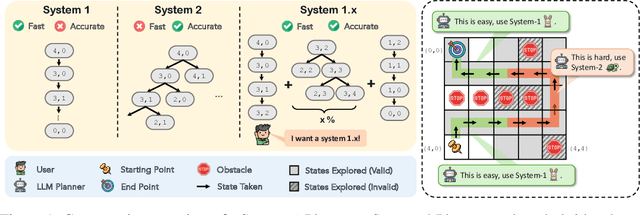
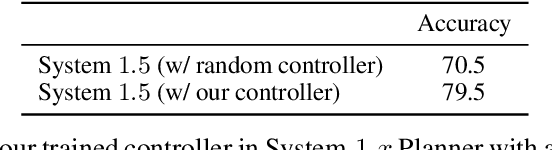
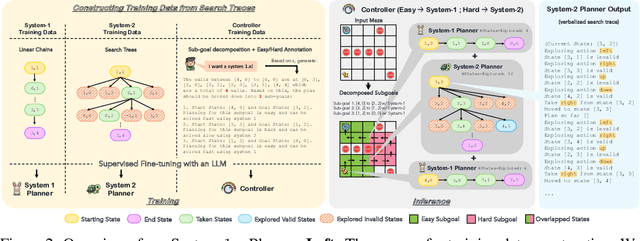
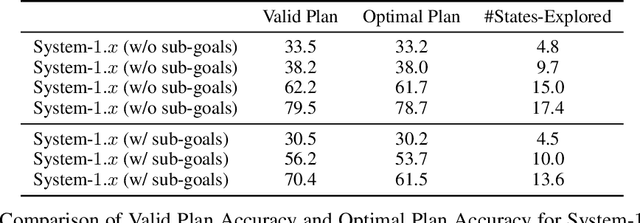
Language models can be used to solve long-horizon planning problems in two distinct modes: a fast 'System-1' mode, directly generating plans without any explicit search or backtracking, and a slow 'System-2' mode, planning step-by-step by explicitly searching over possible actions. While System-2 is typically more effective, it is also more computationally expensive, making it infeasible for long plans or large action spaces. Moreover, isolated System-1 or 2 ignores the user's end goals, failing to provide ways to control the model's behavior. To this end, we propose the System-1.x Planner, a controllable planning framework with LLMs that is capable of generating hybrid plans and balancing between the two planning modes based on the difficulty of the problem at hand. System-1.x consists of (i) a controller, (ii) a System-1 Planner, and (iii) a System-2 Planner. Based on a user-specified hybridization factor (x) governing the mixture between System-1 and 2, the controller decomposes a problem into sub-goals, and classifies them as easy or hard to be solved by either System-1 or 2, respectively. We fine-tune all three components on top of a single base LLM, requiring only search traces as supervision. Experiments with two diverse planning tasks -- Maze Navigation and Blocksworld -- show that our System-1.x Planner outperforms a System-1 Planner, a System-2 Planner trained to approximate A* search, and also a symbolic planner (A*). We demonstrate the following key properties of our planner: (1) controllability: increasing the hybridization factor (e.g., System-1.75 vs 1.5) performs more search, improving performance, (2) flexibility: by building a neuro-symbolic variant with a neural System-1 and a symbolic System-2, we can use existing symbolic methods, and (3) generalizability: by being able to learn from different search algorithms, our method is robust to the choice of search algorithm.
Vision-and-Language Navigation Today and Tomorrow: A Survey in the Era of Foundation Models
Jul 09, 2024


Vision-and-Language Navigation (VLN) has gained increasing attention over recent years and many approaches have emerged to advance their development. The remarkable achievements of foundation models have shaped the challenges and proposed methods for VLN research. In this survey, we provide a top-down review that adopts a principled framework for embodied planning and reasoning, and emphasizes the current methods and future opportunities leveraging foundation models to address VLN challenges. We hope our in-depth discussions could provide valuable resources and insights: on one hand, to milestone the progress and explore opportunities and potential roles for foundation models in this field, and on the other, to organize different challenges and solutions in VLN to foundation model researchers.
Fundamental Problems With Model Editing: How Should Rational Belief Revision Work in LLMs?
Jun 27, 2024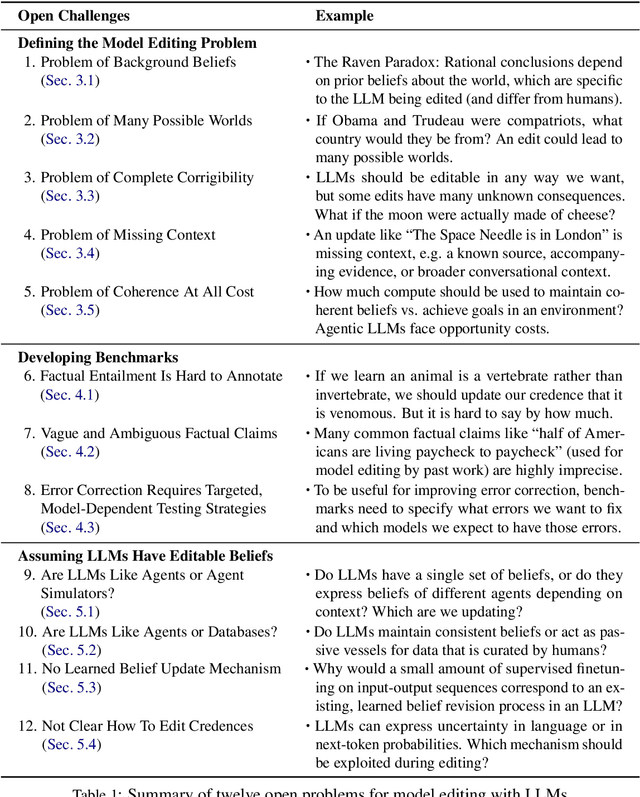
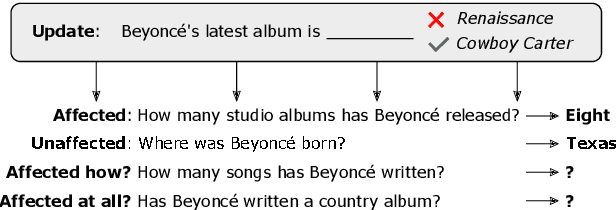
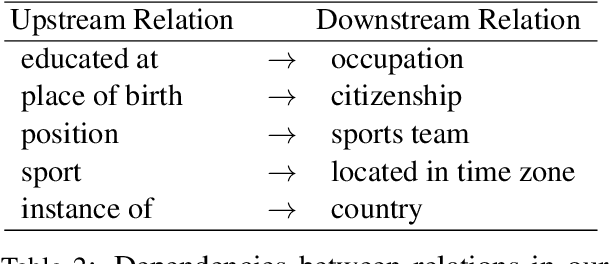
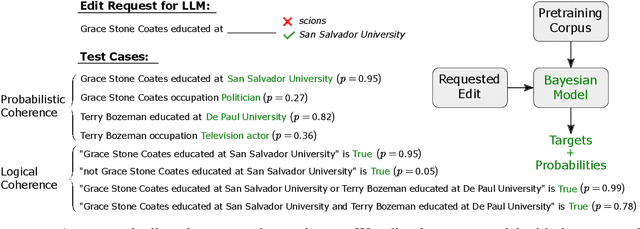
The model editing problem concerns how language models should learn new facts about the world over time. While empirical research on model editing has drawn widespread attention, the conceptual foundations of model editing remain shaky -- perhaps unsurprisingly, since model editing is essentially belief revision, a storied problem in philosophy that has eluded succinct solutions for decades. Model editing nonetheless demands a solution, since we need to be able to control the knowledge within language models. With this goal in mind, this paper critiques the standard formulation of the model editing problem and proposes a formal testbed for model editing research. We first describe 12 open problems with model editing, based on challenges with (1) defining the problem, (2) developing benchmarks, and (3) assuming LLMs have editable beliefs in the first place. Many of these challenges are extremely difficult to address, e.g. determining far-reaching consequences of edits, labeling probabilistic entailments between facts, and updating beliefs of agent simulators. Next, we introduce a semi-synthetic dataset for model editing based on Wikidata, where we can evaluate edits against labels given by an idealized Bayesian agent. This enables us to say exactly how belief revision in language models falls short of a desirable epistemic standard. We encourage further research exploring settings where such a gold standard can be compared against. Our code is publicly available at: https://github.com/peterbhase/LLM-belief-revision
See It from My Perspective: Diagnosing the Western Cultural Bias of Large Vision-Language Models in Image Understanding
Jun 17, 2024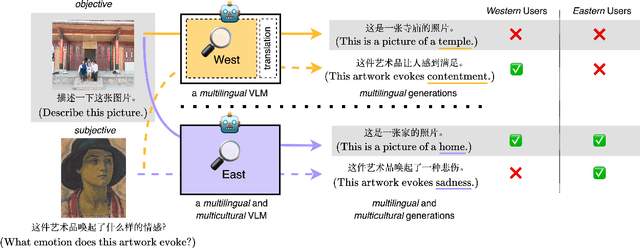
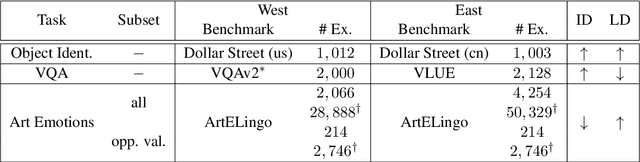
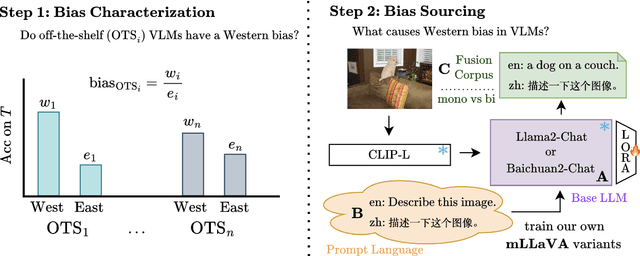

Vision-language models (VLMs) can respond to queries about images in many languages. However, beyond language, culture affects how we see things. For example, individuals from Western cultures focus more on the central figure in an image while individuals from Eastern cultures attend more to scene context. In this work, we present a novel investigation that demonstrates and localizes VLMs' Western bias in image understanding. We evaluate large VLMs across subjective and objective visual tasks with culturally diverse images and annotations. We find that VLMs perform better on the Western subset than the Eastern subset of each task. Controlled experimentation tracing the source of this bias highlights the importance of a diverse language mix in text-only pre-training for building equitable VLMs, even when inference is performed in English. Moreover, while prompting in the language of a target culture can lead to reductions in bias, it is not a substitute for building AI more representative of the world's languages.
REAL Sampling: Boosting Factuality and Diversity of Open-Ended Generation via Asymptotic Entropy
Jun 11, 2024
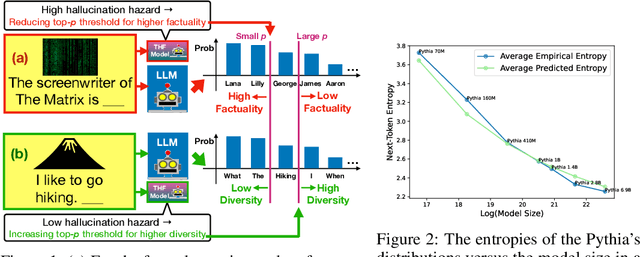
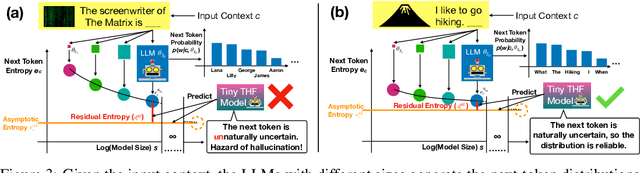
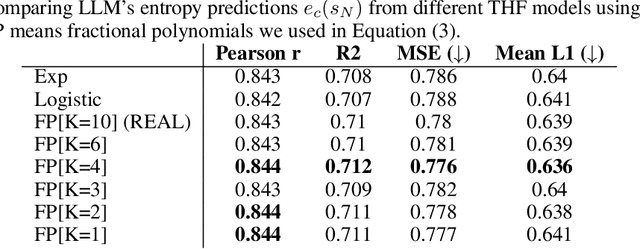
Decoding methods for large language models (LLMs) usually struggle with the tradeoff between ensuring factuality and maintaining diversity. For example, a higher p threshold in the nucleus (top-p) sampling increases the diversity but decreases the factuality, and vice versa. In this paper, we propose REAL (Residual Entropy from Asymptotic Line) sampling, a decoding method that achieves improved factuality and diversity over nucleus sampling by predicting an adaptive threshold of $p$. Specifically, REAL sampling predicts the step-wise likelihood of an LLM to hallucinate, and lowers the p threshold when an LLM is likely to hallucinate. Otherwise, REAL sampling increases the p threshold to boost the diversity. To predict the step-wise hallucination likelihood without supervision, we construct a Token-level Hallucination Forecasting (THF) model to predict the asymptotic entropy (i.e., inherent uncertainty) of the next token by extrapolating the next-token entropies from a series of LLMs with different sizes. If a LLM's entropy is higher than the asymptotic entropy (i.e., the LLM is more uncertain than it should be), the THF model predicts a high hallucination hazard, which leads to a lower p threshold in REAL sampling. In the FactualityPrompts benchmark, we demonstrate that REAL sampling based on a 70M THF model can substantially improve the factuality and diversity of 7B LLMs simultaneously, judged by both retrieval-based metrics and human evaluation. After combined with contrastive decoding, REAL sampling outperforms 9 sampling methods, and generates texts that are more factual than the greedy sampling and more diverse than the nucleus sampling with $p=0.5$. Furthermore, the predicted asymptotic entropy is also a useful unsupervised signal for hallucination detection tasks.
Are language models rational? The case of coherence norms and belief revision
Jun 05, 2024Do norms of rationality apply to machine learning models, in particular language models? In this paper we investigate this question by focusing on a special subset of rational norms: coherence norms. We consider both logical coherence norms as well as coherence norms tied to the strength of belief. To make sense of the latter, we introduce the Minimal Assent Connection (MAC) and propose a new account of credence, which captures the strength of belief in language models. This proposal uniformly assigns strength of belief simply on the basis of model internal next token probabilities. We argue that rational norms tied to coherence do apply to some language models, but not to others. This issue is significant since rationality is closely tied to predicting and explaining behavior, and thus it is connected to considerations about AI safety and alignment, as well as understanding model behavior more generally.