 Add to Chrome
 Add to Firefox
 Add to Edge
MapVerse: A Benchmark for Geospatial Question Answering on Diverse Real-World Maps
Feb 11, 2026
Maps are powerful carriers of structured and contextual knowledge, encompassing geography, demographics, infrastructure, and environmental patterns. Reasoning over such knowledge requires models to integrate spatial relationships, visual cues, real-world context, and domain-specific expertise-capabilities that current large language models (LLMs) and vision-language models (VLMs) still struggle to exhibit consistently. Yet, datasets used to benchmark VLMs on map-based reasoning remain narrow in scope, restricted to specific domains, and heavily reliant on artificially generated content (outputs from LLMs or pipeline-based methods), offering limited depth for evaluating genuine geospatial reasoning. To address this gap, we present MapVerse, a large-scale benchmark built on real-world maps. It comprises 11,837 human-authored question-answer pairs across 1,025 maps, spanning ten diverse map categories and multiple question categories for each. The dataset provides a rich setting for evaluating map reading, interpretation, and multimodal reasoning. We evaluate ten state-of-the-art models against our benchmark to establish baselines and quantify reasoning gaps. Beyond overall performance, we conduct fine-grained categorical analyses to assess model inference across multiple dimensions and investigate the visual factors shaping reasoning outcomes. Our findings reveal that while current VLMs perform competitively on classification-style tasks, both open- and closed-source models fall short on advanced tasks requiring complex spatial reasoning.

Knowledge-Aware Reasoning over Multimodal Semi-structured Tables
Aug 25, 2024Existing datasets for tabular question answering typically focus exclusively on text within cells. However, real-world data is inherently multimodal, often blending images such as symbols, faces, icons, patterns, and charts with textual content in tables. With the evolution of AI models capable of multimodal reasoning, it is pertinent to assess their efficacy in handling such structured data. This study investigates whether current AI models can perform knowledge-aware reasoning on multimodal structured data. We explore their ability to reason on tables that integrate both images and text, introducing MMTabQA, a new dataset designed for this purpose. Our experiments highlight substantial challenges for current AI models in effectively integrating and interpreting multiple text and image inputs, understanding visual context, and comparing visual content across images. These findings establish our dataset as a robust benchmark for advancing AI's comprehension and capabilities in analyzing multimodal structured data.
PhonologyBench: Evaluating Phonological Skills of Large Language Models
Apr 05, 2024
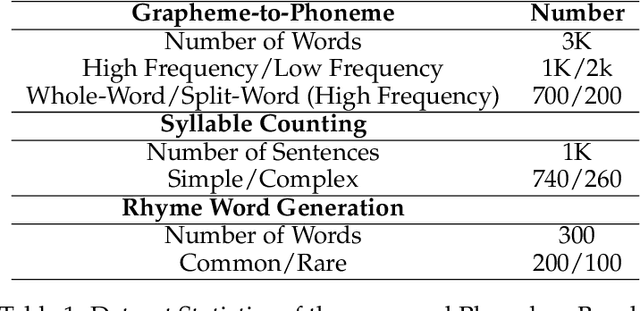
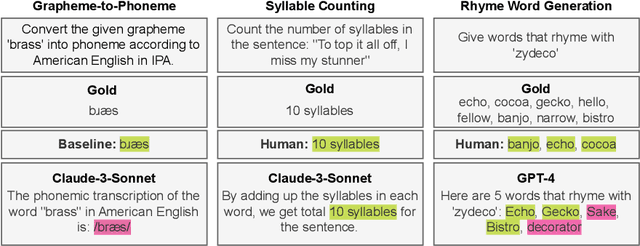
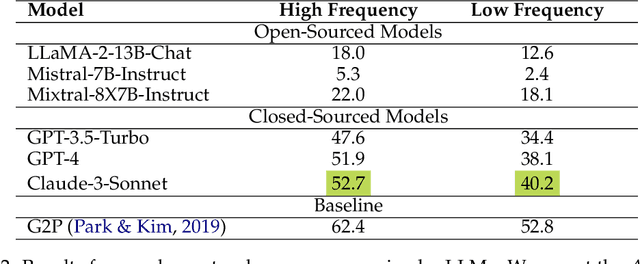
Phonology, the study of speech's structure and pronunciation rules, is a critical yet often overlooked component in Large Language Model (LLM) research. LLMs are widely used in various downstream applications that leverage phonology such as educational tools and poetry generation. Moreover, LLMs can potentially learn imperfect associations between orthographic and phonological forms from the training data. Thus, it is imperative to benchmark the phonological skills of LLMs. To this end, we present PhonologyBench, a novel benchmark consisting of three diagnostic tasks designed to explicitly test the phonological skills of LLMs in English: grapheme-to-phoneme conversion, syllable counting, and rhyme word generation. Despite having no access to speech data, LLMs showcased notable performance on the PhonologyBench tasks. However, we observe a significant gap of 17% and 45% on Rhyme Word Generation and Syllable counting, respectively, when compared to humans. Our findings underscore the importance of studying LLM performance on phonological tasks that inadvertently impact real-world applications. Furthermore, we encourage researchers to choose LLMs that perform well on the phonological task that is closely related to the downstream application since we find that no single model consistently outperforms the others on all the tasks.