 Add to Chrome
 Add to Firefox
 Add to Edge
Trade-offs in Ensembling, Merging and Routing Among Parameter-Efficient Experts
Mar 03, 2026
While large language models (LLMs) fine-tuned with lightweight adapters achieve strong performance across diverse tasks, their performance on individual tasks depends on the fine-tuning strategy. Fusing independently trained models with different strengths has shown promise for multi-task learning through three main strategies: ensembling, which combines outputs from independent models; merging, which fuses model weights via parameter averaging; and routing, which integrates models in an input-dependent fashion. However, many design decisions in these approaches remain understudied, and the relative benefits of more sophisticated ensembling, merging and routing techniques are not fully understood. We empirically evaluate their trade-offs, addressing two key questions: What are the advantages of going beyond uniform ensembling or merging? And does the flexibility of routing justify its complexity? Our findings indicate that non-uniform ensembling and merging improve performance, but routing offers even greater gains. To mitigate the computational cost of routing, we analyze expert selection techniques, showing that clustering and greedy subset selection can maintain reasonable performance with minimal overhead. These insights advance our understanding of model fusion for multi-task learning.

Modular Memory is the Key to Continual Learning Agents
Mar 02, 2026Foundation models have transformed machine learning through large-scale pretraining and increased test-time compute. Despite surpassing human performance in several domains, these models remain fundamentally limited in continuous operation, experience accumulation, and personalization, capabilities that are central to adaptive intelligence. While continual learning research has long targeted these goals, its historical focus on in-weight learning (IWL), i.e., updating a single model's parameters to absorb new knowledge, has rendered catastrophic forgetting a persistent challenge. Our position is that combining the strengths of In-Weight Learning (IWL) and the newly emerged capabilities of In-Context Learning (ICL) through the design of modular memory is the missing piece for continual adaptation at scale. We outline a conceptual framework for modular memory-centric architectures that leverage ICL for rapid adaptation and knowledge accumulation, and IWL for stable updates to model capabilities, charting a practical roadmap toward continually learning agents.
Learning to Solve Complex Problems via Dataset Decomposition
Feb 23, 2026Curriculum learning is a class of training strategies that organizes the data being exposed to a model by difficulty, gradually from simpler to more complex examples. This research explores a reverse curriculum generation approach that recursively decomposes complex datasets into simpler, more learnable components. We propose a teacher-student framework where the teacher is equipped with the ability to reason step-by-step, which is used to recursively generate easier versions of examples, enabling the student model to progressively master difficult tasks. We propose a novel scoring system to measure data difficulty based on its structural complexity and conceptual depth, allowing curriculum construction over decomposed data. Experiments on math datasets (MATH and AIME) and code generation datasets demonstrate that models trained with curricula generated by our approach exhibit superior performance compared to standard training on original datasets.
Learning to Extract Context for Context-Aware LLM Inference
Dec 12, 2025User prompts to large language models (LLMs) are often ambiguous or under-specified, and subtle contextual cues shaped by user intentions, prior knowledge, and risk factors strongly influence what constitutes an appropriate response. Misinterpreting intent or risks may lead to unsafe outputs, while overly cautious interpretations can cause unnecessary refusal of benign requests. In this paper, we question the conventional framework in which LLMs generate immediate responses to requests without considering broader contextual factors. User requests are situated within broader contexts such as intentions, knowledge, and prior experience, which strongly influence what constitutes an appropriate answer. We propose a framework that extracts and leverages such contextual information from the user prompt itself. Specifically, a reinforcement learning based context generator, designed in an autoencoder-like fashion, is trained to infer contextual signals grounded in the prompt and use them to guide response generation. This approach is particularly important for safety tasks, where ambiguous requests may bypass safeguards while benign but confusing requests can trigger unnecessary refusals. Experiments show that our method reduces harmful responses by an average of 5.6% on the SafetyInstruct dataset across multiple foundation models and improves the harmonic mean of attack success rate and compliance on benign prompts by 6.2% on XSTest and WildJailbreak. These results demonstrate the effectiveness of context extraction for safer and more reliable LLM inferences.
Gistify! Codebase-Level Understanding via Runtime Execution
Oct 30, 2025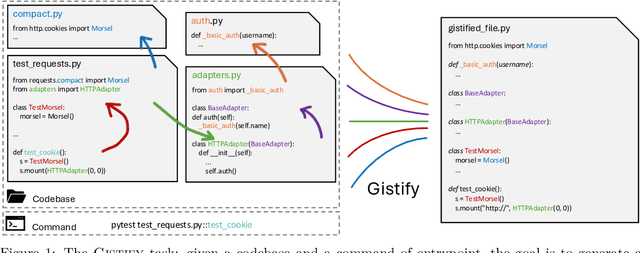
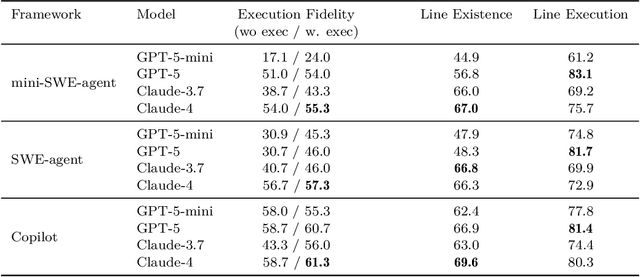

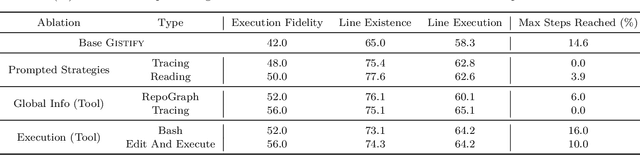
As coding agents are increasingly deployed in large codebases, the need to automatically design challenging, codebase-level evaluation is central. We propose Gistify, a task where a coding LLM must create a single, minimal, self-contained file that can reproduce a specific functionality of a codebase. The coding LLM is given full access to a codebase along with a specific entrypoint (e.g., a python command), and the generated file must replicate the output of the same command ran under the full codebase, while containing only the essential components necessary to execute the provided command. Success on Gistify requires both structural understanding of the codebase, accurate modeling of its execution flow as well as the ability to produce potentially large code patches. Our findings show that current state-of-the-art models struggle to reliably solve Gistify tasks, especially ones with long executions traces.
A Modular Approach for Clinical SLMs Driven by Synthetic Data with Pre-Instruction Tuning, Model Merging, and Clinical-Tasks Alignment
May 15, 2025High computation costs and latency of large language models such as GPT-4 have limited their deployment in clinical settings. Small language models (SLMs) offer a cost-effective alternative, but their limited capacity requires biomedical domain adaptation, which remains challenging. An additional bottleneck is the unavailability and high sensitivity of clinical data. To address these challenges, we propose a novel framework for adapting SLMs into high-performing clinical models. We introduce the MediPhi collection of 3.8B-parameter SLMs developed with our novel framework: pre-instruction tuning of experts on relevant medical and clinical corpora (PMC, Medical Guideline, MedWiki, etc.), model merging, and clinical-tasks alignment. To cover most clinical tasks, we extended the CLUE benchmark to CLUE+, doubling its size. Our expert models deliver relative improvements on this benchmark over the base model without any task-specific fine-tuning: 64.3% on medical entities, 49.5% on radiology reports, and 44% on ICD-10 coding (outperforming GPT-4-0125 by 14%). We unify the expert models into MediPhi via model merging, preserving gains across benchmarks. Furthermore, we built the MediFlow collection, a synthetic dataset of 2.5 million high-quality instructions on 14 medical NLP tasks, 98 fine-grained document types, and JSON format support. Alignment of MediPhi using supervised fine-tuning and direct preference optimization achieves further gains of 18.9% on average.
debug-gym: A Text-Based Environment for Interactive Debugging
Mar 27, 2025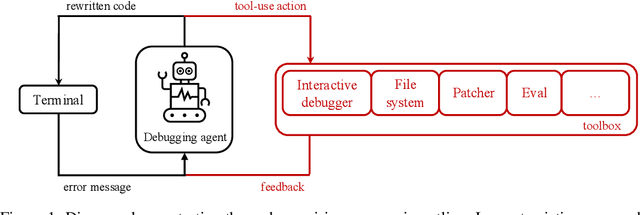
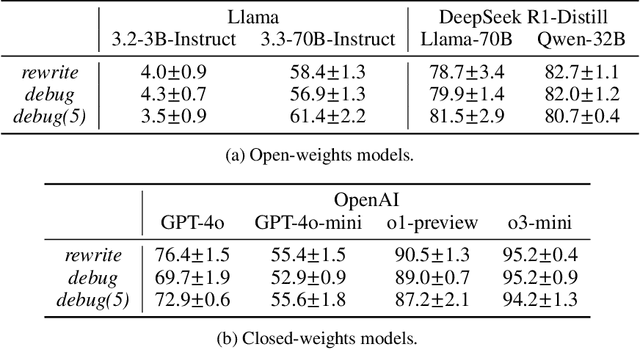
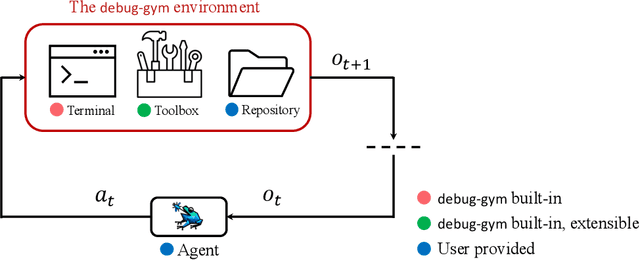
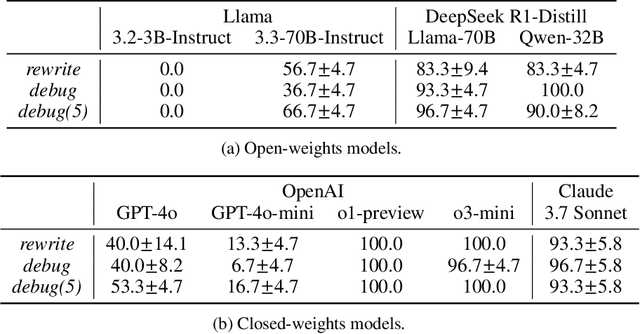
Large Language Models (LLMs) are increasingly relied upon for coding tasks, yet in most scenarios it is assumed that all relevant information can be either accessed in context or matches their training data. We posit that LLMs can benefit from the ability to interactively explore a codebase to gather the information relevant to their task. To achieve this, we present a textual environment, namely debug-gym, for developing LLM-based agents in an interactive coding setting. Our environment is lightweight and provides a preset of useful tools, such as a Python debugger (pdb), designed to facilitate an LLM-based agent's interactive debugging. Beyond coding and debugging tasks, this approach can be generalized to other tasks that would benefit from information-seeking behavior by an LLM agent.
Training Plug-n-Play Knowledge Modules with Deep Context Distillation
Mar 11, 2025Dynamically integrating new or rapidly evolving information after (Large) Language Model pre-training remains challenging, particularly in low-data scenarios or when dealing with private and specialized documents. In-context learning and retrieval-augmented generation (RAG) face limitations, including their high inference costs and their inability to capture global document information. In this paper, we propose a way of modularizing knowledge by training document-level Knowledge Modules (KMs). KMs are lightweight components implemented as parameter-efficient LoRA modules, which are trained to store information about new documents and can be easily plugged into models on demand. We show that next-token prediction performs poorly as the training objective for KMs. We instead propose Deep Context Distillation: we learn KMs parameters such as to simulate hidden states and logits of a teacher that takes the document in context. Our method outperforms standard next-token prediction and pre-instruction training techniques, across two datasets. Finally, we highlight synergies between KMs and retrieval-augmented generation.
Generative Modeling of Individual Behavior at Scale
Feb 20, 2025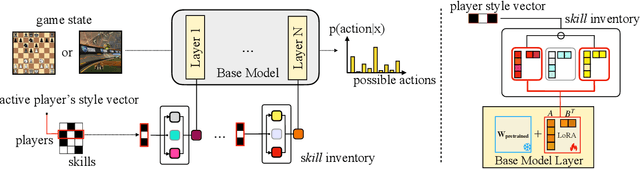
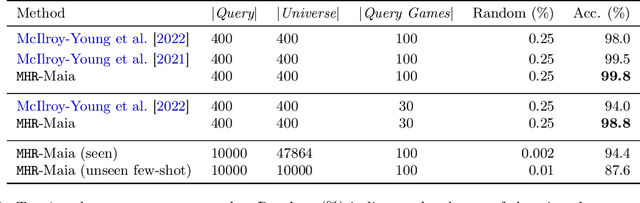
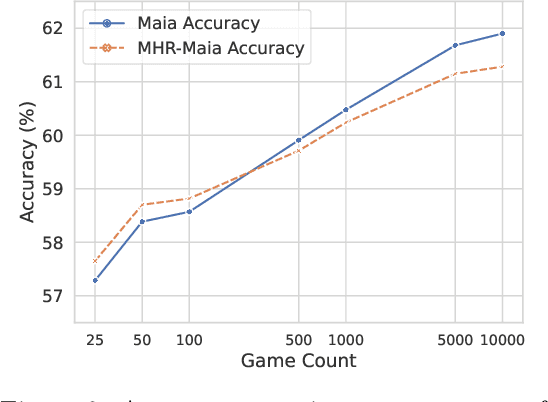
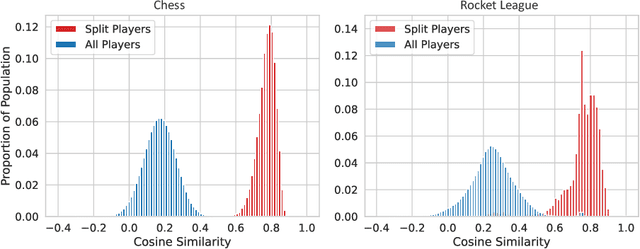
There has been a growing interest in using AI to model human behavior, particularly in domains where humans interact with this technology. While most existing work models human behavior at an aggregate level, our goal is to model behavior at the individual level. Recent approaches to behavioral stylometry -- or the task of identifying a person from their actions alone -- have shown promise in domains like chess, but these approaches are either not scalable (e.g., fine-tune a separate model for each person) or not generative, in that they cannot generate actions. We address these limitations by framing behavioral stylometry as a multi-task learning problem -- where each task represents a distinct person -- and use parameter-efficient fine-tuning (PEFT) methods to learn an explicit style vector for each person. Style vectors are generative: they selectively activate shared "skill" parameters to generate actions in the style of each person. They also induce a latent space that we can interpret and manipulate algorithmically. In particular, we develop a general technique for style steering that allows us to steer a player's style vector towards a desired property. We apply our approach to two very different games, at unprecedented scales: chess (47,864 players) and Rocket League (2,000 players). We also show generality beyond gaming by applying our method to image generation, where we learn style vectors for 10,177 celebrities and use these vectors to steer their images.
A Survey on Model MoErging: Recycling and Routing Among Specialized Experts for Collaborative Learning
Aug 13, 2024
The availability of performant pre-trained models has led to a proliferation of fine-tuned expert models that are specialized to a particular domain or task. Model MoErging methods aim to recycle expert models to create an aggregate system with improved performance or generalization. A key component of MoErging methods is the creation of a router that decides which expert model(s) to use for a particular input or application. The promise, effectiveness, and large design space of MoErging has spurred the development of many new methods over the past few years. This rapid pace of development has made it challenging to compare different MoErging methods, which are rarely compared to one another and are often validated in different experimental setups. To remedy such gaps, we present a comprehensive survey of MoErging methods that includes a novel taxonomy for cataloging key design choices and clarifying suitable applications for each method. Apart from surveying MoErging research, we inventory software tools and applications that make use of MoErging. We additionally discuss related fields of study such as model merging, multitask learning, and mixture-of-experts models. Taken as a whole, our survey provides a unified overview of existing MoErging methods and creates a solid foundation for future work in this burgeoning field.