 Add to Chrome
 Add to Firefox
 Add to Edge
Active Inference-Enabled Agentic Closed-Loop ISAC with Long-Horizon Planning
Apr 21, 2026
Wireless agentic systems enable agents to autonomously perceive, reason, and act. However, existing works neglect the tight coupling between sensing and control in closed-loop integrated sensing and communication (ISAC) systems. In this paper, we propose an active inference (AIF)-driven wireless agentic system for closed-loop ISAC, which jointly optimizes control and sensing resource allocation via backward--forward message passing on a factor graph. The AIF agent maintains a generative model as a digital twin by integrating a localization model for uncertainty-aware state inference and a localization channel knowledge map (CKM) for approximating observation quality during planning. Simulation results demonstrate that the AIF-enabled agent adaptively allocates sensing resources based on spatially varying channel conditions, achieving superior balance among tracking accuracy, control effort, and sensing resource consumption over baseline strategies.

Semantic-based Distributed Learning for Diverse and Discriminative Representations
Apr 20, 2026In large-scale distributed scenarios, increasingly complex tasks demand more intelligent collaboration across networks, requiring the joint extraction of structural representations from data samples. However, conventional task-specific approaches often result in nonstructural embeddings, leading to collapsed variability among data samples within the same class, particularly in classification tasks. To address this issue and fully leverage the intrinsic structure of data for downstream applications, we propose a novel distributed learning framework that ensures both diverse and discriminative representations. For independent and identically distributed (i.i.d.) data, we reformulate and decouple the global optimization function by introducing constraints on representation variance. The update rules are then derived and simplified using a primal-dual approach. For non-i.i.d. data distributions, we tackle the problem by clustering and virtually replicating nodes, allowing model updates within each cluster using block coordinate descent. In both cases, the resulting optimal solutions are theoretically proven to maintain discriminative and diverse properties, with a guaranteed convergence for i.i.d. conditions. Additionally, semantic information from representations is shared among nodes, reducing the need for common neural network architectures. Finally, extensive simulations on MNIST, CIFAR-10 and CIFAR-100 confirm the effectiveness of the proposed algorithms in capturing global structural representations.
Telecom World Models: Unifying Digital Twins, Foundation Models, and Predictive Planning for 6G
Apr 08, 2026The integration of machine learning tools into telecom networks, has led to two prevailing paradigms, namely, language-based systems, such as Large Language Models (LLMs), and physics-based systems, such as Digital Twins (DTs). While LLM-based approaches enable flexible interaction and automation, they lack explicit representations of network dynamics. DTs, in contrast, offer a high-fidelity network simulation, but remain scenario-specific and are not designed for learning or decision-making under uncertainty. This gap becomes critical for 6G systems, where decisions must take into account the evolving network states, uncertainty, and the cascading effects of control actions across multiple layers. In this article, we introduce the {Telecom World Model}~(TWM) concept, an architecture for learned, action-conditioned, uncertainty-aware modeling of telecom system dynamics. We decompose the problem into two interacting worlds, a controllable system world consisting of operator-configurable settings and an external world that captures propagation, mobility, traffic, and failures. We propose a three-layer architecture, comprising a field world model for spatial environment prediction, a control/dynamics world model for action-conditioned Key Performance Indicator (KPI) trajectory prediction, and a telecom foundation model layer for intent translation and orchestration. We showcase a comparative analysis between existing paradigms, which demonstrates that TWM jointly provides telecom state grounding, fast action-conditioned roll-outs, calibrated uncertainty, multi-timescale dynamics, model-based planning, and LLM-integrated guardrails. Furthermore, we present a proof-of-concept on network slicing to validate the proposed architecture, showing that the full three-layer pipeline outperforms single-world baselines and accurately predicts KPI trajectories.
Equivariant Multi-agent Reinforcement Learning for Multimodal Vehicle-to-Infrastructure Systems
Apr 08, 2026In this paper, we study a vehicle-to-infrastructure (V2I) system where distributed base stations (BSs) acting as road-side units (RSUs) collect multimodal (wireless and visual) data from moving vehicles. We consider a decentralized rate maximization problem, where each RSU relies on its local observations to optimize its resources, while all RSUs must collaborate to guarantee favorable network performance. We recast this problem as a distributed multi-agent reinforcement learning (MARL) problem, by incorporating rotation symmetries in terms of vehicles' locations. To exploit these symmetries, we propose a novel self-supervised learning framework where each BS agent aligns the latent features of its multimodal observation to extract the positions of the vehicles in its local region. Equipped with this sensing data at each RSU, we train an equivariant policy network using a graph neural network (GNN) with message passing layers, such that each agent computes its policy locally, while all agents coordinate their policies via a signaling scheme that overcomes partial observability and guarantees the equivariance of the global policy. We present numerical results carried out in a simulation environment, where ray-tracing and computer graphics are used to collect wireless and visual data. Results show the generalizability of our self-supervised and multimodal sensing approach, achieving more than two-fold accuracy gains over baselines, and the efficiency of our equivariant MARL training, attaining more than 50% performance gains over standard approaches.
JEPA-MSAC: A Joint-Embedding Predictive Architecture for Multimodal Sensing-Assisted Communications
Mar 31, 2026Future wireless systems increasingly require predictive and transferable representations that can support multiple physical-layer (PHY) tasks under dynamic environments. However, most existing supervised learning-based methods are designed for a single task, which leads to high adaptation cost. To address this issue, we propose a joint-embedding predictive architecture for multimodal sensing-assisted communications (JEPA-MSAC), a self-supervised multimodal predictive representation learning framework for wireless environments. The proposed framework first maps multimodal sensing and communication measurements into a unified token space, and then pretrains a shared backbone using temporal block-masked JEPA to learn a predictive latent space that captures environment dynamics and cross-modal dependencies. After pretraining, the backbone is frozen and reused as a general future-feature generator, on top of which lightweight task heads are trained for localization, beam prediction, and received signal strength indicator (RSSI) prediction. Extensive experiments show the latent state supports accurate multi-task prediction with low adaptation cost. Additionally, ablation studies reveal its scaling behavior and the impact of key pretraining setups.
Structured Latent Dynamics in Wireless CSI via Homomorphic World Models
Mar 20, 2026We introduce a self-supervised framework for learning predictive and structured representations of wireless channels by modeling the temporal evolution of channel state information (CSI) in a compact latent space. Our method casts the problem as a world modeling task and leverages the Joint Embedding Predictive Architecture (JEPA) to learn action-conditioned latent dynamics from CSI trajectories. To promote geometric consistency and compositionality, we parameterize transitions using homomorphic updates derived from Lie algebra, yielding a structured latent space that reflects spatial layout and user motion. Evaluations on the DICHASUS dataset show that our approach outperforms strong baselines in preserving topology and forecasting future embeddings across unseen environments. The resulting latent space enables metrically faithful channel charts, offering a scalable foundation for downstream applications such as mobility-aware scheduling, localization, and wireless scene understanding.
Communication-Efficient and Robust Multi-Modal Federated Learning via Latent-Space Consensus
Mar 19, 2026Federated learning (FL) enables collaborative model training across distributed devices without sharing raw data, but applying FL to multi-modal settings introduces significant challenges. Clients typically possess heterogeneous modalities and model architectures, making it difficult to align feature spaces efficiently while preserving privacy and minimizing communication costs. To address this, we introduce CoMFed, a Communication-Efficient Multi-Modal Federated Learning framework that uses learnable projection matrices to generate compressed latent representations. A latent-space regularizer aligns these representations across clients, improving cross-modal consistency and robustness to outliers. Experiments on human activity recognition benchmarks show that CoMFed achieves competitive accuracy with minimal overhead.
LiQSS: Post-Transformer Linear Quantum-Inspired State-Space Tensor Networks for Real-Time 6G
Jan 18, 2026Proactive and agentic control in Sixth-Generation (6G) Open Radio Access Networks (O-RAN) requires control-grade prediction under stringent Near-Real-Time (Near-RT) latency and computational constraints. While Transformer-based models are effective for sequence modeling, their quadratic complexity limits scalability in Near-RT RAN Intelligent Controller (RIC) analytics. This paper investigates a post-Transformer design paradigm for efficient radio telemetry forecasting. We propose a quantum-inspired many-body state-space tensor network that replaces self-attention with stable structured state-space dynamics kernels, enabling linear-time sequence modeling. Tensor-network factorizations in the form of Tensor Train (TT) / Matrix Product State (MPS) representations are employed to reduce parameterization and data movement in both input projections and prediction heads, while lightweight channel gating and mixing layers capture non-stationary cross-Key Performance Indicator (KPI) dependencies. The proposed model is instantiated as an agentic perceive-predict xApp and evaluated on a bespoke O-RAN KPI time-series dataset comprising 59,441 sliding windows across 13 KPIs, using Reference Signal Received Power (RSRP) forecasting as a representative use case. Our proposed Linear Quantum-Inspired State-Space (LiQSS) model is 10.8x-15.8x smaller and approximately 1.4x faster than prior structured state-space baselines. Relative to Transformer-based models, LiQSS achieves up to a 155x reduction in parameter count and up to 2.74x faster inference, without sacrificing forecasting accuracy.
Logic-Driven Semantic Communication for Resilient Multi-Agent Systems
Jan 11, 2026The advent of 6G networks is accelerating autonomy and intelligence in large-scale, decentralized multi-agent systems (MAS). While this evolution enables adaptive behavior, it also heightens vulnerability to stressors such as environmental changes and adversarial behavior. Existing literature on resilience in decentralized MAS largely focuses on isolated aspects, such as fault tolerance, without offering a principled unified definition of multi-agent resilience. This gap limits the ability to design systems that can continuously sense, adapt, and recover under dynamic conditions. This article proposes a formal definition of MAS resilience grounded in two complementary dimensions: epistemic resilience, wherein agents recover and sustain accurate knowledge of the environment, and action resilience, wherein agents leverage that knowledge to coordinate and sustain goals under disruptions. We formalize resilience via temporal epistemic logic and quantify it using recoverability time (how quickly desired properties are re-established after a disturbance) and durability time (how long accurate beliefs and goal-directed behavior are sustained after recovery). We design an agent architecture and develop decentralized algorithms to achieve both epistemic and action resilience. We provide formal verification guarantees, showing that our specifications are sound with respect to the metric bounds and admit finite-horizon verification, enabling design-time certification and lightweight runtime monitoring. Through a case study on distributed multi-agent decision-making under stressors, we show that our approach outperforms baseline methods. Our formal verification analysis and simulation results highlight that the proposed framework enables resilient, knowledge-driven decision-making and sustained operation, laying the groundwork for resilient decentralized MAS in next-generation communication systems.
Compositional Distributed Learning for Multi-View Perception: A Maximal Coding Rate Reduction Perspective
Nov 11, 2025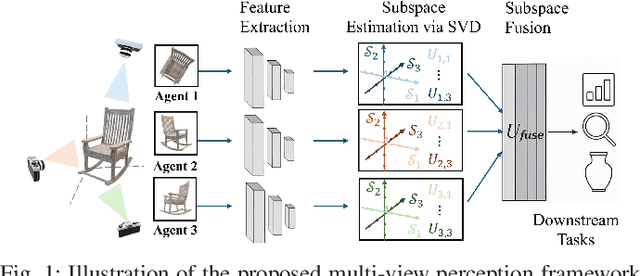
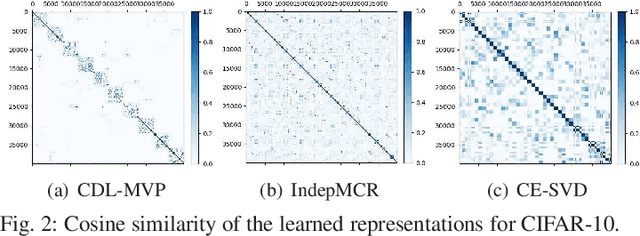

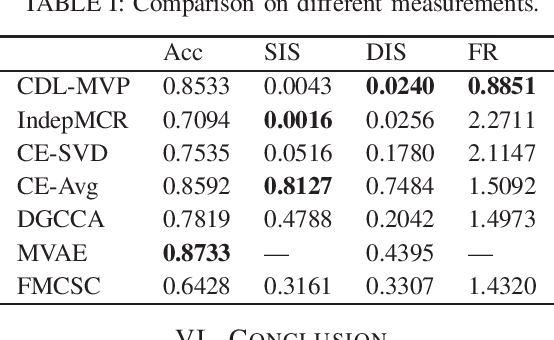
In this letter, we formulate a compositional distributed learning framework for multi-view perception by leveraging the maximal coding rate reduction principle combined with subspace basis fusion. In the proposed algorithm, each agent conducts a periodic singular value decomposition on its learned subspaces and exchanges truncated basis matrices, based on which the fused subspaces are obtained. By introducing a projection matrix and minimizing the distance between the outputs and its projection, the learned representations are enforced towards the fused subspaces. It is proved that the trace on the coding-rate change is bounded and the consistency of basis fusion is guaranteed theoretically. Numerical simulations validate that the proposed algorithm achieves high classification accuracy while maintaining representations' diversity, compared to baselines showing correlated subspaces and coupled representations.