 Add to Chrome
 Add to Firefox
 Add to Edge
Communication-Efficient and Robust Multi-Modal Federated Learning via Latent-Space Consensus
Mar 19, 2026
Federated learning (FL) enables collaborative model training across distributed devices without sharing raw data, but applying FL to multi-modal settings introduces significant challenges. Clients typically possess heterogeneous modalities and model architectures, making it difficult to align feature spaces efficiently while preserving privacy and minimizing communication costs. To address this, we introduce CoMFed, a Communication-Efficient Multi-Modal Federated Learning framework that uses learnable projection matrices to generate compressed latent representations. A latent-space regularizer aligns these representations across clients, improving cross-modal consistency and robustness to outliers. Experiments on human activity recognition benchmarks show that CoMFed achieves competitive accuracy with minimal overhead.

Balancing Energy Efficiency and Distributional Robustness in Over-the-Air Federated Learning
Dec 22, 2023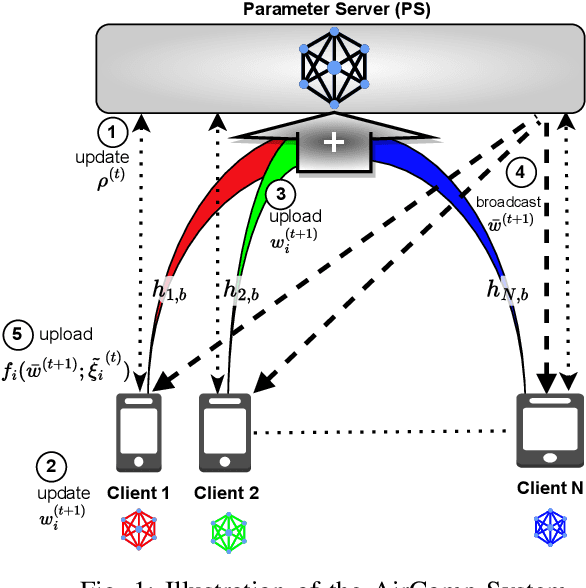

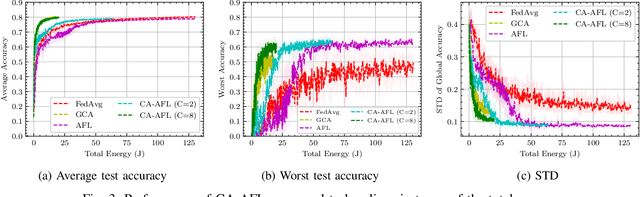
The growing number of wireless edge devices has magnified challenges concerning energy, bandwidth, latency, and data heterogeneity. These challenges have become bottlenecks for distributed learning. To address these issues, this paper presents a novel approach that ensures energy efficiency for distributionally robust federated learning (FL) with over air computation (AirComp). In this context, to effectively balance robustness with energy efficiency, we introduce a novel client selection method that integrates two complementary insights: a deterministic one that is designed for energy efficiency, and a probabilistic one designed for distributional robustness. Simulation results underscore the efficacy of the proposed algorithm, revealing its superior performance compared to baselines from both robustness and energy efficiency perspectives, achieving more than 3-fold energy savings compared to the considered baselines.