 Add to Chrome
 Add to Firefox
 Add to Edge
Learning Low-Dimensional Representation for O-RAN Testing via Transformer-ESN
Apr 14, 2026
Open Radio Access Network (O-RAN) architectures enhance flexibility for 6G and NextG networks. However, it also brings significant challenges in O-RAN testing with evaluating abundant, high-dimensional key performance indicators (KPIs). In this paper, we introduce a novel two-stage framework to learn temporally-aware low-dimensional representations of O-RAN testing KPIs. To be specific, stage one employs an information-theoretic H-score to train a hybrid self-attentive transformer and echo state network (ESN) reservoir, called Transformer-ESN, capturing temporal dynamics and producing task-aligned $8$-dimensional embeddings. Stage two evaluates these embeddings by training a lightweight multilayer perceptron (MLP) predictor exclusively on them for key target KPIs such as reference signal received quality (RSRQ) and spectral efficiency. Using real-world O-RAN testbed data (video streaming with interference), our approach demonstrates a significant advantage specifically when training samples are very limited. In this scenario, the low-dimensional representations learned from the Transformer-ESN yield mean square error (MSE) reductions of up to 41.9\% for RSRQ and 29.9\% for spectral efficiency compared to predictions from the original high-dimensional data. The framework exhibits high efficiency for O-RAN testing, significantly reducing testing complexities for O-RAN systems.

LiQSS: Post-Transformer Linear Quantum-Inspired State-Space Tensor Networks for Real-Time 6G
Jan 18, 2026Proactive and agentic control in Sixth-Generation (6G) Open Radio Access Networks (O-RAN) requires control-grade prediction under stringent Near-Real-Time (Near-RT) latency and computational constraints. While Transformer-based models are effective for sequence modeling, their quadratic complexity limits scalability in Near-RT RAN Intelligent Controller (RIC) analytics. This paper investigates a post-Transformer design paradigm for efficient radio telemetry forecasting. We propose a quantum-inspired many-body state-space tensor network that replaces self-attention with stable structured state-space dynamics kernels, enabling linear-time sequence modeling. Tensor-network factorizations in the form of Tensor Train (TT) / Matrix Product State (MPS) representations are employed to reduce parameterization and data movement in both input projections and prediction heads, while lightweight channel gating and mixing layers capture non-stationary cross-Key Performance Indicator (KPI) dependencies. The proposed model is instantiated as an agentic perceive-predict xApp and evaluated on a bespoke O-RAN KPI time-series dataset comprising 59,441 sliding windows across 13 KPIs, using Reference Signal Received Power (RSRP) forecasting as a representative use case. Our proposed Linear Quantum-Inspired State-Space (LiQSS) model is 10.8x-15.8x smaller and approximately 1.4x faster than prior structured state-space baselines. Relative to Transformer-based models, LiQSS achieves up to a 155x reduction in parameter count and up to 2.74x faster inference, without sacrificing forecasting accuracy.
Digital Co-Founders: Transforming Imagination into Viable Solo Business via Agentic AI
Nov 12, 2025This paper investigates how individual entrepreneurs can turn creative ideas into successful solo businesses in an era increasingly shaped by Artificial Intelligence (AI) agents. It highlights the key steps that connect personal vision, structured experimentation, and lasting value creation, and shows how AI agents can act as digital co-founders throughout this journey. Building on research in entrepreneurship, creativity, and innovation, we present a framework with three key stages: (1) Imagination shaping, where vague goals become clear value propositions, supported by AI agents that help with market scanning, idea refinement, and rapid concept generation; (2) Reality testing, where these ideas are tested through low-cost experiments, structured feedback loops, and efficient execution, with AI agents automating tasks such as prototyping, content creation, customer interaction, and data analysis; and (3) Reality scaling, where successful ideas are transformed into repeatable processes, scalable market strategies, and long-term business models, increasingly operated and optimized by autonomous or semi-autonomous AI workflows. We focus on the specific context of solopreneurship, characterized by limited human resources, complete accountability for decision-making, and a strong association between the founder's identity and the business. The framework clearly identifies key enabling factors such as mental adaptability, effective planning, and successful human-AI collaboration within digital ecosystems. It also thoughtfully addresses ongoing challenges, like uncertainty and cognitive overload, which are heightened by our constant connectivity.
Decentralized Energy Marketplace via NFTs and AI-based Agents
Nov 17, 2023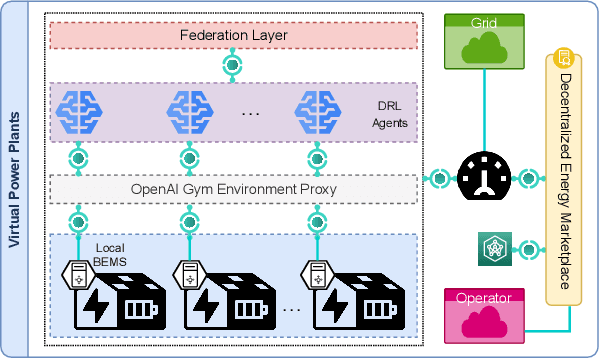

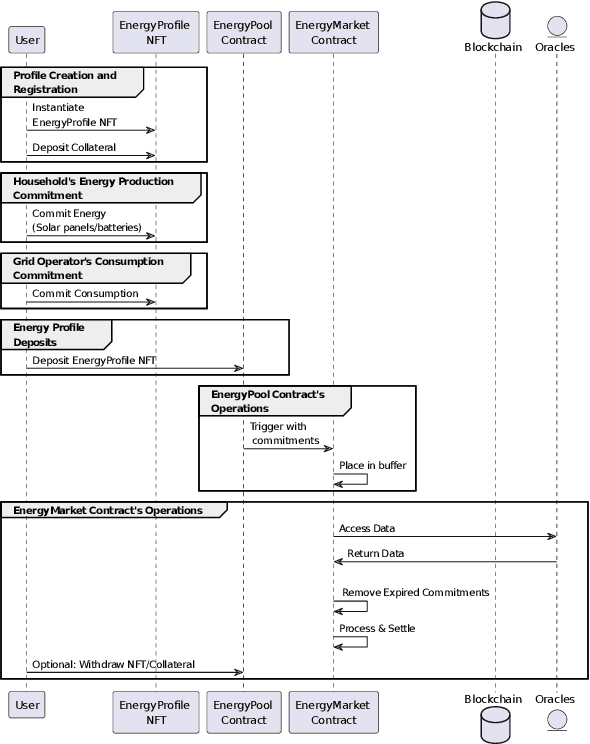
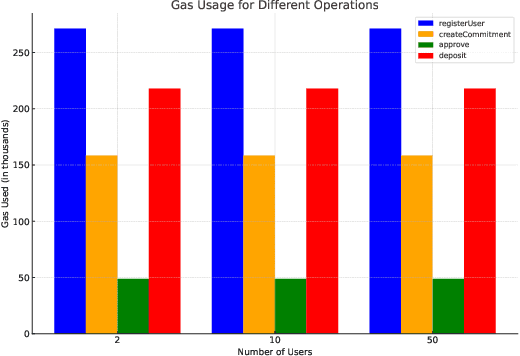
The paper introduces an advanced Decentralized Energy Marketplace (DEM) integrating blockchain technology and artificial intelligence to manage energy exchanges among smart homes with energy storage systems. The proposed framework uses Non-Fungible Tokens (NFTs) to represent unique energy profiles in a transparent and secure trading environment. Leveraging Federated Deep Reinforcement Learning (FDRL), the system promotes collaborative and adaptive energy management strategies, maintaining user privacy. A notable innovation is the use of smart contracts, ensuring high efficiency and integrity in energy transactions. Extensive evaluations demonstrate the system's scalability and the effectiveness of the FDRL method in optimizing energy distribution. This research significantly contributes to developing sophisticated decentralized smart grid infrastructures. Our approach broadens potential blockchain and AI applications in sustainable energy systems and addresses incentive alignment and transparency challenges in traditional energy trading mechanisms. The implementation of this paper is publicly accessible at \url{https://github.com/RasoulNik/DEM}.
SliceOps: Explainable MLOps for Streamlined Automation-Native 6G Networks
Jul 04, 2023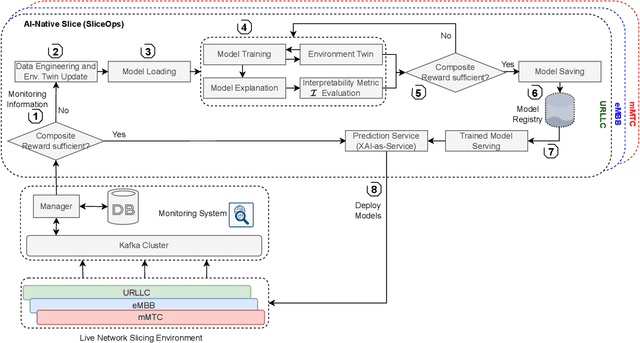
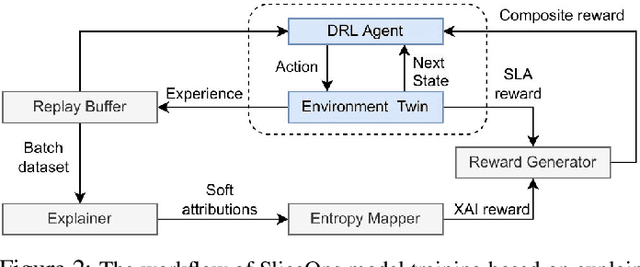
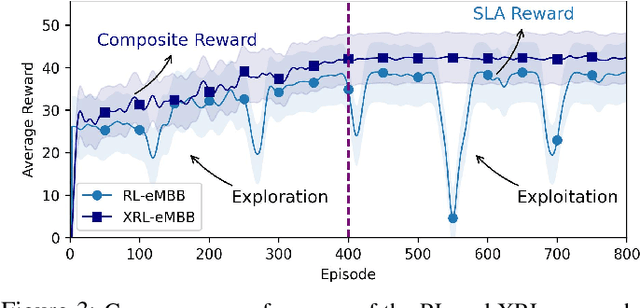
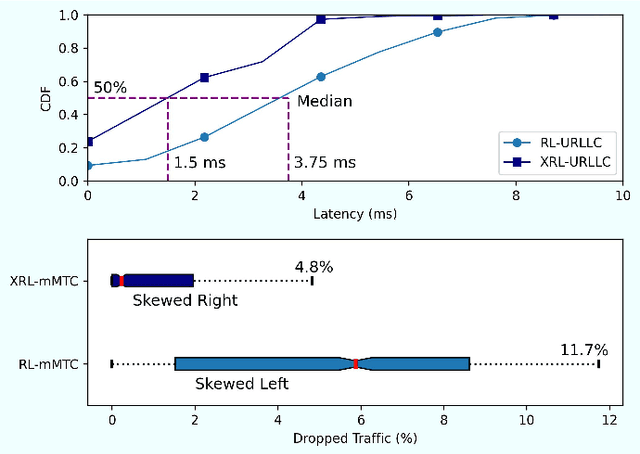
Sixth-generation (6G) network slicing is the backbone of future communications systems. It inaugurates the era of extreme ultra-reliable and low-latency communication (xURLLC) and pervades the digitalization of the various vertical immersive use cases. Since 6G inherently underpins artificial intelligence (AI), we propose a systematic and standalone slice termed SliceOps that is natively embedded in the 6G architecture, which gathers and manages the whole AI lifecycle through monitoring, re-training, and deploying the machine learning (ML) models as a service for the 6G slices. By leveraging machine learning operations (MLOps) in conjunction with eXplainable AI (XAI), SliceOps strives to cope with the opaqueness of black-box AI using explanation-guided reinforcement learning (XRL) to fulfill transparency, trustworthiness, and interpretability in the network slicing ecosystem. This article starts by elaborating on the architectural and algorithmic aspects of SliceOps. Then, the deployed cloud-native SliceOps working is exemplified via a latency-aware resource allocation problem. The deep RL (DRL)-based SliceOps agents within slices provide AI services aiming to allocate optimal radio resources and impede service quality degradation. Simulation results demonstrate the effectiveness of SliceOps-driven slicing. The article discusses afterward the SliceOps challenges and limitations. Finally, the key open research directions corresponding to the proposed approach are identified.