 Add to Chrome
 Add to Firefox
 Add to Edge
PlanCraft: Sketch, Refine, and Furnish for Architect-Inspired Progressive 3D Residential Scene Generation
Jul 26, 2026
Two structural insights have been overlooked in automated residential floor plan generation. First, design is inherently progressive. Architects begin with rough strokes and refine them over time, whereas existing methods typically require their conditioning representation to be fully specified before generation, a fundamental mismatch with how design actually works. Second, the 2D floor plan is not an optional intermediate but an irreplaceable spatial contract. Once room boundaries, doors, and windows are fixed, furnishing reduces from open-ended spatial reasoning to bounded constraint satisfaction. Bypassing this contract, as existing 3D systems do by delegating layout to language models, yields overlapping rooms and implausible proportions; directly calling general-purpose language models likewise produces geometrically invalid layouts. Guided by these insights, we present PlanCraft. SketchPlan supplies the missing training signal by replaying the architect's drawing process on 80K real floor plans, producing partial sketches at every completeness level. PlanCraft-Diff progressively sharpens an incomplete sketch into a geometrically precise, vectorizable floor plan through a coarse-to-fine strategy. With the spatial contract established, PlanCraft-Agent then furnishes the scene within well-defined room boundaries. Experiments show that PlanCraft achieves a 61.1\% lower FID than the best existing 2D method and surpasses existing 3D systems by 15 points in expert-rated spatial rationality, with a sketch at only 25\% completion already outperforming all fully specified baselines.

Multi-Joint Physics-Informed Deep Learning Framework for Time-Efficient Inverse Dynamics
Nov 14, 2025Time-efficient estimation of muscle activations and forces across multi-joint systems is critical for clinical assessment and assistive device control. However, conventional approaches are computationally expensive and lack a high-quality labeled dataset for multi-joint applications. To address these challenges, we propose a physics-informed deep learning framework that estimates muscle activations and forces directly from kinematics. The framework employs a novel Multi-Joint Cross-Attention (MJCA) module with Bidirectional Gated Recurrent Unit (BiGRU) layers to capture inter-joint coordination, enabling each joint to adaptively integrate motion information from others. By embedding multi-joint dynamics, inter-joint coupling, and external force interactions into the loss function, our Physics-Informed MJCA-BiGRU (PI-MJCA-BiGRU) delivers physiologically consistent predictions without labeled data while enabling time-efficient inference. Experimental validation on two datasets demonstrates that PI-MJCA-BiGRU achieves performance comparable to conventional supervised methods without requiring ground-truth labels, while the MJCA module significantly enhances inter-joint coordination modeling compared to other baseline architectures.
Knowledge-Based Deep Learning for Time-Efficient Inverse Dynamics
Dec 06, 2024


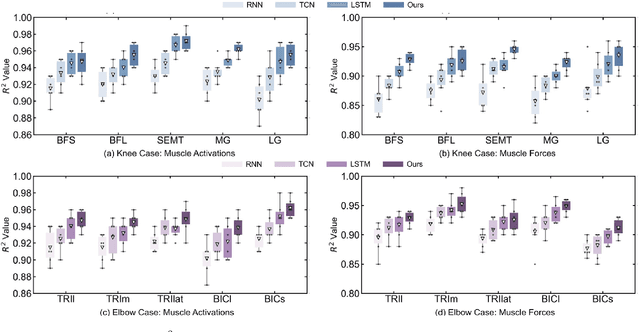
Accurate understanding of muscle activation and muscle forces plays an essential role in neuro-rehabilitation and musculoskeletal disorder treatments. Computational musculoskeletal modeling has been widely used as a powerful non-invasive tool to estimate them through inverse dynamics using static optimization, but the inherent computational complexity results in time-consuming analysis. In this paper, we propose a knowledge-based deep learning framework for time-efficient inverse dynamic analysis, which can predict muscle activation and muscle forces from joint kinematic data directly while not requiring any label information during model training. The Bidirectional Gated Recurrent Unit (BiGRU) neural network is selected as the backbone of our model due to its proficient handling of time-series data. Prior physical knowledge from forward dynamics and pre-selected inverse dynamics based physiological criteria are integrated into the loss function to guide the training of neural networks. Experimental validations on two datasets, including one benchmark upper limb movement dataset and one self-collected lower limb movement dataset from six healthy subjects, are performed. The experimental results have shown that the selected BiGRU architecture outperforms other neural network models when trained using our specifically designed loss function, which illustrates the effectiveness and robustness of the proposed framework.
Physics-informed Deep Learning for Muscle Force Prediction with Unlabeled sEMG Signals
Dec 05, 2024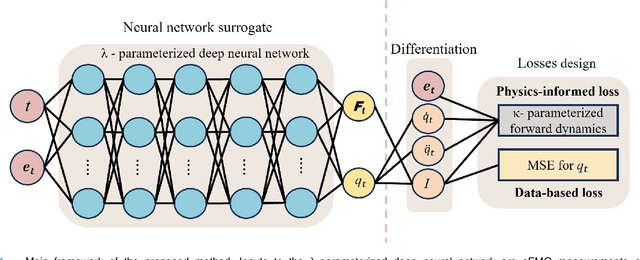
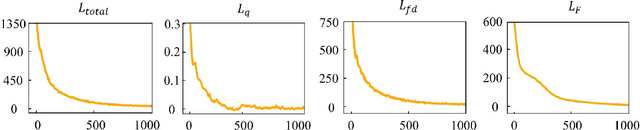
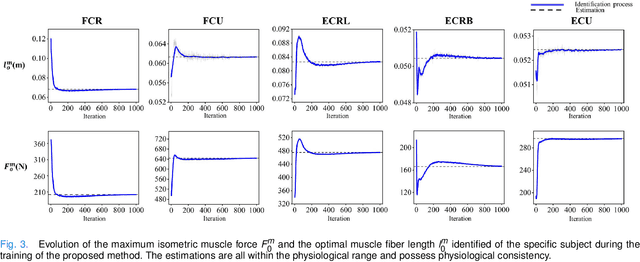
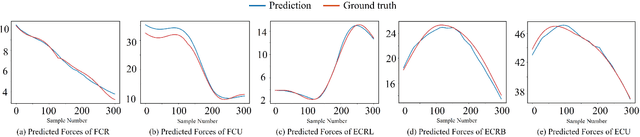
Computational biomechanical analysis plays a pivotal role in understanding and improving human movements and physical functions. Although physics-based modeling methods can interpret the dynamic interaction between the neural drive to muscle dynamics and joint kinematics, they suffer from high computational latency. In recent years, data-driven methods have emerged as a promising alternative due to their fast execution speed, but label information is still required during training, which is not easy to acquire in practice. To tackle these issues, this paper presents a novel physics-informed deep learning method to predict muscle forces without any label information during model training. In addition, the proposed method could also identify personalized muscle-tendon parameters. To achieve this, the Hill muscle model-based forward dynamics is embedded into the deep neural network as the additional loss to further regulate the behavior of the deep neural network. Experimental validations on the wrist joint from six healthy subjects are performed, and a fully connected neural network (FNN) is selected to implement the proposed method. The predicted results of muscle forces show comparable or even lower root mean square error (RMSE) and higher coefficient of determination compared with baseline methods, which have to use the labeled surface electromyography (sEMG) signals, and it can also identify muscle-tendon parameters accurately, demonstrating the effectiveness of the proposed physics-informed deep learning method.
* 11pages, 8 figures, journal