 Add to Chrome
 Add to Firefox
 Add to Edge
Samba: Synchronized Set-of-Sequences Modeling for Multiple Object Tracking
Oct 02, 2024

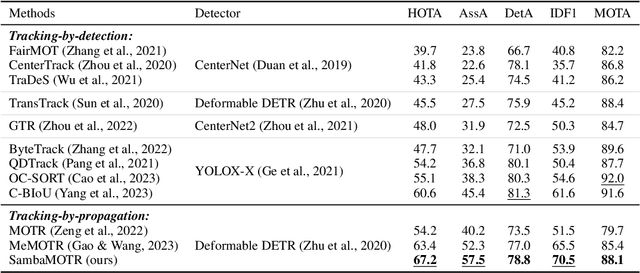

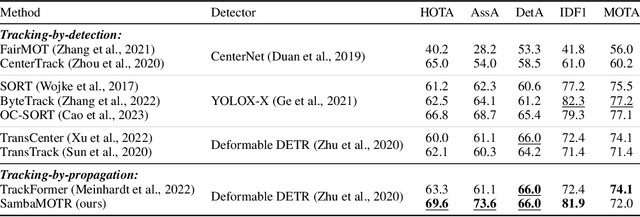
Multiple object tracking in complex scenarios - such as coordinated dance performances, team sports, or dynamic animal groups - presents unique challenges. In these settings, objects frequently move in coordinated patterns, occlude each other, and exhibit long-term dependencies in their trajectories. However, it remains a key open research question on how to model long-range dependencies within tracklets, interdependencies among tracklets, and the associated temporal occlusions. To this end, we introduce Samba, a novel linear-time set-of-sequences model designed to jointly process multiple tracklets by synchronizing the multiple selective state-spaces used to model each tracklet. Samba autoregressively predicts the future track query for each sequence while maintaining synchronized long-term memory representations across tracklets. By integrating Samba into a tracking-by-propagation framework, we propose SambaMOTR, the first tracker effectively addressing the aforementioned issues, including long-range dependencies, tracklet interdependencies, and temporal occlusions. Additionally, we introduce an effective technique for dealing with uncertain observations (MaskObs) and an efficient training recipe to scale SambaMOTR to longer sequences. By modeling long-range dependencies and interactions among tracked objects, SambaMOTR implicitly learns to track objects accurately through occlusions without any hand-crafted heuristics. Our approach significantly surpasses prior state-of-the-art on the DanceTrack, BFT, and SportsMOT datasets.

Walker: Self-supervised Multiple Object Tracking by Walking on Temporal Appearance Graphs
Sep 25, 2024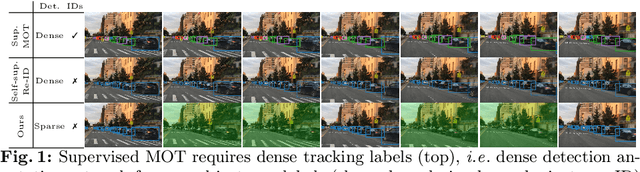


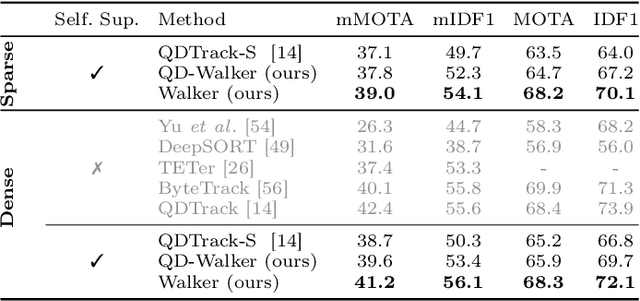
The supervision of state-of-the-art multiple object tracking (MOT) methods requires enormous annotation efforts to provide bounding boxes for all frames of all videos, and instance IDs to associate them through time. To this end, we introduce Walker, the first self-supervised tracker that learns from videos with sparse bounding box annotations, and no tracking labels. First, we design a quasi-dense temporal object appearance graph, and propose a novel multi-positive contrastive objective to optimize random walks on the graph and learn instance similarities. Then, we introduce an algorithm to enforce mutually-exclusive connective properties across instances in the graph, optimizing the learned topology for MOT. At inference time, we propose to associate detected instances to tracklets based on the max-likelihood transition state under motion-constrained bi-directional walks. Walker is the first self-supervised tracker to achieve competitive performance on MOT17, DanceTrack, and BDD100K. Remarkably, our proposal outperforms the previous self-supervised trackers even when drastically reducing the annotation requirements by up to 400x.
Self-supervised Shape Completion via Involution and Implicit Correspondences
Sep 24, 2024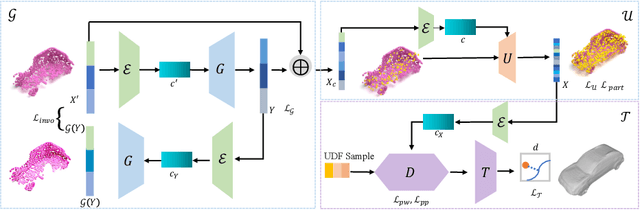
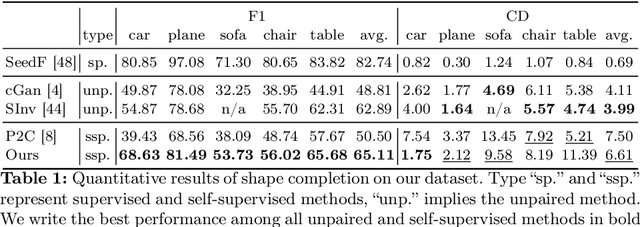
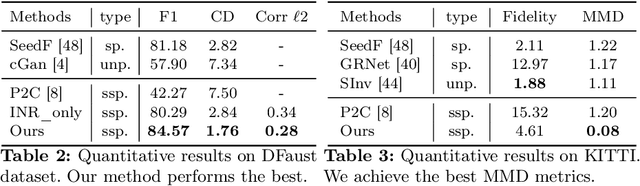
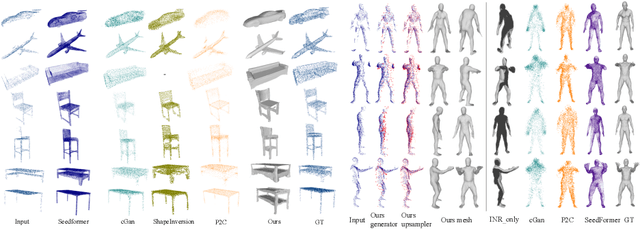
3D shape completion is traditionally solved using supervised training or by distribution learning on complete shape examples. Recently self-supervised learning approaches that do not require any complete 3D shape examples have gained more interests. In this paper, we propose a non-adversarial self-supervised approach for the shape completion task. Our first finding is that completion problems can be formulated as an involutory function trivially, which implies a special constraint on the completion function G, such that G(G(X)) = X. Our second constraint on self-supervised shape completion relies on the fact that shape completion becomes easier to solve with correspondences and similarly, completion can simplify the correspondences problem. We formulate a consistency measure in the canonical space in order to supervise the completion function. We efficiently optimize the completion and correspondence modules using "freeze and alternate" strategy. The overall approach performs well for rigid shapes in a category as well as dynamic non-rigid shapes. We ablate our design choices and compare our solution against state-of-the-art methods, showing remarkable accuracy approaching supervised accuracy in some cases.
SLAck: Semantic, Location, and Appearance Aware Open-Vocabulary Tracking
Sep 17, 2024
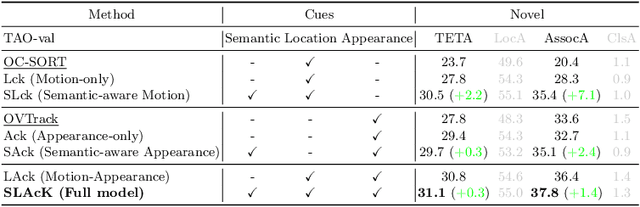


Open-vocabulary Multiple Object Tracking (MOT) aims to generalize trackers to novel categories not in the training set. Currently, the best-performing methods are mainly based on pure appearance matching. Due to the complexity of motion patterns in the large-vocabulary scenarios and unstable classification of the novel objects, the motion and semantics cues are either ignored or applied based on heuristics in the final matching steps by existing methods. In this paper, we present a unified framework SLAck that jointly considers semantics, location, and appearance priors in the early steps of association and learns how to integrate all valuable information through a lightweight spatial and temporal object graph. Our method eliminates complex post-processing heuristics for fusing different cues and boosts the association performance significantly for large-scale open-vocabulary tracking. Without bells and whistles, we outperform previous state-of-the-art methods for novel classes tracking on the open-vocabulary MOT and TAO TETA benchmarks. Our code is available at \href{https://github.com/siyuanliii/SLAck}{github.com/siyuanliii/SLAck}.
Test-time Training for Hyperspectral Image Super-resolution
Sep 13, 2024The progress on Hyperspectral image (HSI) super-resolution (SR) is still lagging behind the research of RGB image SR. HSIs usually have a high number of spectral bands, so accurately modeling spectral band interaction for HSI SR is hard. Also, training data for HSI SR is hard to obtain so the dataset is usually rather small. In this work, we propose a new test-time training method to tackle this problem. Specifically, a novel self-training framework is developed, where more accurate pseudo-labels and more accurate LR-HR relationships are generated so that the model can be further trained with them to improve performance. In order to better support our test-time training method, we also propose a new network architecture to learn HSI SR without modeling spectral band interaction and propose a new data augmentation method Spectral Mixup to increase the diversity of the training data at test time. We also collect a new HSI dataset with a diverse set of images of interesting objects ranging from food to vegetation, to materials, and to general scenes. Extensive experiments on multiple datasets show that our method can improve the performance of pre-trained models significantly after test-time training and outperform competing methods significantly for HSI SR.
Autonomous Vehicle Controllers From End-to-End Differentiable Simulation
Sep 12, 2024Current methods to learn controllers for autonomous vehicles (AVs) focus on behavioural cloning. Being trained only on exact historic data, the resulting agents often generalize poorly to novel scenarios. Simulators provide the opportunity to go beyond offline datasets, but they are still treated as complicated black boxes, only used to update the global simulation state. As a result, these RL algorithms are slow, sample-inefficient, and prior-agnostic. In this work, we leverage a differentiable simulator and design an analytic policy gradients (APG) approach to training AV controllers on the large-scale Waymo Open Motion Dataset. Our proposed framework brings the differentiable simulator into an end-to-end training loop, where gradients of the environment dynamics serve as a useful prior to help the agent learn a more grounded policy. We combine this setup with a recurrent architecture that can efficiently propagate temporal information across long simulated trajectories. This APG method allows us to learn robust, accurate, and fast policies, while only requiring widely-available expert trajectories, instead of scarce expert actions. We compare to behavioural cloning and find significant improvements in performance and robustness to noise in the dynamics, as well as overall more intuitive human-like handling.
Bayesian Self-Training for Semi-Supervised 3D Segmentation
Sep 12, 2024
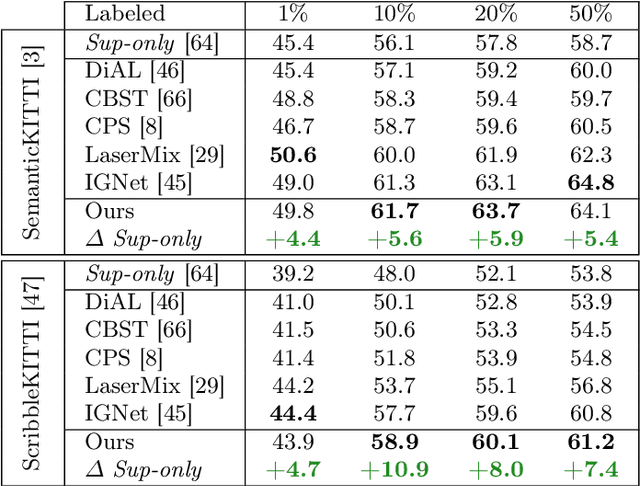
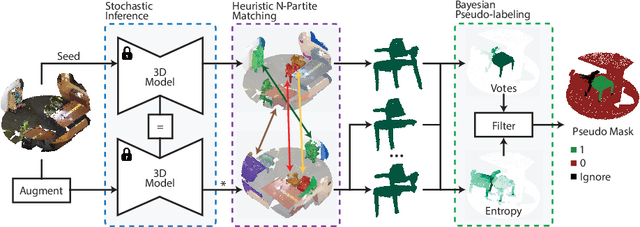
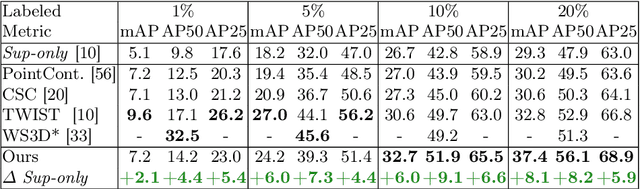
3D segmentation is a core problem in computer vision and, similarly to many other dense prediction tasks, it requires large amounts of annotated data for adequate training. However, densely labeling 3D point clouds to employ fully-supervised training remains too labor intensive and expensive. Semi-supervised training provides a more practical alternative, where only a small set of labeled data is given, accompanied by a larger unlabeled set. This area thus studies the effective use of unlabeled data to reduce the performance gap that arises due to the lack of annotations. In this work, inspired by Bayesian deep learning, we first propose a Bayesian self-training framework for semi-supervised 3D semantic segmentation. Employing stochastic inference, we generate an initial set of pseudo-labels and then filter these based on estimated point-wise uncertainty. By constructing a heuristic $n$-partite matching algorithm, we extend the method to semi-supervised 3D instance segmentation, and finally, with the same building blocks, to dense 3D visual grounding. We demonstrate state-of-the-art results for our semi-supervised method on SemanticKITTI and ScribbleKITTI for 3D semantic segmentation and on ScanNet and S3DIS for 3D instance segmentation. We further achieve substantial improvements in dense 3D visual grounding over supervised-only baselines on ScanRefer. Our project page is available at ouenal.github.io/bst/.
Learning Generative Interactive Environments By Trained Agent Exploration
Sep 10, 2024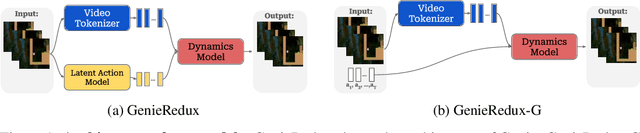


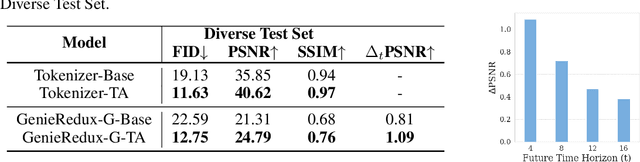
World models are increasingly pivotal in interpreting and simulating the rules and actions of complex environments. Genie, a recent model, excels at learning from visually diverse environments but relies on costly human-collected data. We observe that their alternative method of using random agents is too limited to explore the environment. We propose to improve the model by employing reinforcement learning based agents for data generation. This approach produces diverse datasets that enhance the model's ability to adapt and perform well across various scenarios and realistic actions within the environment. In this paper, we first release the model GenieRedux - an implementation based on Genie. Additionally, we introduce GenieRedux-G, a variant that uses the agent's readily available actions to factor out action prediction uncertainty during validation. Our evaluation, including a replication of the Coinrun case study, shows that GenieRedux-G achieves superior visual fidelity and controllability using the trained agent exploration. The proposed approach is reproducable, scalable and adaptable to new types of environments. Our codebase is available at https://github.com/insait-institute/GenieRedux .
Taming CLIP for Fine-grained and Structured Visual Understanding of Museum Exhibits
Sep 03, 2024CLIP is a powerful and widely used tool for understanding images in the context of natural language descriptions to perform nuanced tasks. However, it does not offer application-specific fine-grained and structured understanding, due to its generic nature. In this work, we aim to adapt CLIP for fine-grained and structured -- in the form of tabular data -- visual understanding of museum exhibits. To facilitate such understanding we (a) collect, curate, and benchmark a dataset of 200K+ image-table pairs, and (b) develop a method that allows predicting tabular outputs for input images. Our dataset is the first of its kind in the public domain. At the same time, the proposed method is novel in leveraging CLIP's powerful representations for fine-grained and tabular understanding. The proposed method (MUZE) learns to map CLIP's image embeddings to the tabular structure by means of a proposed transformer-based parsing network (parseNet). More specifically, parseNet enables prediction of missing attribute values while integrating context from known attribute-value pairs for an input image. We show that this leads to significant improvement in accuracy. Through exhaustive experiments, we show the effectiveness of the proposed method on fine-grained and structured understanding of museum exhibits, by achieving encouraging results in a newly established benchmark. Our dataset and source-code can be found at: https://github.com/insait-institute/MUZE
MICDrop: Masking Image and Depth Features via Complementary Dropout for Domain-Adaptive Semantic Segmentation
Aug 29, 2024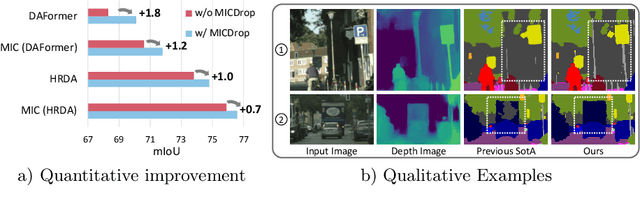
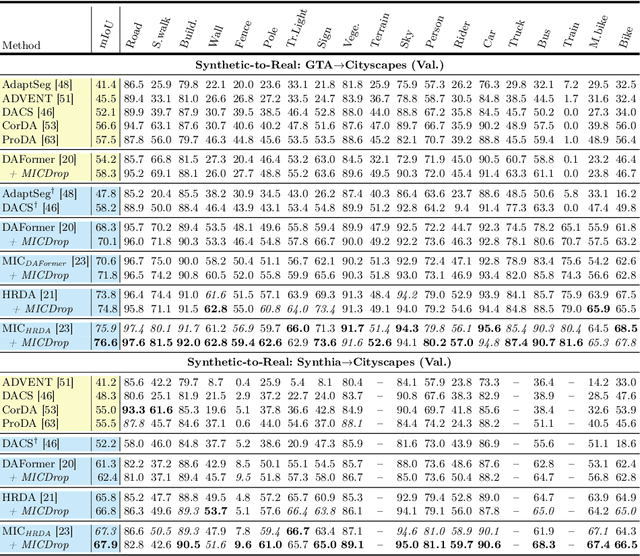
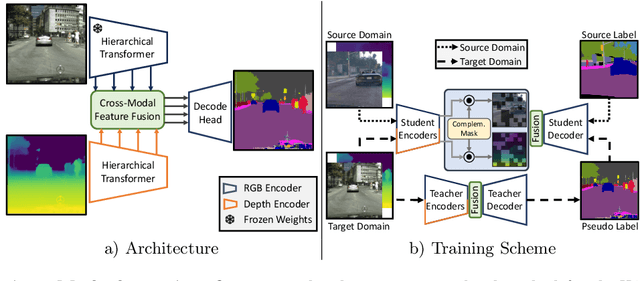

Unsupervised Domain Adaptation (UDA) is the task of bridging the domain gap between a labeled source domain, e.g., synthetic data, and an unlabeled target domain. We observe that current UDA methods show inferior results on fine structures and tend to oversegment objects with ambiguous appearance. To address these shortcomings, we propose to leverage geometric information, i.e., depth predictions, as depth discontinuities often coincide with segmentation boundaries. We show that naively incorporating depth into current UDA methods does not fully exploit the potential of this complementary information. To this end, we present MICDrop, which learns a joint feature representation by masking image encoder features while inversely masking depth encoder features. With this simple yet effective complementary masking strategy, we enforce the use of both modalities when learning the joint feature representation. To aid this process, we propose a feature fusion module to improve both global as well as local information sharing while being robust to errors in the depth predictions. We show that our method can be plugged into various recent UDA methods and consistently improve results across standard UDA benchmarks, obtaining new state-of-the-art performances.