 Add to Chrome
 Add to Firefox
 Add to Edge
ProSR: Process-Shaped Spatial Reasoning for Reliable Chain-of-Thought in VLMs
May 25, 2026
Reliable spatial reasoning remains a core bottleneck for vision-language models (VLMs). Existing mainstream training paradigms for spatial reasoning largely rely on outcome alignment or process imitation, lacking explicit constraints on the reasoning process, and therefore struggle to ensure genuine visual dependence and stable reasoning trajectories. In this paper, we construct a high-quality CoT dataset covering diverse spatial phenomena and diagnose the model's reasoning process, revealing two typical types of process degradation during reinforcement learning optimization: Spurious Grounding, which bypasses visual evidence, and Tail Instability, where uncertainty abnormally rises in the later stage of reasoning. To address these issues, we propose ProSR, a process-shaping optimization framework for spatial reasoning. Through a Counterfactual Invariance Penalty and a Tail Drift Penalty, ProSR extends the optimization objective from single answer correctness to two process-level dimensions: visual dependence and trajectory stability. Experiments on multiple complex and out-of-distribution spatial reasoning benchmarks show that ProSR improves answer accuracy while generating reasoning trajectories that are more stable and more dependent on visual evidence.

DeepSight: Long-Horizon World Modeling via Latent States Prediction for End-to-End Autonomous Driving
May 11, 2026End-to-end autonomous driving systems are increasingly integrating Vision-Language Model (VLM) architectures, incorporating text reasoning or visual reasoning to enhance the robustness and accuracy of driving decisions. However, the reasoning mechanisms employed in most methods are direct adaptations from general domains, lacking in-depth exploration tailored to autonomous driving scenarios, particularly within visual reasoning modules. In this paper, we propose a driving world model that performs parallel prediction of latent semantic features for consecutive future frames in the bird's-eye-view (BEV) space, thereby enabling long-horizon modeling of future world states. We also introduce an efficient and adaptive text reasoning mechanism that utilizes additional social knowledge and reasoning capabilities to further improve driving performance in challenging long-tail scenarios. We present a novel, efficient, and effective approach that achieves state-of-the-art (SOTA) results on the closed-loop Bench2drive benchmark. Codes are available at: https://github.com/hotdogcheesewhite/DeepSight.
MindDriver: Introducing Progressive Multimodal Reasoning for Autonomous Driving
Feb 25, 2026Vision-Language Models (VLM) exhibit strong reasoning capabilities, showing promise for end-to-end autonomous driving systems. Chain-of-Thought (CoT), as VLM's widely used reasoning strategy, is facing critical challenges. Existing textual CoT has a large gap between text semantic space and trajectory physical space. Although the recent approach utilizes future image to replace text as CoT process, it lacks clear planning-oriented objective guidance to generate images with accurate scene evolution. To address these, we innovatively propose MindDriver, a progressive multimodal reasoning framework that enables VLM to imitate human-like progressive thinking for autonomous driving. MindDriver presents semantic understanding, semantic-to-physical space imagination, and physical-space trajectory planning. To achieve aligned reasoning processes in MindDriver, we develop a feedback-guided automatic data annotation pipeline to generate aligned multimodal reasoning training data. Furthermore, we develop a progressive reinforcement fine-tuning method to optimize the alignment through progressive high- level reward-based learning. MindDriver demonstrates superior performance in both nuScences open-loop and Bench2Drive closed-loop evaluation. Codes are available at https://github.com/hotdogcheesewhite/MindDriver.
Brush Your Text: Synthesize Any Scene Text on Images via Diffusion Model
Dec 19, 2023

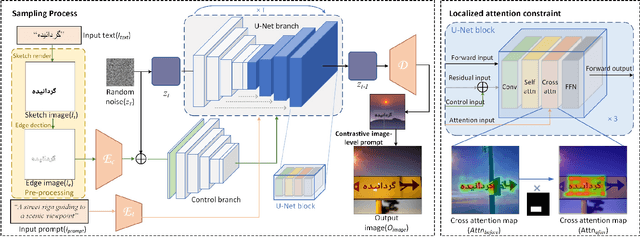

Recently, diffusion-based image generation methods are credited for their remarkable text-to-image generation capabilities, while still facing challenges in accurately generating multilingual scene text images. To tackle this problem, we propose Diff-Text, which is a training-free scene text generation framework for any language. Our model outputs a photo-realistic image given a text of any language along with a textual description of a scene. The model leverages rendered sketch images as priors, thus arousing the potential multilingual-generation ability of the pre-trained Stable Diffusion. Based on the observation from the influence of the cross-attention map on object placement in generated images, we propose a localized attention constraint into the cross-attention layer to address the unreasonable positioning problem of scene text. Additionally, we introduce contrastive image-level prompts to further refine the position of the textual region and achieve more accurate scene text generation. Experiments demonstrate that our method outperforms the existing method in both the accuracy of text recognition and the naturalness of foreground-background blending.
SEINE: Short-to-Long Video Diffusion Model for Generative Transition and Prediction
Nov 06, 2023Recently video generation has achieved substantial progress with realistic results. Nevertheless, existing AI-generated videos are usually very short clips ("shot-level") depicting a single scene. To deliver a coherent long video ("story-level"), it is desirable to have creative transition and prediction effects across different clips. This paper presents a short-to-long video diffusion model, SEINE, that focuses on generative transition and prediction. The goal is to generate high-quality long videos with smooth and creative transitions between scenes and varying lengths of shot-level videos. Specifically, we propose a random-mask video diffusion model to automatically generate transitions based on textual descriptions. By providing the images of different scenes as inputs, combined with text-based control, our model generates transition videos that ensure coherence and visual quality. Furthermore, the model can be readily extended to various tasks such as image-to-video animation and autoregressive video prediction. To conduct a comprehensive evaluation of this new generative task, we propose three assessing criteria for smooth and creative transition: temporal consistency, semantic similarity, and video-text semantic alignment. Extensive experiments validate the effectiveness of our approach over existing methods for generative transition and prediction, enabling the creation of story-level long videos. Project page: https://vchitect.github.io/SEINE-project/ .