 Add to Chrome
 Add to Firefox
 Add to Edge
FM-Bench: A Benchmark for Long-Horizon Management with Competing Agents
Aug 19, 2026
Language model agents now execute bounded tasks reliably. Whether they can sustain effective decision-making over long horizons, where actions have cumulative consequences and the environment responds to their choices, remains largely unmeasured. FM-Bench (Football Management Benchmark) measures this. An LLM agent runs a football club for 20 in-game years through 26 tools and roughly 340 to 400 decision stops. It drafts a squad on the same budget as every rival, trades players, negotiates contracts, invests in facilities and youth, sets lineups, and answers to a board that can fire it, while a deterministic engine accumulates every year into one final score with no LLM judge or human rater. The solo track plays each of 15 frontier models against a frozen scripted world, and the Arena places the same models plus a scripted anchor in one shared 20-year world; to our knowledge, the first head-to-head evaluation at this scale. We measure six behavioral capabilities behind the score. Across three seeds, all 15 models complete every horizon while the blind scripted baselines die out in most of theirs, and claude-fable-5 tops the solo board on mean score and the Arena, where the title nonetheless rotates among ten models. Neither scale, price, nor vendor predicts the order; the order settles only late in the horizon, and the best first-play human lands only at the bottom of the model board. What separates the models is managerial behavior rather than computation. Higher-scoring models reduce slow-payoff investment near the end, keep cash invested rather than idle, and open renewals well before the deadline, while token spend predicts nothing. No model learns the market's hidden prices from hundreds of rejected bids, and self-managed memory fails in two opposite modes: an archive that only grows or a plan rewritten every season. Code is available at https://github.com/Analogy-AI/fm-bench.

Imitation from Heterogeneous Demonstrations using Grounded Latent-Action World Models
Jun 19, 2026Imitation learning has emerged as a powerful paradigm for learning visuomotor policies, but its generalisation and stability are limited by the scale and quality of demonstration data needed. A promising direction is to leverage more abundant but heterogeneous data sources, which differ in action space and often lack action labels altogether. Existing co-training approaches that combine heterogeneous data sources rely on heuristic and hand-engineered alignment techniques. In contrast, we argue that action representations should be grounded in prediction: actions that produce the same effect on the environment should share the same representation, regardless of their sources. To this end, we instantiate this principle by using a grounded latent-action world model (GLAM), a pair of generative models with a shared latent action space across data sources that is grounded by predicting future observations consistently across sources. This latent action space is used to train downstream behavioural cloning (BC) policies which map observations to latent actions and decode them back to robot actions, providing a paradigm for learning from heterogeneous data. Empirically, we demonstrate that GLAM successfully learns an aligned latent action space that facilitates action transfer across data sources with and without action labels. Across five manipulation tasks in simulation and in the real world, GLAM-aligned policies significantly outperform BC baselines and prior latent-action methods, achieving an average of +48% improvement in task success rate with the same data-scarce setting. Videos and code are available at https://viccccciv.github.io/glam/.
Zero-shot Reconstruction of In-Scene Object Manipulation from Video
Dec 22, 2025


We build the first system to address the problem of reconstructing in-scene object manipulation from a monocular RGB video. It is challenging due to ill-posed scene reconstruction, ambiguous hand-object depth, and the need for physically plausible interactions. Existing methods operate in hand centric coordinates and ignore the scene, hindering metric accuracy and practical use. In our method, we first use data-driven foundation models to initialize the core components, including the object mesh and poses, the scene point cloud, and the hand poses. We then apply a two-stage optimization that recovers a complete hand-object motion from grasping to interaction, which remains consistent with the scene information observed in the input video.
ZeroMimic: Distilling Robotic Manipulation Skills from Web Videos
Mar 31, 2025


Many recent advances in robotic manipulation have come through imitation learning, yet these rely largely on mimicking a particularly hard-to-acquire form of demonstrations: those collected on the same robot in the same room with the same objects as the trained policy must handle at test time. In contrast, large pre-recorded human video datasets demonstrating manipulation skills in-the-wild already exist, which contain valuable information for robots. Is it possible to distill a repository of useful robotic skill policies out of such data without any additional requirements on robot-specific demonstrations or exploration? We present the first such system ZeroMimic, that generates immediately deployable image goal-conditioned skill policies for several common categories of manipulation tasks (opening, closing, pouring, pick&place, cutting, and stirring) each capable of acting upon diverse objects and across diverse unseen task setups. ZeroMimic is carefully designed to exploit recent advances in semantic and geometric visual understanding of human videos, together with modern grasp affordance detectors and imitation policy classes. After training ZeroMimic on the popular EpicKitchens dataset of ego-centric human videos, we evaluate its out-of-the-box performance in varied real-world and simulated kitchen settings with two different robot embodiments, demonstrating its impressive abilities to handle these varied tasks. To enable plug-and-play reuse of ZeroMimic policies on other task setups and robots, we release software and policy checkpoints of our skill policies.
A Method for Arbitrary Instance Style Transfer
Dec 13, 2019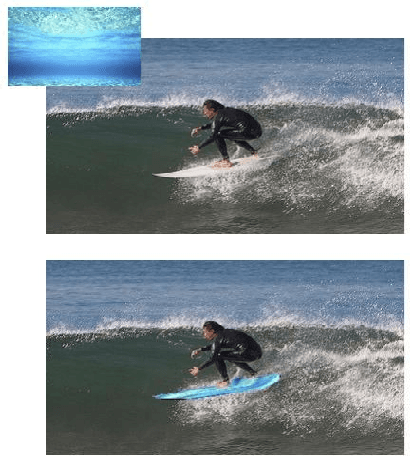
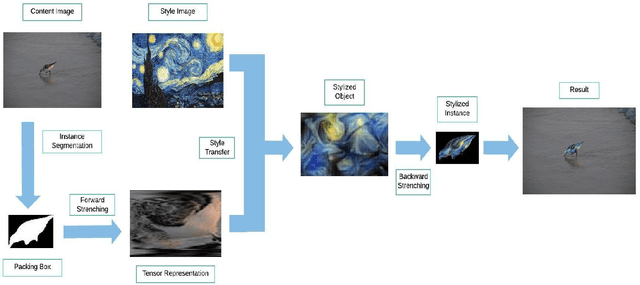
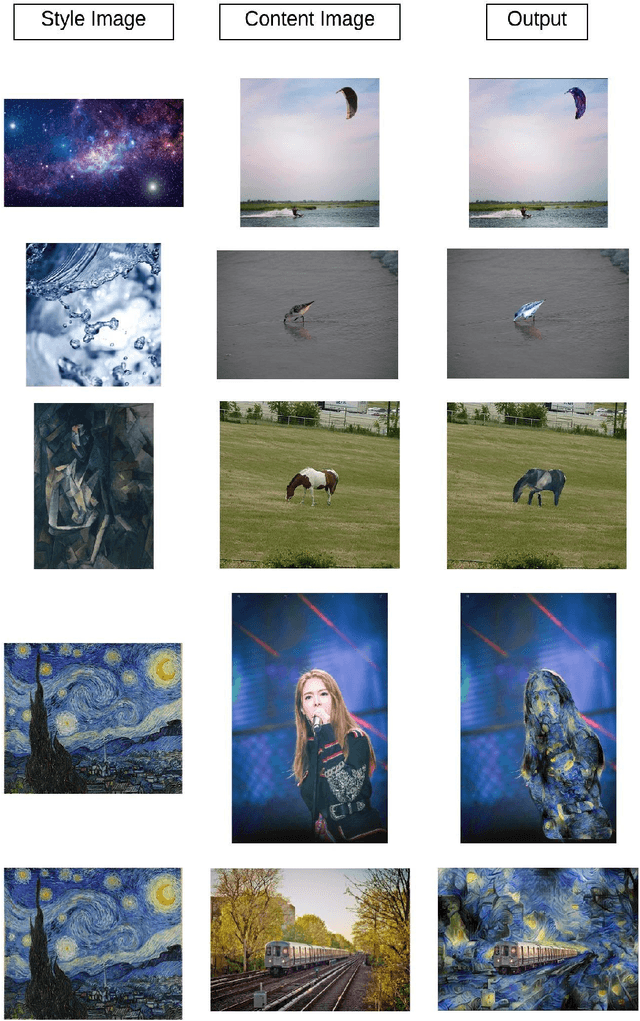
The ability to synthesize style and content of different images to form a visually coherent image holds great promise in various applications such as stylistic painting, design prototyping, image editing, and augmented reality. However, the majority of works in image style transfer have focused on transferring the style of an image to the entirety of another image, and only a very small number of works have experimented on methods to transfer style to an instance of another image. Researchers have proposed methods to circumvent the difficulty of transferring style to an instance in an arbitrary shape. In this paper, we propose a topologically inspired algorithm called Forward Stretching to tackle this problem by transforming an instance into a tensor representation, which allows us to transfer style to this instance itself directly. Forward Stretching maps pixels to specific positions and interpolate values between pixels to transform an instance to a tensor. This algorithm allows us to introduce a method to transfer arbitrary style to an instance in an arbitrary shape. We showcase the results of our method in this paper.