 Add to Chrome
 Add to Firefox
 Add to Edge
Imaginative Perception Tokens Enhance Spatial Reasoning in Multimodal Language Models
Jun 03, 2026
Vision language models (VLMs) excel at many tasks but still struggle with spatial reasoning when critical information is not directly observable. Many such problems require imaginative perception: inferring what would be seen from an unseen viewpoint, tracing paths through occluded spaces, or integrating partial observations into a coherent spatial representation. We introduce Imaginative Perception Tokens (IPT), intermediate perceptual representations that externalize what a VLM would perceive under alternative spatial configurations while remaining consistent with the observed input. To study this capability, we formulate three tasks, Perspective Taking (PET), Path Tracing (PT), and Multiview Counting (MVC), and construct datasets of approximately 20K examples with ground truth imaginations, answers, and evaluation benchmarks. Using the unified VLM BAGEL as the backbone, IPT supervision consistently improves spatial reasoning and often outperforms textual chain of thought training, even without generating images at inference time. On MVC, IPT improves accuracy by 3.4% and achieves competitive performance with strong closed-source models on PT. We further find that combining IPT and label-only supervision yields additional gains, whereas textual chain of thought can substantially degrade performance, suggesting a modality mismatch when spatial computation is forced through language. Overall, IPT provides a principled supervision signal for reasoning about unobserved spatial structure, improving generalization while producing interpretable intermediate representations.

Ablate-to-Validate: Are Vision-Language Models Really Using Continuous Thought Tokens?
May 20, 2026Vision-language models (VLMs) are increasingly augmented with continuous or latent non-textual tokens intended to support "visual thinking." Despite improved task accuracy, this alone does not show that models actually use these tokens for reasoning -- gains may arise from confounds such as added context length, special-token anchoring, or training-time regularization. We formalize a diagnostic principle, Ablate-to-Validate, for testing whether latent-token content is genuinely utilized, and instantiate it as the Token Replacement Test (TRT), a standardized suite of content-replacement ablations. TRT holds the prompt, image, token budget, and decoding fixed while replacing intermediate tokens with zero, random, first-repeat, or oracle alternatives, isolating whether performance depends on token content or merely on token presence. As a controlled testbed, we study relative depth reasoning with LLaVA-13B and Qwen2.5-VL-3B, training models to predict and consume continuous or discrete depth spans across multiple frozen encoders (SigLIP2, CLIP, DINOv2) and token budgets. We additionally apply TRT to three off-the-shelf visual-thinking systems (Mirage, Mull-Tokens, CoVT) on BLINK, VSP, and CV-Bench. Across all settings, accuracy gains are a misleading proxy for latent-token reasoning: VLMs retain most improvement even when token content is corrupted or replaced, revealing a persistent gap between having a latent channel and using it as an information bottleneck. We recommend TRT as a standard diagnostic alongside accuracy for any method introducing continuous thought tokens.
Unfolding Spatial Cognition: Evaluating Multimodal Models on Visual Simulations
Jun 05, 2025Spatial cognition is essential for human intelligence, enabling problem-solving through visual simulations rather than solely relying on verbal reasoning. However, existing AI benchmarks primarily assess verbal reasoning, neglecting the complexities of non-verbal, multi-step visual simulation. We introduce STARE(Spatial Transformations and Reasoning Evaluation), a benchmark designed to rigorously evaluate multimodal large language models on tasks better solved through multi-step visual simulation. STARE features 4K tasks spanning foundational geometric transformations (2D and 3D), integrated spatial reasoning (cube net folding and tangram puzzles), and real-world spatial reasoning (perspective and temporal reasoning), reflecting practical cognitive challenges like object assembly, mechanical diagram interpretation, and everyday spatial navigation. Our evaluations show that models excel at reasoning over simpler 2D transformations, but perform close to random chance on more complex tasks like 3D cube net folding and tangram puzzles that require multi-step visual simulations. Humans achieve near-perfect accuracy but take considerable time (up to 28.9s) on complex tasks, significantly speeding up (down by 7.5 seconds on average) with intermediate visual simulations. In contrast, models exhibit inconsistent performance gains from visual simulations, improving on most tasks but declining in specific cases like tangram puzzles (GPT-4o, o1) and cube net folding (Claude-3.5, Gemini-2.0 Flash), indicating that models may not know how to effectively leverage intermediate visual information.
Perception Tokens Enhance Visual Reasoning in Multimodal Language Models
Dec 04, 2024Multimodal language models (MLMs) still face challenges in fundamental visual perception tasks where specialized models excel. Tasks requiring reasoning about 3D structures benefit from depth estimation, and reasoning about 2D object instances benefits from object detection. Yet, MLMs can not produce intermediate depth or boxes to reason over. Finetuning MLMs on relevant data doesn't generalize well and outsourcing computation to specialized vision tools is too compute-intensive and memory-inefficient. To address this, we introduce Perception Tokens, intrinsic image representations designed to assist reasoning tasks where language is insufficient. Perception tokens act as auxiliary reasoning tokens, akin to chain-of-thought prompts in language models. For example, in a depth-related task, an MLM augmented with perception tokens can reason by generating a depth map as tokens, enabling it to solve the problem effectively. We propose AURORA, a training method that augments MLMs with perception tokens for improved reasoning over visual inputs. AURORA leverages a VQVAE to transform intermediate image representations, such as depth maps into a tokenized format and bounding box tokens, which is then used in a multi-task training framework. AURORA achieves notable improvements across counting benchmarks: +10.8% on BLINK, +11.3% on CVBench, and +8.3% on SEED-Bench, outperforming finetuning approaches in generalization across datasets. It also improves on relative depth: over +6% on BLINK. With perception tokens, AURORA expands the scope of MLMs beyond language-based reasoning, paving the way for more effective visual reasoning capabilities.
Gene-Level Representation Learning via Interventional Style Transfer in Optical Pooled Screening
Jun 11, 2024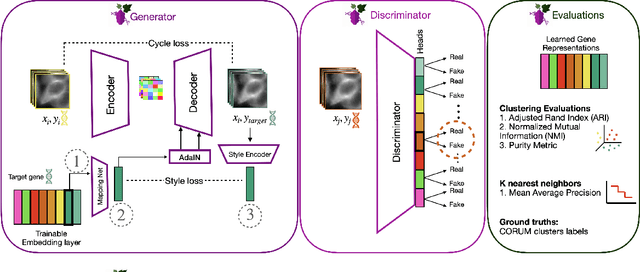

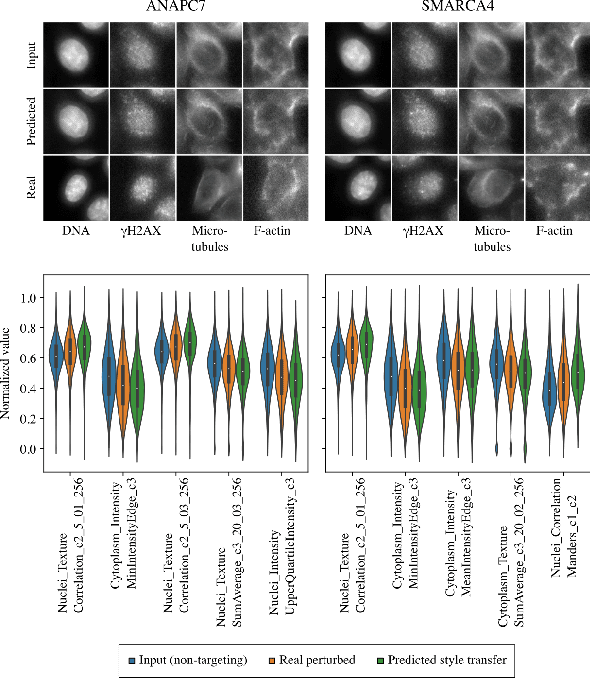

Optical pooled screening (OPS) combines automated microscopy and genetic perturbations to systematically study gene function in a scalable and cost-effective way. Leveraging the resulting data requires extracting biologically informative representations of cellular perturbation phenotypes from images. We employ a style-transfer approach to learn gene-level feature representations from images of genetically perturbed cells obtained via OPS. Our method outperforms widely used engineered features in clustering gene representations according to gene function, demonstrating its utility for uncovering latent biological relationships. This approach offers a promising alternative to investigate the role of genes in health and disease.
Data Alignment for Zero-Shot Concept Generation in Dermatology AI
Apr 19, 2024


AI in dermatology is evolving at a rapid pace but the major limitation to training trustworthy classifiers is the scarcity of data with ground-truth concept level labels, which are meta-labels semantically meaningful to humans. Foundation models like CLIP providing zero-shot capabilities can help alleviate this challenge by leveraging vast amounts of image-caption pairs available on the internet. CLIP can be fine-tuned using domain specific image-caption pairs to improve classification performance. However, CLIP's pre-training data is not well-aligned with the medical jargon that clinicians use to perform diagnoses. The development of large language models (LLMs) in recent years has led to the possibility of leveraging the expressive nature of these models to generate rich text. Our goal is to use these models to generate caption text that aligns well with both the clinical lexicon and with the natural human language used in CLIP's pre-training data. Starting with captions used for images in PubMed articles, we extend them by passing the raw captions through an LLM fine-tuned on the field's several textbooks. We find that using captions generated by an expressive fine-tuned LLM like GPT-3.5 improves downstream zero-shot concept classification performance.
MIMIC: Masked Image Modeling with Image Correspondences
Jun 28, 2023Many pixelwise dense prediction tasks-depth estimation and semantic segmentation in computer vision today rely on pretrained image representations. Therefore, curating effective pretraining datasets is vital. Unfortunately, the effective pretraining datasets are those with multi-view scenes and have only been curated using annotated 3D meshes, point clouds, and camera parameters from simulated environments. We propose a dataset-curation mechanism that does not require any annotations. We mine two datasets: MIMIC-1M with 1.3M and MIMIC-3M with 3.1M multi-view image pairs from open-sourced video datasets and from synthetic 3D environments. We train multiple self-supervised models with different masked image modeling objectives to showcase the following findings: Representations trained on MIMIC-3M outperform those mined using annotations on multiple downstream tasks, including depth estimation, semantic segmentation, surface normals, and pose estimation. They also outperform representations that are frozen and when downstream training data is limited to few-shot. Larger dataset (MIMIC-3M) significantly improves performance, which is promising since our curation method can arbitrarily scale to produce even larger datasets. MIMIC code, dataset, and pretrained models are open-sourced at https://github.com/RAIVNLab/MIMIC.