 Add to Chrome
 Add to Firefox
 Add to Edge
MolmoMotion: Forecasting Point Trajectories in 3D with Language Instruction
Jun 17, 2026
Motion forecasting is central to visual intelligence: agents must anticipate how objects will move in order to plan actions, reason about physical interactions, and synthesize realistic futures. We argue that 3D points in world coordinates provide a general representation that is class-agnostic, view-stable, compact, and directly useful for downstream tasks. We formalize the task of goal-conditioned 3D point motion forecasting: given a short visual history, a set of 3D query points on an object of interest, and a language description of the intended goal, the model predicts the future 3D trajectory of each point. We introduce a full stack to study this task at scale: (1) MolmoMotion-1M is a large corpus of action-described, object-grounded 3D point trajectories annotated from 1.16M unconstrained videos; (2) PointMotionBench is a human-verified benchmark spanning 111 object categories and 61 motion types; and (3) MolmoMotion is a general motion forecasting model that supports both autoregressive coordinate prediction and flow-matching-based trajectory generation. MolmoMotion accurately predicts diverse motion patterns with different language instructions, and significantly outperforms existing motion prediction baselines on PointMotionBench. Finally, we show that the learned 3D motion prior transfers well to downstream applications: it improves training efficiency and generalization for robot manipulation, and its predicted trajectories provide effective motion guidance for generative models to synthesize videos with more realistic object motion.

WildDet3D: Scaling Promptable 3D Detection in the Wild
Apr 09, 2026Understanding objects in 3D from a single image is a cornerstone of spatial intelligence. A key step toward this goal is monocular 3D object detection--recovering the extent, location, and orientation of objects from an input RGB image. To be practical in the open world, such a detector must generalize beyond closed-set categories, support diverse prompt modalities, and leverage geometric cues when available. Progress is hampered by two bottlenecks: existing methods are designed for a single prompt type and lack a mechanism to incorporate additional geometric cues, and current 3D datasets cover only narrow categories in controlled environments, limiting open-world transfer. In this work we address both gaps. First, we introduce WildDet3D, a unified geometry-aware architecture that natively accepts text, point, and box prompts and can incorporate auxiliary depth signals at inference time. Second, we present WildDet3D-Data, the largest open 3D detection dataset to date, constructed by generating candidate 3D boxes from existing 2D annotations and retaining only human-verified ones, yielding over 1M images across 13.5K categories in diverse real-world scenes. WildDet3D establishes a new state-of-the-art across multiple benchmarks and settings. In the open-world setting, it achieves 22.6/24.8 AP3D on our newly introduced WildDet3D-Bench with text and box prompts. On Omni3D, it reaches 34.2/36.4 AP3D with text and box prompts, respectively. In zero-shot evaluation, it achieves 40.3/48.9 ODS on Argoverse 2 and ScanNet. Notably, incorporating depth cues at inference time yields substantial additional gains (+20.7 AP on average across settings).
CrossFusion: A Multi-Scale Cross-Attention Convolutional Fusion Model for Cancer Survival Prediction
Mar 03, 2025Cancer survival prediction from whole slide images (WSIs) is a challenging task in computational pathology due to the large size, irregular shape, and high granularity of the WSIs. These characteristics make it difficult to capture the full spectrum of patterns, from subtle cellular abnormalities to complex tissue interactions, which are crucial for accurate prognosis. To address this, we propose CrossFusion, a novel multi-scale feature integration framework that extracts and fuses information from patches across different magnification levels. By effectively modeling both scale-specific patterns and their interactions, CrossFusion generates a rich feature set that enhances survival prediction accuracy. We validate our approach across six cancer types from public datasets, demonstrating significant improvements over existing state-of-the-art methods. Moreover, when coupled with domain-specific feature extraction backbones, our method shows further gains in prognostic performance compared to general-purpose backbones. The source code is available at: https://github.com/RustinS/CrossFusion
PathFinder: A Multi-Modal Multi-Agent System for Medical Diagnostic Decision-Making Applied to Histopathology
Feb 13, 2025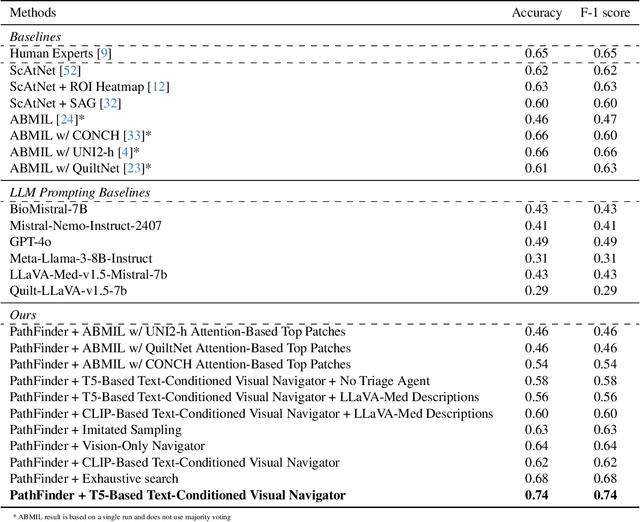
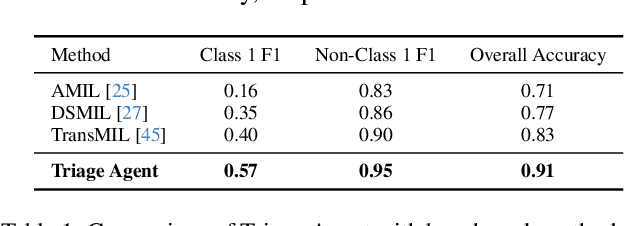

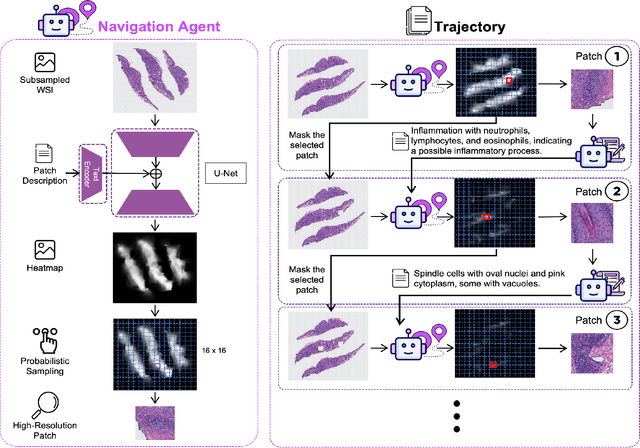
Diagnosing diseases through histopathology whole slide images (WSIs) is fundamental in modern pathology but is challenged by the gigapixel scale and complexity of WSIs. Trained histopathologists overcome this challenge by navigating the WSI, looking for relevant patches, taking notes, and compiling them to produce a final holistic diagnostic. Traditional AI approaches, such as multiple instance learning and transformer-based models, fail short of such a holistic, iterative, multi-scale diagnostic procedure, limiting their adoption in the real-world. We introduce PathFinder, a multi-modal, multi-agent framework that emulates the decision-making process of expert pathologists. PathFinder integrates four AI agents, the Triage Agent, Navigation Agent, Description Agent, and Diagnosis Agent, that collaboratively navigate WSIs, gather evidence, and provide comprehensive diagnoses with natural language explanations. The Triage Agent classifies the WSI as benign or risky; if risky, the Navigation and Description Agents iteratively focus on significant regions, generating importance maps and descriptive insights of sampled patches. Finally, the Diagnosis Agent synthesizes the findings to determine the patient's diagnostic classification. Our Experiments show that PathFinder outperforms state-of-the-art methods in skin melanoma diagnosis by 8% while offering inherent explainability through natural language descriptions of diagnostically relevant patches. Qualitative analysis by pathologists shows that the Description Agent's outputs are of high quality and comparable to GPT-4o. PathFinder is also the first AI-based system to surpass the average performance of pathologists in this challenging melanoma classification task by 9%, setting a new record for efficient, accurate, and interpretable AI-assisted diagnostics in pathology. Data, code and models available at https://pathfinder-dx.github.io/