 Add to Chrome
 Add to Firefox
 Add to Edge
Chain-of-Procedure: Hierarchical Visual-Language Reasoning for Procedural QA
May 14, 2026
Recent advances in vision-language models (VLMs) have achieved impressive results on standard image-text tasks, yet their potential for visual procedure question answering (VP-QA) remains largely unexplored. VP-QA presents unique challenges where users query next-step actions by uploading images for intermediate states of complex procedures. To systematically evaluate VLMs on this practical task, we propose ProcedureVQA, a novel multimodal benchmark specifically designed for visual procedural reasoning. Through comprehensive analysis, we identify two critical limitations in current VLMs: inadequate cross-modal retrieval of structured procedures given visual states, and misalignment between image sequence granularity and textual step decomposition. To address these issues, we present Chain-of-Procedure (CoP), a hierarchical reasoning framework that first retrieves relevant instructions using visual cues, then performs step refinement through semantic decomposition, and finally generates the next step. Experiments across six VLMs demonstrate CoP's effectiveness, achieving up to 13% absolute improvement over standard baselines.

Not All LoRA Parameters Are Essential: Insights on Inference Necessity
Mar 30, 2025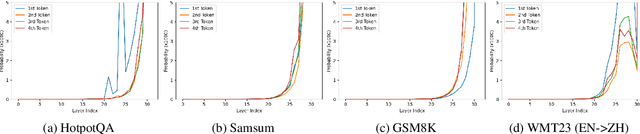
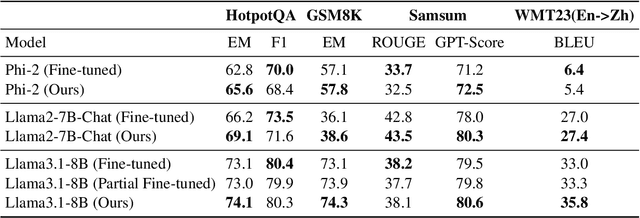

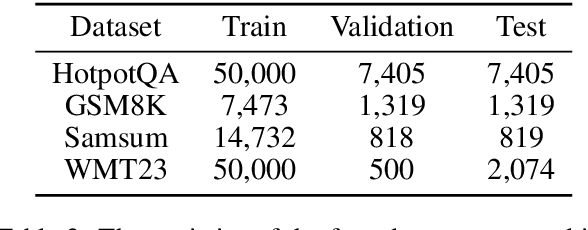
Current research on LoRA primarily focuses on minimizing the number of fine-tuned parameters or optimizing its architecture. However, the necessity of all fine-tuned LoRA layers during inference remains underexplored. In this paper, we investigate the contribution of each LoRA layer to the model's ability to predict the ground truth and hypothesize that lower-layer LoRA modules play a more critical role in model reasoning and understanding. To address this, we propose a simple yet effective method to enhance the performance of large language models (LLMs) fine-tuned with LoRA. Specifically, we identify a ``boundary layer'' that distinguishes essential LoRA layers by analyzing a small set of validation samples. During inference, we drop all LoRA layers beyond this boundary. We evaluate our approach on three strong baselines across four widely-used text generation datasets. Our results demonstrate consistent and significant improvements, underscoring the effectiveness of selectively retaining critical LoRA layers during inference.