 Add to Chrome
 Add to Firefox
 Add to Edge
Beyond LLaVA-HD: Diving into High-Resolution Large Multimodal Models
Jun 12, 2024
Seeing clearly with high resolution is a foundation of Large Multimodal Models (LMMs), which has been proven to be vital for visual perception and reasoning. Existing works usually employ a straightforward resolution upscaling method, where the image consists of global and local branches, with the latter being the sliced image patches but resized to the same resolution as the former. This means that higher resolution requires more local patches, resulting in exorbitant computational expenses, and meanwhile, the dominance of local image tokens may diminish the global context. In this paper, we dive into the problems and propose a new framework as well as an elaborate optimization strategy. Specifically, we extract contextual information from the global view using a mixture of adapters, based on the observation that different adapters excel at different tasks. With regard to local patches, learnable query embeddings are introduced to reduce image tokens, the most important tokens accounting for the user question will be further selected by a similarity-based selector. Our empirical results demonstrate a `less is more' pattern, where \textit{utilizing fewer but more informative local image tokens leads to improved performance}. Besides, a significant challenge lies in the training strategy, as simultaneous end-to-end training of the global mining block and local compression block does not yield optimal results. We thus advocate for an alternating training way, ensuring balanced learning between global and local aspects. Finally, we also introduce a challenging dataset with high requirements for image detail, enhancing the training of the local compression layer. The proposed method, termed LMM with Sophisticated Tasks, Local image compression, and Mixture of global Experts (SliME), achieves leading performance across various benchmarks with only 2 million training data.

Interpretable Multimodal Out-of-context Detection with Soft Logic Regularization
Jun 07, 2024

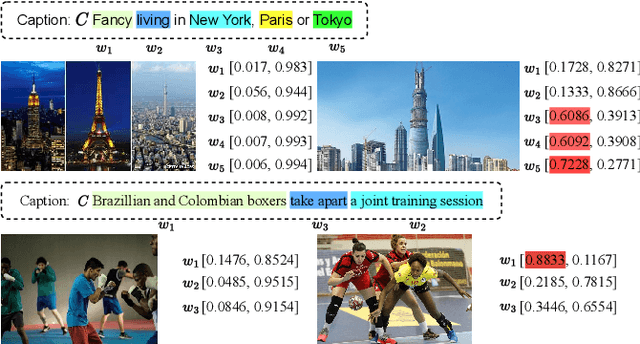
The rapid spread of information through mobile devices and media has led to the widespread of false or deceptive news, causing significant concerns in society. Among different types of misinformation, image repurposing, also known as out-of-context misinformation, remains highly prevalent and effective. However, current approaches for detecting out-of-context misinformation often lack interpretability and offer limited explanations. In this study, we propose a logic regularization approach for out-of-context detection called LOGRAN (LOGic Regularization for out-of-context ANalysis). The primary objective of LOGRAN is to decompose the out-of-context detection at the phrase level. By employing latent variables for phrase-level predictions, the final prediction of the image-caption pair can be aggregated using logical rules. The latent variables also provide an explanation for how the final result is derived, making this fine-grained detection method inherently explanatory. We evaluate the performance of LOGRAN on the NewsCLIPpings dataset, showcasing competitive overall results. Visualized examples also reveal faithful phrase-level predictions of out-of-context images, accompanied by explanations. This highlights the effectiveness of our approach in addressing out-of-context detection and enhancing interpretability.
Less is More: Pseudo-Label Filtering for Continual Test-Time Adaptation
Jun 03, 2024Continual Test-Time Adaptation (CTTA) aims to adapt a pre-trained model to a sequence of target domains during the test phase without accessing the source data. To adapt to unlabeled data from unknown domains, existing methods rely on constructing pseudo-labels for all samples and updating the model through self-training. However, these pseudo-labels often involve noise, leading to insufficient adaptation. To improve the quality of pseudo-labels, we propose a pseudo-label selection method for CTTA, called Pseudo Labeling Filter (PLF). The key idea of PLF is to keep selecting appropriate thresholds for pseudo-labels and identify reliable ones for self-training. Specifically, we present three principles for setting thresholds during continuous domain learning, including initialization, growth and diversity. Based on these principles, we design Self-Adaptive Thresholding to filter pseudo-labels. Additionally, we introduce a Class Prior Alignment (CPA) method to encourage the model to make diverse predictions for unknown domain samples. Through extensive experiments, PLF outperforms current state-of-the-art methods, proving its effectiveness in CTTA.
Controllable Continual Test-Time Adaptation
May 23, 2024

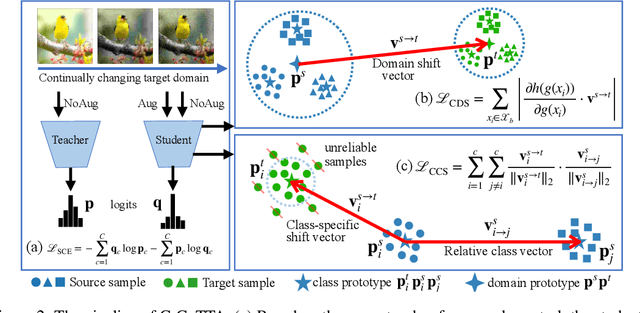

Continual Test-Time Adaptation (CTTA) is an emerging and challenging task where a model trained in a source domain must adapt to continuously changing conditions during testing, without access to the original source data. CTTA is prone to error accumulation due to uncontrollable domain shifts, leading to blurred decision boundaries between categories. Existing CTTA methods primarily focus on suppressing domain shifts, which proves inadequate during the unsupervised test phase. In contrast, we introduce a novel approach that guides rather than suppresses these shifts. Specifically, we propose $\textbf{C}$ontrollable $\textbf{Co}$ntinual $\textbf{T}$est-$\textbf{T}$ime $\textbf{A}$daptation (C-CoTTA), which explicitly prevents any single category from encroaching on others, thereby mitigating the mutual influence between categories caused by uncontrollable shifts. Moreover, our method reduces the sensitivity of model to domain transformations, thereby minimizing the magnitude of category shifts. Extensive quantitative experiments demonstrate the effectiveness of our method, while qualitative analyses, such as t-SNE plots, confirm the theoretical validity of our approach.
Overcoming Domain Drift in Online Continual Learning
May 15, 2024
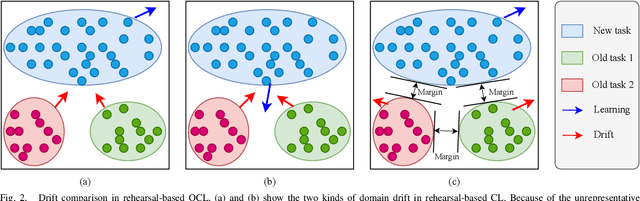
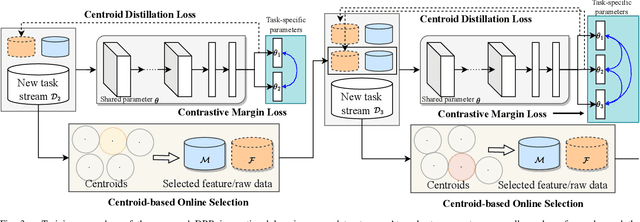
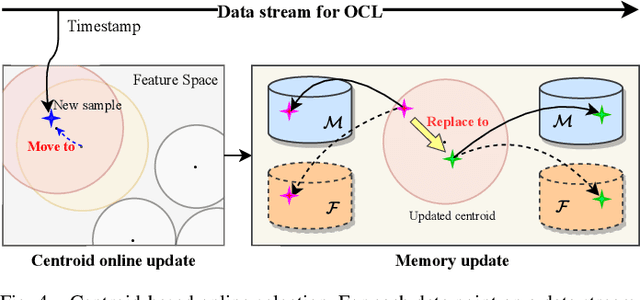
Online Continual Learning (OCL) empowers machine learning models to acquire new knowledge online across a sequence of tasks. However, OCL faces a significant challenge: catastrophic forgetting, wherein the model learned in previous tasks is substantially overwritten upon encountering new tasks, leading to a biased forgetting of prior knowledge. Moreover, the continual doman drift in sequential learning tasks may entail the gradual displacement of the decision boundaries in the learned feature space, rendering the learned knowledge susceptible to forgetting. To address the above problem, in this paper, we propose a novel rehearsal strategy, termed Drift-Reducing Rehearsal (DRR), to anchor the domain of old tasks and reduce the negative transfer effects. First, we propose to select memory for more representative samples guided by constructed centroids in a data stream. Then, to keep the model from domain chaos in drifting, a two-level angular cross-task Contrastive Margin Loss (CML) is proposed, to encourage the intra-class and intra-task compactness, and increase the inter-class and inter-task discrepancy. Finally, to further suppress the continual domain drift, we present an optional Centorid Distillation Loss (CDL) on the rehearsal memory to anchor the knowledge in feature space for each previous old task. Extensive experimental results on four benchmark datasets validate that the proposed DRR can effectively mitigate the continual domain drift and achieve the state-of-the-art (SOTA) performance in OCL.
Transformer-based RGB-T Tracking with Channel and Spatial Feature Fusion
May 06, 2024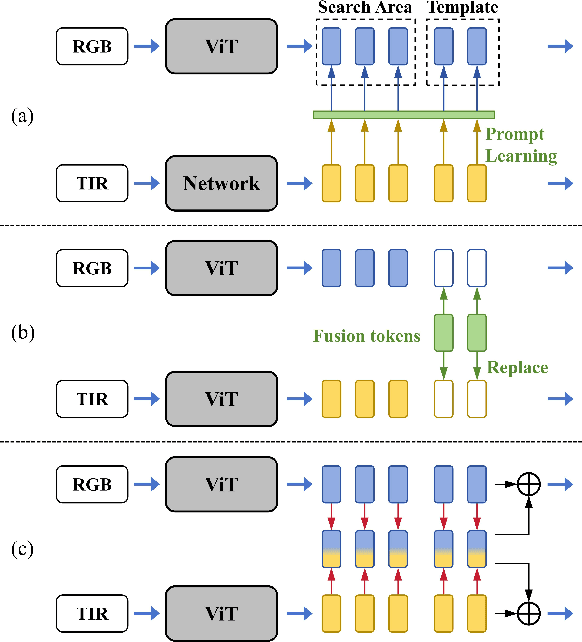

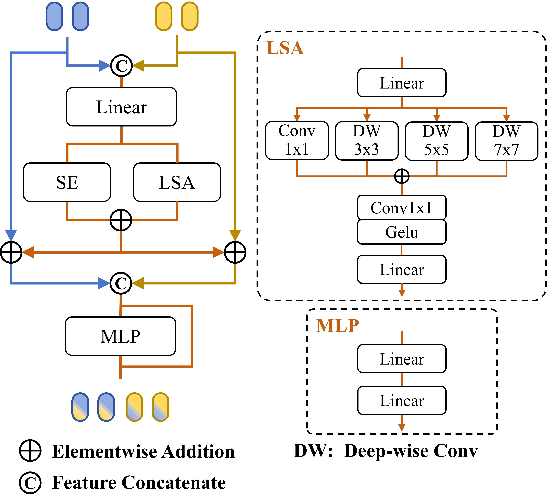
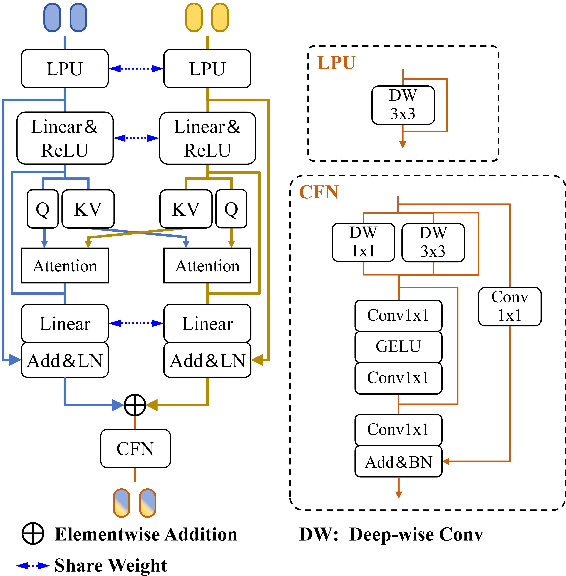
Complementary RGB and TIR modalities enable RGB-T tracking to achieve competitive performance in challenging scenarios. Therefore, how to better fuse cross-modal features is the core issue of RGB-T tracking. Some previous methods either insufficiently fuse RGB and TIR features, or depend on intermediaries containing information from both modalities to achieve cross-modal information interaction. The former does not fully exploit the potential of using only RGB and TIR information of the template or search region for channel and spatial feature fusion, and the latter lacks direct interaction between the template and search area, which limits the model's ability to fully exploit the original semantic information of both modalities. To alleviate these limitations, we explore how to improve the performance of a visual Transformer by using direct fusion of cross-modal channels and spatial features, and propose CSTNet. CSTNet uses ViT as a backbone and inserts cross-modal channel feature fusion modules (CFM) and cross-modal spatial feature fusion modules (SFM) for direct interaction between RGB and TIR features. The CFM performs parallel joint channel enhancement and joint multilevel spatial feature modeling of RGB and TIR features and sums the features, and then globally integrates the sum feature with the original features. The SFM uses cross-attention to model the spatial relationship of cross-modal features and then introduces a convolutional feedforward network for joint spatial and channel integration of multimodal features. Comprehensive experiments show that CSTNet achieves state-of-the-art performance on three public RGB-T tracking benchmarks. Code is available at https://github.com/LiYunfengLYF/CSTNet.
AnchorGT: Efficient and Flexible Attention Architecture for Scalable Graph Transformers
May 06, 2024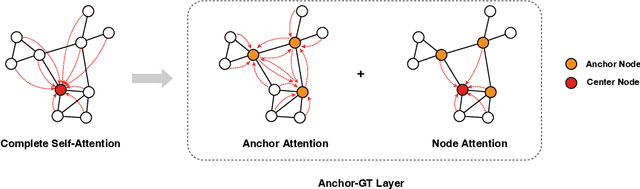
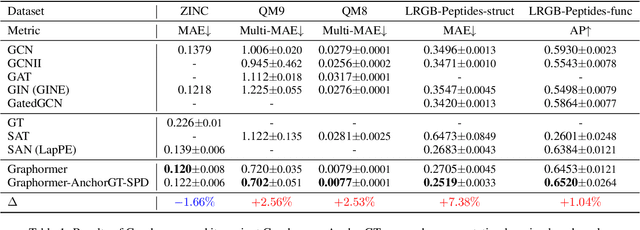
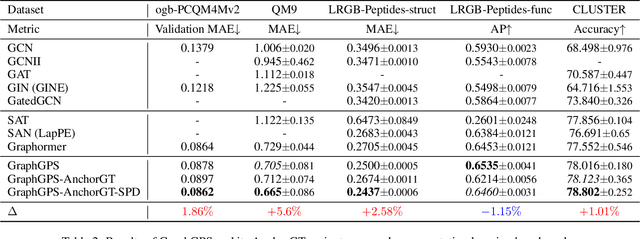
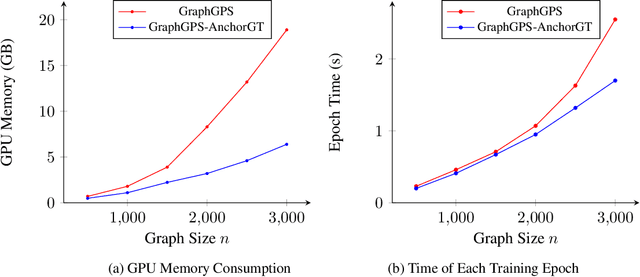
Graph Transformers (GTs) have significantly advanced the field of graph representation learning by overcoming the limitations of message-passing graph neural networks (GNNs) and demonstrating promising performance and expressive power. However, the quadratic complexity of self-attention mechanism in GTs has limited their scalability, and previous approaches to address this issue often suffer from expressiveness degradation or lack of versatility. To address this issue, we propose AnchorGT, a novel attention architecture for GTs with global receptive field and almost linear complexity, which serves as a flexible building block to improve the scalability of a wide range of GT models. Inspired by anchor-based GNNs, we employ structurally important $k$-dominating node set as anchors and design an attention mechanism that focuses on the relationship between individual nodes and anchors, while retaining the global receptive field for all nodes. With its intuitive design, AnchorGT can easily replace the attention module in various GT models with different network architectures and structural encodings, resulting in reduced computational overhead without sacrificing performance. In addition, we theoretically prove that AnchorGT attention can be strictly more expressive than Weisfeiler-Lehman test, showing its superiority in representing graph structures. Our experiments on three state-of-the-art GT models demonstrate that their AnchorGT variants can achieve better results while being faster and significantly more memory efficient.
Semantic Evolvement Enhanced Graph Autoencoder for Rumor Detection
Apr 24, 2024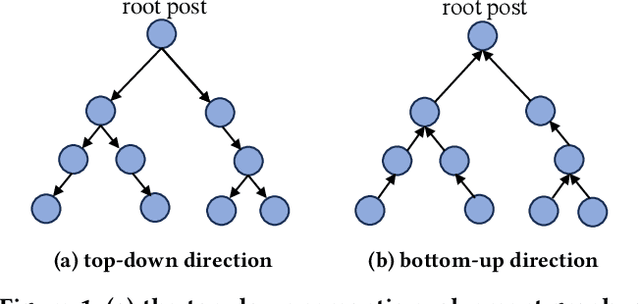
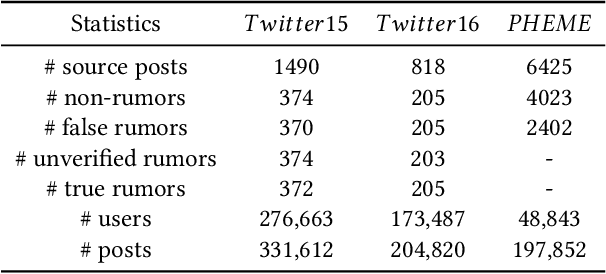

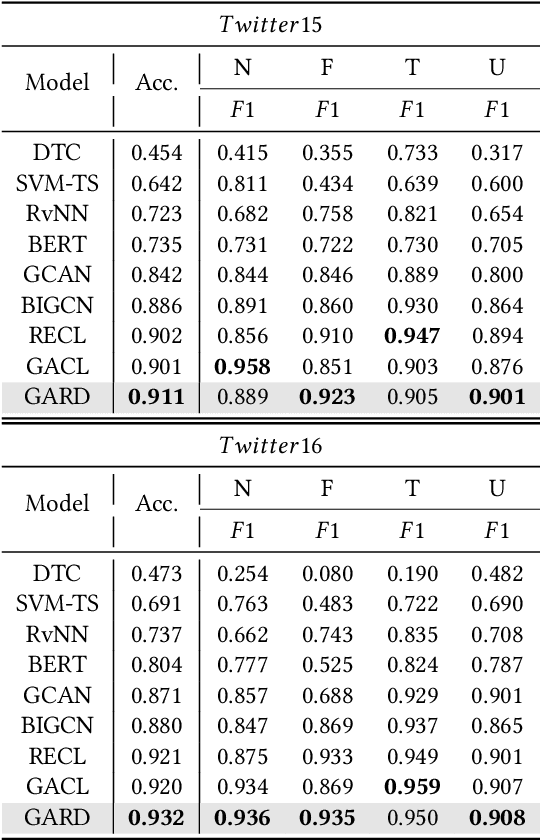
Due to the rapid spread of rumors on social media, rumor detection has become an extremely important challenge. Recently, numerous rumor detection models which utilize textual information and the propagation structure of events have been proposed. However, these methods overlook the importance of semantic evolvement information of event in propagation process, which is often challenging to be truly learned in supervised training paradigms and traditional rumor detection methods. To address this issue, we propose a novel semantic evolvement enhanced Graph Autoencoder for Rumor Detection (GARD) model in this paper. The model learns semantic evolvement information of events by capturing local semantic changes and global semantic evolvement information through specific graph autoencoder and reconstruction strategies. By combining semantic evolvement information and propagation structure information, the model achieves a comprehensive understanding of event propagation and perform accurate and robust detection, while also detecting rumors earlier by capturing semantic evolvement information in the early stages. Moreover, in order to enhance the model's ability to learn the distinct patterns of rumors and non-rumors, we introduce a uniformity regularizer to further improve the model's performance. Experimental results on three public benchmark datasets confirm the superiority of our GARD method over the state-of-the-art approaches in both overall performance and early rumor detection.
Multiclass ROC
Apr 19, 2024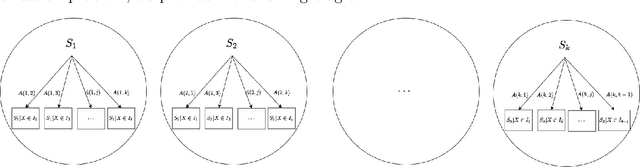
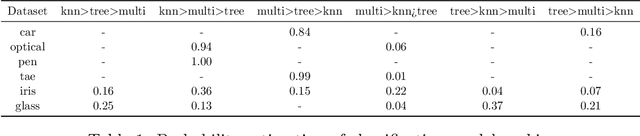
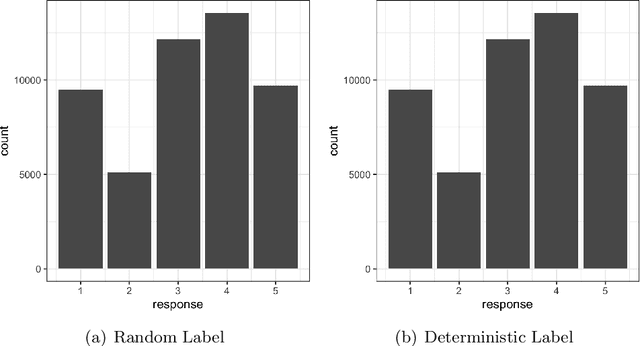
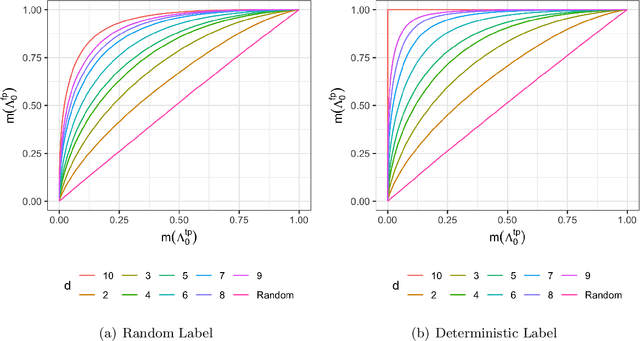
Model evaluation is of crucial importance in modern statistics application. The construction of ROC and calculation of AUC have been widely used for binary classification evaluation. Recent research generalizing the ROC/AUC analysis to multi-class classification has problems in at least one of the four areas: 1. failure to provide sensible plots 2. being sensitive to imbalanced data 3. unable to specify mis-classification cost and 4. unable to provide evaluation uncertainty quantification. Borrowing from a binomial matrix factorization model, we provide an evaluation metric summarizing the pair-wise multi-class True Positive Rate (TPR) and False Positive Rate (FPR) with one-dimensional vector representation. Visualization on the representation vector measures the relative speed of increment between TPR and FPR across all the classes pairs, which in turns provides a ROC plot for the multi-class counterpart. An integration over those factorized vector provides a binary AUC-equivalent summary on the classifier performance. Mis-clasification weights specification and bootstrapped confidence interval are also enabled to accommodate a variety of of evaluation criteria. To support our findings, we conducted extensive simulation studies and compared our method to the pair-wise averaged AUC statistics on benchmark datasets.
LongEmbed: Extending Embedding Models for Long Context Retrieval
Apr 18, 2024Embedding models play a pivot role in modern NLP applications such as IR and RAG. While the context limit of LLMs has been pushed beyond 1 million tokens, embedding models are still confined to a narrow context window not exceeding 8k tokens, refrained from application scenarios requiring long inputs such as legal contracts. This paper explores context window extension of existing embedding models, pushing the limit to 32k without requiring additional training. First, we examine the performance of current embedding models for long context retrieval on our newly constructed LongEmbed benchmark. LongEmbed comprises two synthetic tasks and four carefully chosen real-world tasks, featuring documents of varying length and dispersed target information. Benchmarking results underscore huge room for improvement in these models. Based on this, comprehensive experiments show that training-free context window extension strategies like position interpolation can effectively extend the context window of existing embedding models by several folds, regardless of their original context being 512 or beyond 4k. Furthermore, for models employing absolute position encoding (APE), we show the possibility of further fine-tuning to harvest notable performance gains while strictly preserving original behavior for short inputs. For models using rotary position embedding (RoPE), significant enhancements are observed when employing RoPE-specific methods, such as NTK and SelfExtend, indicating RoPE's superiority over APE for context window extension. To facilitate future research, we release E5-Base-4k and E5-RoPE-Base, along with the LongEmbed benchmark.