 Add to Chrome
 Add to Firefox
 Add to Edge
NeoVerse: Enhancing 4D World Model with in-the-wild Monocular Videos
Jan 01, 2026
In this paper, we propose NeoVerse, a versatile 4D world model that is capable of 4D reconstruction, novel-trajectory video generation, and rich downstream applications. We first identify a common limitation of scalability in current 4D world modeling methods, caused either by expensive and specialized multi-view 4D data or by cumbersome training pre-processing. In contrast, our NeoVerse is built upon a core philosophy that makes the full pipeline scalable to diverse in-the-wild monocular videos. Specifically, NeoVerse features pose-free feed-forward 4D reconstruction, online monocular degradation pattern simulation, and other well-aligned techniques. These designs empower NeoVerse with versatility and generalization to various domains. Meanwhile, NeoVerse achieves state-of-the-art performance in standard reconstruction and generation benchmarks. Our project page is available at https://neoverse-4d.github.io

Conformal Uncertainty Indicator for Continual Test-Time Adaptation
Feb 05, 2025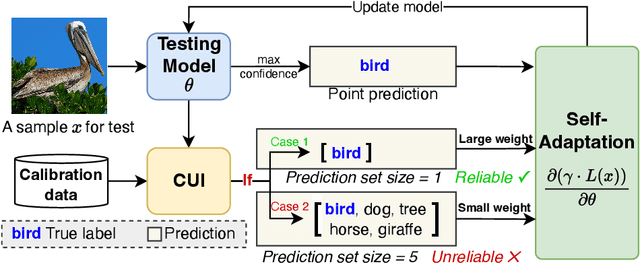
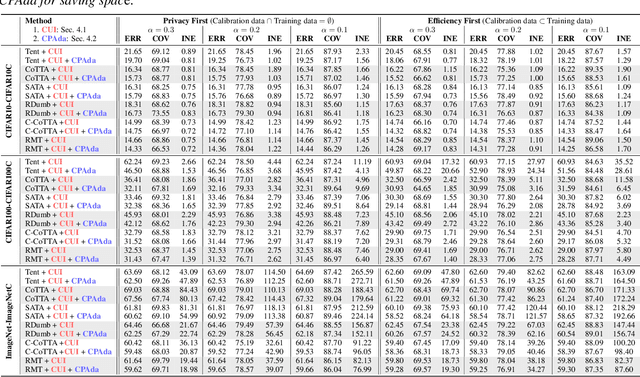
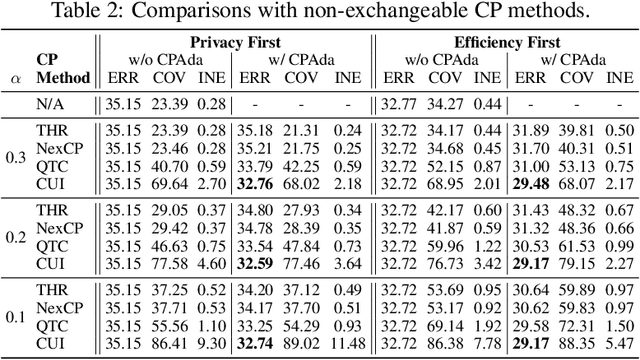
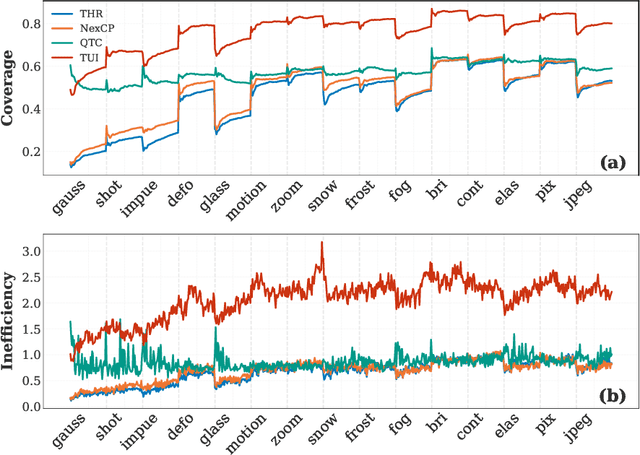
Continual Test-Time Adaptation (CTTA) aims to adapt models to sequentially changing domains during testing, relying on pseudo-labels for self-adaptation. However, incorrect pseudo-labels can accumulate, leading to performance degradation. To address this, we propose a Conformal Uncertainty Indicator (CUI) for CTTA, leveraging Conformal Prediction (CP) to generate prediction sets that include the true label with a specified coverage probability. Since domain shifts can lower the coverage than expected, making CP unreliable, we dynamically compensate for the coverage by measuring both domain and data differences. Reliable pseudo-labels from CP are then selectively utilized to enhance adaptation. Experiments confirm that CUI effectively estimates uncertainty and improves adaptation performance across various existing CTTA methods.
Controllable Continual Test-Time Adaptation
May 23, 2024

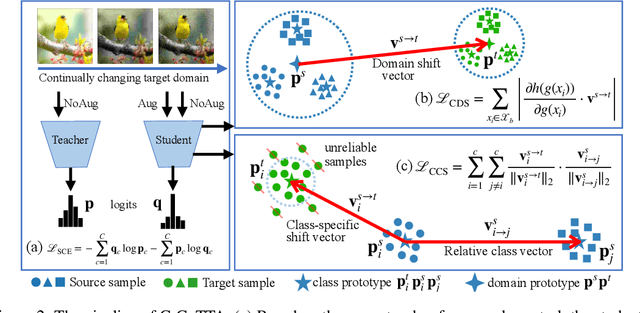

Continual Test-Time Adaptation (CTTA) is an emerging and challenging task where a model trained in a source domain must adapt to continuously changing conditions during testing, without access to the original source data. CTTA is prone to error accumulation due to uncontrollable domain shifts, leading to blurred decision boundaries between categories. Existing CTTA methods primarily focus on suppressing domain shifts, which proves inadequate during the unsupervised test phase. In contrast, we introduce a novel approach that guides rather than suppresses these shifts. Specifically, we propose $\textbf{C}$ontrollable $\textbf{Co}$ntinual $\textbf{T}$est-$\textbf{T}$ime $\textbf{A}$daptation (C-CoTTA), which explicitly prevents any single category from encroaching on others, thereby mitigating the mutual influence between categories caused by uncontrollable shifts. Moreover, our method reduces the sensitivity of model to domain transformations, thereby minimizing the magnitude of category shifts. Extensive quantitative experiments demonstrate the effectiveness of our method, while qualitative analyses, such as t-SNE plots, confirm the theoretical validity of our approach.