 Add to Chrome
 Add to Firefox
 Add to Edge
Adversarial Attacks in Multi-Agent LLM Pipelines: Unveiling Structural Vulnerabilities in Agentic AI Architectures
Aug 01, 2026
Multi-agent LLM pipelines orchestrate multiple specialized language model agents into structured workflows where intermediate outputs are passed across agents to solve complex tasks. This design introduces a security gap absent in single-agent settings: once an agent accepts adversarial content, it is propagated as trusted input throughout the pipeline. We argue that this vulnerability stems from the absence of boundary verification, a security primitive that enforces explicit validation of data as it crosses inter-agent boundaries, including content, identity, execution intent, and state integrity. Without such verification, modern pipelines embed implicit trust assumptions that are not adversarially robust, giving rise to structurally distinct attack surfaces (e.g., content injection, agent impersonation, plan deviation, and memory poisoning). Leveraging annotated production traces from the GAIA and SWE-Bench benchmark, we show that these vulnerabilities arise in benign deployments and largely evade existing evaluation frameworks. We further operationalize these failure modes within a controlled multi-agent setting and evaluate them across GPT-5-mini, Claude Sonnet 4.5, and Kimi K2.5 under identical pipeline configurations. The results reveal that attack success aligns with pipeline structure rather than model capability, indicating that adversarial vulnerability is fundamentally an architectural property and motivating a shift toward pipeline-level defenses.

Towards Robust Iris Recognition Through Occlusion Identification and Conditional Diffusion-Based Reconstruction
Jul 23, 2026Iris recognition is a reliable biometric approach that identifies individuals using the distinctive and stable texture of the iris. However, recognition performance can degrade when discriminative iris texture is partially occluded by eyelids, eyelashes, specular reflections, or other acquisition artifacts. Existing approaches often perform recognition directly on degraded samples or rely only on the remaining visible iris region, which may be inadequate when substantial texture is corrupted. To address this limitation, we propose an occlusion-aware iris recognition framework with three sequential modules: occlusion-type identification, diffusion-based reconstruction, and deep-learning-based recognition. First, a residual 2D CNN-based network determines whether an iris image is non-occluded or belongs to one of the controlled occlusion categories. Second, the occluded image, binary mask, and predicted occlusion type condition a denoising diffusion probabilistic model to reconstruct the corrupted region. Finally, VGG19-HPMNet, a modified VGG19 model with horizontal pyramid mapping, extracts discriminative global and part-wise local iris features for recognition. Experiments on the CASIA-Iris-Thousand dataset under a controlled synthetic-occlusion protocol show that the proposed framework improves iris recognition performance by identifying the occlusion type, reconstructing masked regions, and re-evaluating the restored iris samples.
Hierarchical Flow Decomposition for Turning Movement Prediction at Signalized Intersections
Apr 10, 2026Accurate prediction of intersection turning movements is essential for adaptive signal control but remains difficult due to the high volatility of directional flows. This study proposes HFD-TM (Hierarchical Flow-Decomposition for Turning Movement Prediction), a hierarchical deep learning framework that predicts turning movements by first forecasting corridor through-movements and then expanding these predictions to individual turning streams. This design is motivated by empirical traffic structure, where corridor flows account for 65.1% of total volume, exhibit lower volatility than turning movements, and explain 35.5% of turning-movement variance. A physics-informed loss function enforces flow conservation to maintain structural consistency. Evaluated on six months of 15-minute interval LiDAR (Light Detection and Ranging) data from a six-intersection corridor in Nashville, Tennessee, HFD-TM achieves a mean absolute error of 2.49 vehicles per interval, reducing MAE by 5.7% compared to a Transformer and by 27.0% compared to a GRU (Gated Recurrent Unit). Ablation results show that hierarchical decomposition provides the largest performance gain, while training time is 12.8 times lower than DCRNN (Diffusion Convolutional Recurrent Neural Network), demonstrating suitability for real-time traffic applications.
Physics-Embedded Feature Learning for AI in Medical Imaging
Mar 30, 2026Deep learning (DL) models have achieved strong performance in an intelligence healthcare setting, yet most existing approaches operate as black boxes and ignore the physical processes that govern tumor growth, limiting interpretability, robustness, and clinical trust. To address this limitation, we propose PhysNet, a physics-embedded DL framework that integrates tumor growth dynamics directly into the feature learning process of a convolutional neural network (CNN). Unlike conventional physics-informed methods that impose physical constraints only at the output level, PhysNet embeds a reaction diffusion model of tumor growth within intermediate feature representations of a ResNet backbone. The architecture jointly performs multi-class tumor classification while learning a latent tumor density field, its temporal evolution, and biologically meaningful physical parameters, including tumor diffusion and growth rates, through end-to-end training. This design is necessary because purely data-driven models, even when highly accurate or ensemble-based, cannot guarantee physically consistent predictions or provide insight into tumor behavior. Experimental results on a large brain MRI dataset demonstrate that PhysNet outperforms multiple state-of-the-art DL baselines, including MobileNetV2, VGG16, VGG19, and ensemble models, achieving superior classification accuracy and F1-score. In addition to improved performance, PhysNet produces interpretable latent representations and learned bio-physical parameters that align with established medical knowledge, highlighting physics-embedded representation learning as a practical pathway toward more trustworthy and clinically meaningful medical AI systems.
Digital-Twin Empowered Deep Reinforcement Learning For Site-Specific Radio Resource Management in NextG Wireless Aerial Corridor
Feb 03, 2026Joint base station (BS) association and beam selection in multi-UAV aerial corridors constitutes a challenging radio resource management (RRM) problem. It is driven by high-dimensional action spaces, need for substantial overhead to acquire global channel state information (CSI), rapidly varying propagation channels, and stringent latency requirements. Conventional combinatorial optimization methods, while near-optimal, are computationally prohibitive for real-time operation in such dynamic environments. While learning-based approaches can mitigate computational complexity and CSI overhead, the need for extensive site-specific (SS) datasets for model training remains a key challenge. To address these challenges, we develop a Digital Twin (DT)-enabled two-stage optimization framework that couples physics-based beam gain modeling with DRL for scalable online decision-making. In the first stage, a channel twin (CT) is constructed using a high-fidelity ray-tracing solver with geo-spatial contexts, and network information to capture SS propagation characteristics, and dual annealing algorithm is employed to precompute optimal transmission beam directions. In the second stage, a Multi-Head Proximal Policy Optimization (MH-PPO) agent, equipped with a scalable multi-head actor-critic architecture, is trained on the DT-generated channel dataset to directly map complex channel and beam states to jointly execute UAV-BS-beam association decisions. The proposed PPO agent achieves a 44%-121% improvement over DQN and 249%-807% gain over traditional heuristic based optimization schemes in a dense UAV scenario, while reducing inference latency by several orders of magnitude. These results demonstrate that DT-driven training pipelines can deliver high-performance, low-latency RRM policies tailored to SS deployments suitable for real-time resource management in next-generation aerial corridor networks.
Mam-App: A Novel Parameter-Efficient Mamba Model for Apple Leaf Disease Classification
Jan 29, 2026The rapid growth of the global population, alongside exponential technological advancement, has intensified the demand for food production. Meeting this demand depends not only on increasing agricultural yield but also on minimizing food loss caused by crop diseases. Diseases account for a substantial portion of apple production losses, despite apples being among the most widely produced and nutritionally valuable fruits worldwide. Previous studies have employed machine learning techniques for feature extraction and early diagnosis of apple leaf diseases, and more recently, deep learning-based models have shown remarkable performance in disease recognition. However, most state-of-the-art deep learning models are highly parameter-intensive, resulting in increased training and inference time. Although lightweight models are more suitable for user-friendly and resource-constrained applications, they often suffer from performance degradation. To address the trade-off between efficiency and performance, we propose Mam-App, a parameter-efficient Mamba-based model for feature extraction and leaf disease classification. The proposed approach achieves competitive state-of-the-art performance on the PlantVillage Apple Leaf Disease dataset, attaining 99.58% accuracy, 99.30% precision, 99.14% recall, and a 99.22% F1-score, while using only 0.051M parameters. This extremely low parameter count makes the model suitable for deployment on drones, mobile devices, and other low-resource platforms. To demonstrate the robustness and generalizability of the proposed model, we further evaluate it on the PlantVillage Corn Leaf Disease and Potato Leaf Disease datasets. The model achieves 99.48%, 99.20%, 99.34%, and 99.27% accuracy, precision, recall, and F1-score on the corn dataset and 98.46%, 98.91%, 95.39%, and 97.01% on the potato dataset, respectively.
PRISM: Privacy-preserving Inference System with Homomorphic Encryption and Modular Activation
Nov 11, 2025With the rapid advancements in machine learning, models have become increasingly capable of learning and making predictions in various industries. However, deploying these models in critical infrastructures presents a major challenge, as concerns about data privacy prevent unrestricted data sharing. Homomorphic encryption (HE) offers a solution by enabling computations on encrypted data, but it remains incompatible with machine learning models like convolutional neural networks (CNNs), due to their reliance on non-linear activation functions. To bridge this gap, this work proposes an optimized framework that replaces standard non-linear functions with homomorphically compatible approximations, ensuring secure computations while minimizing computational overhead. The proposed approach restructures the CNN architecture and introduces an efficient activation function approximation method to mitigate the performance trade-offs introduced by encryption. Experiments on CIFAR-10 achieve 94.4% accuracy with 2.42 s per single encrypted sample and 24,000 s per 10,000 encrypted samples, using a degree-4 polynomial and Softplus activation under CKKS, balancing accuracy and privacy.
Fine-Tuning Video Transformers for Word-Level Bangla Sign Language: A Comparative Analysis for Classification Tasks
Jun 04, 2025Sign Language Recognition (SLR) involves the automatic identification and classification of sign gestures from images or video, converting them into text or speech to improve accessibility for the hearing-impaired community. In Bangladesh, Bangla Sign Language (BdSL) serves as the primary mode of communication for many individuals with hearing impairments. This study fine-tunes state-of-the-art video transformer architectures -- VideoMAE, ViViT, and TimeSformer -- on BdSLW60 (arXiv:2402.08635), a small-scale BdSL dataset with 60 frequent signs. We standardized the videos to 30 FPS, resulting in 9,307 user trial clips. To evaluate scalability and robustness, the models were also fine-tuned on BdSLW401 (arXiv:2503.02360), a large-scale dataset with 401 sign classes. Additionally, we benchmark performance against public datasets, including LSA64 and WLASL. Data augmentation techniques such as random cropping, horizontal flipping, and short-side scaling were applied to improve model robustness. To ensure balanced evaluation across folds during model selection, we employed 10-fold stratified cross-validation on the training set, while signer-independent evaluation was carried out using held-out test data from unseen users U4 and U8. Results show that video transformer models significantly outperform traditional machine learning and deep learning approaches. Performance is influenced by factors such as dataset size, video quality, frame distribution, frame rate, and model architecture. Among the models, the VideoMAE variant (MCG-NJU/videomae-base-finetuned-kinetics) achieved the highest accuracies of 95.5% on the frame rate corrected BdSLW60 dataset and 81.04% on the front-facing signs of BdSLW401 -- demonstrating strong potential for scalable and accurate BdSL recognition.
AI-Driven Secure Data Sharing: A Trustworthy and Privacy-Preserving Approach
Jan 26, 2025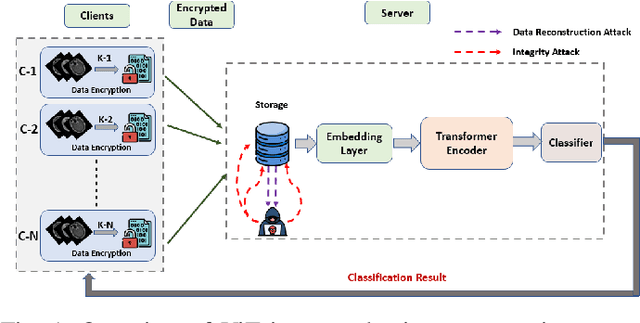
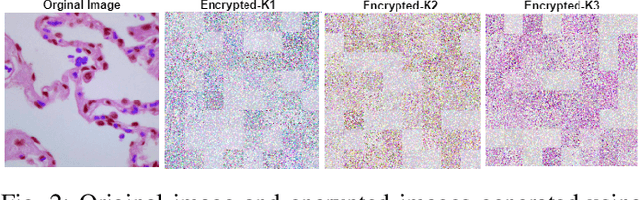
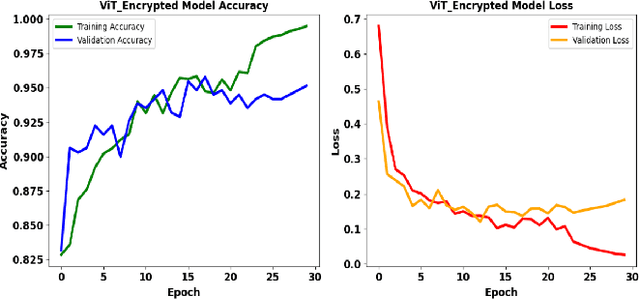
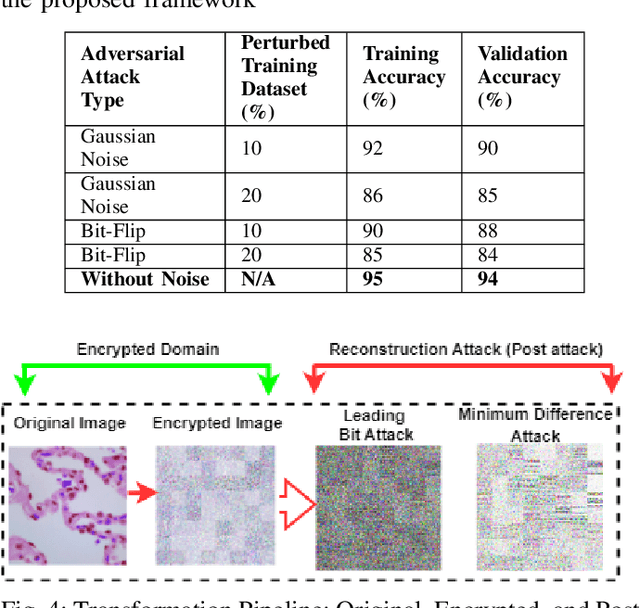
In the era of data-driven decision-making, ensuring the privacy and security of shared data is paramount across various domains. Applying existing deep neural networks (DNNs) to encrypted data is critical and often compromises performance, security, and computational overhead. To address these limitations, this research introduces a secure framework consisting of a learnable encryption method based on the block-pixel operation to encrypt the data and subsequently integrate it with the Vision Transformer (ViT). The proposed framework ensures data privacy and security by creating unique scrambling patterns per key, providing robust performance against adversarial attacks without compromising computational efficiency and data integrity. The framework was tested on sensitive medical datasets to validate its efficacy, proving its ability to handle highly confidential information securely. The suggested framework was validated with a 94\% success rate after extensive testing on real-world datasets, such as MRI brain tumors and histological scans of lung and colon cancers. Additionally, the framework was tested under diverse adversarial attempts against secure data sharing with optimum performance and demonstrated its effectiveness in various threat scenarios. These comprehensive analyses underscore its robustness, making it a trustworthy solution for secure data sharing in critical applications.
ViT Enhanced Privacy-Preserving Secure Medical Data Sharing and Classification
Nov 08, 2024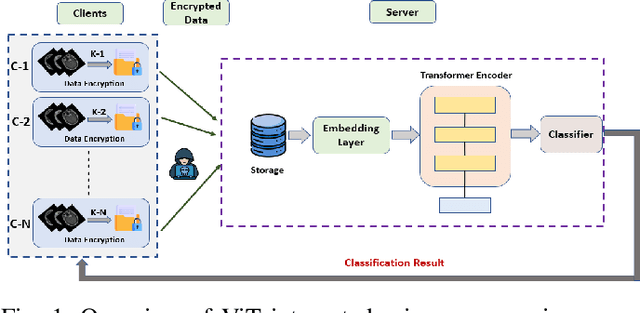
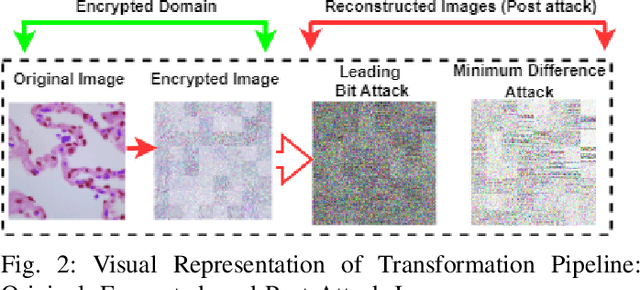
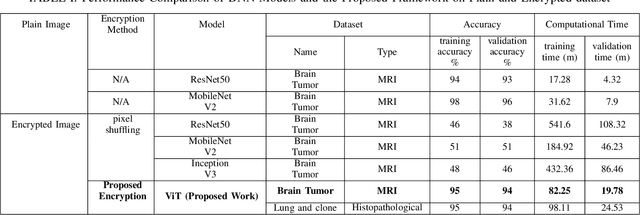
Privacy-preserving and secure data sharing are critical for medical image analysis while maintaining accuracy and minimizing computational overhead are also crucial. Applying existing deep neural networks (DNNs) to encrypted medical data is not always easy and often compromises performance and security. To address these limitations, this research introduces a secure framework consisting of a learnable encryption method based on the block-pixel operation to encrypt the data and subsequently integrate it with the Vision Transformer (ViT). The proposed framework ensures data privacy and security by creating unique scrambling patterns per key, providing robust performance against leading bit attacks and minimum difference attacks.