 Add to Chrome
 Add to Firefox
 Add to Edge
Sampling sea state using a diffusion model
Jun 24, 2026
Sea state prediction is essential for operational maritime applications and coupled earth system modeling, yet current spectral wave models remain computationally prohibitive for many use cases, including online coupling to climate simulations and making probabilistic (ensemble-based) predictions. While deep learning has recently demonstrated strong performance in weather forecasting, existing AI-based wave models are predominantly deterministic and largely limited to bulk variables such as significant wave height, leaving probabilistic sea state estimation largely unexplored. In this work, we propose a diffusion-based generative model for global sea state estimation that conditions on a relatively long history (5 days) of global wind forcing. This generative model directly samples the complex conditional distribution of sea state without autoregressive time-stepping. Unlike prior approaches, our framework naturally extends beyond bulk variables to estimate partition-related variables and derived quantities, such as Stokes drift and mean square slope. Trained on a 30-year global WAVEWATCH-III hindcast, the model achieves substantial computational acceleration compared with numerical spectral models while delivering skillful predictions and a calibrated ensemble spread for the bulk variables. Our results suggest that diffusion-based sea state sampling offers a promising path toward probabilistic wave forecasting and efficient coupling of sea state information into broader earth system models.

Agents' Last Exam
Jun 03, 2026Recent AI systems have achieved strong results on a wide range of benchmarks, yet these gains have not translated into economically meaningful deployment across many professional domains. We argue that this gap is largely an evaluation problem: widely used benchmarks lack sustained performance measurement on real and economically valuable workflows. This paper introduces Agents' Last Exam (ALE), a benchmark designed to evaluate AI agents on long-horizon, economically valuable, real-world tasks with verifiable outcomes. Developed in collaboration with 250+ industry experts, ALE covers non-physical industries defined with reference to O*NET / SOC 2018 (the U.S. federal occupational taxonomy). It is organized around a task taxonomy with 55 subfields grouped into 13 industry clusters covering 1K+ tasks. Current results show that the hardest tier remains far from saturated: across mainstream harness and backbone configurations, the average full pass rate is 2.6%. ALE is designed as a living benchmark: its task pool grows continuously as new workflows and industries are onboarded. More broadly, ALE is intended not merely as another leaderboard, but as an instrument for closing the gap between benchmark success and GDP-relevant impact.
Calibration of a neural network ocean closure for improved mean state and variability
Apr 07, 2026Global ocean models exhibit biases in the mean state and variability, particularly at coarse resolution, where mesoscale eddies are unresolved. To address these biases, parameterization coefficients are typically tuned ad hoc. Here, we formulate parameter tuning as a calibration problem using Ensemble Kalman Inversion (EKI). We optimize parameters of a neural network parameterization of mesoscale eddies in two idealized ocean models at coarse resolution. The calibrated parameterization reduces errors in the time-averaged fluid interfaces and their variability by approximately a factor of two compared to the unparameterized model or the offline-trained parameterization. The EKI method is robust to noise in time-averaged statistics arising from chaotic ocean dynamics. Furthermore, we propose an efficient calibration protocol that bypasses integration to statistical equilibrium by carefully choosing an initial condition. These results demonstrate that systematic calibration can substantially improve coarse-resolution ocean simulations and provide a practical pathway for reducing biases in global ocean models.
Towards Infinitely Long Neural Simulations: Self-Refining Neural Surrogate Models for Dynamical Systems
Mar 18, 2026Recent advances in autoregressive neural surrogate models have enabled orders-of-magnitude speedups in simulating dynamical systems. However, autoregressive models are generally prone to distribution drift: compounding errors in autoregressive rollouts that severely degrade generation quality over long time horizons. Existing work attempts to address this issue by implicitly leveraging the inherent trade-off between short-time accuracy and long-time consistency through hyperparameter tuning. In this work, we introduce a unifying mathematical framework that makes this tradeoff explicit, formalizing and generalizing hyperparameter-based strategies in existing approaches. Within this framework, we propose a robust, hyperparameter-free model implemented as a conditional diffusion model that balances short-time fidelity with long-time consistency by construction. Our model, Self-refining Neural Surrogate model (SNS), can be implemented as a standalone model that refines its own autoregressive outputs or as a complementary model to existing neural surrogates to ensure long-time consistency. We also demonstrate the numerical feasibility of SNS through high-fidelity simulations of complex dynamical systems over arbitrarily long time horizons.
FloeNet: A mass-conserving global sea ice emulator that generalizes across climates
Mar 12, 2026We introduce FloeNet, a machine-learning emulator trained on the Geophysical Fluid Dynamics Laboratory global sea ice model, SIS2. FloeNet is a mass-conserving model, emulating 6-hour mass and area budget tendencies related to sea ice and snow-on-sea-ice growth, melt, and advection. We train FloeNet using simulated data from a reanalysis-forced ice-ocean simulation and test its ability to generalize to pre-industrial control and 1% CO2 climates. FloeNet outperforms a non-conservative model at reproducing sea ice and snow-on-sea-ice mean state, trends, and inter-annual variability, with volume anomaly correlations above 0.96 in the Antarctic and 0.76 in the Arctic, across all forcings. FloeNet also produces the correct thermodynamic vs dynamic response to forcing, enabling physical interpretability of emulator output. Finally, we show that FloeNet outputs high-fidelity coupling-related variables, including ice-surface skin temperature, ice-to-ocean salt flux, and melting energy fluxes. We hypothesize that FloeNet will improve polar climate processes within existing atmosphere and ocean emulators.
Causally constrained reduced-order neural models of complex turbulent dynamical systems
Feb 17, 2026We introduce a flexible framework based on response theory and score matching to suppress spurious, noncausal dependencies in reduced-order neural emulators of turbulent systems, focusing on climate dynamics as a proof-of-concept. We showcase the approach using the stochastic Charney-DeVore model as a relevant prototype for low-frequency atmospheric variability. We show that the resulting causal constraints enhance neural emulators' ability to respond to both weak and strong external forcings, despite being trained exclusively on unforced data. The approach is broadly applicable to modeling complex turbulent dynamical systems in reduced spaces and can be readily integrated into general neural network architectures.
Accelerating scientific discovery with the common task framework
Nov 06, 2025Machine learning (ML) and artificial intelligence (AI) algorithms are transforming and empowering the characterization and control of dynamic systems in the engineering, physical, and biological sciences. These emerging modeling paradigms require comparative metrics to evaluate a diverse set of scientific objectives, including forecasting, state reconstruction, generalization, and control, while also considering limited data scenarios and noisy measurements. We introduce a common task framework (CTF) for science and engineering, which features a growing collection of challenge data sets with a diverse set of practical and common objectives. The CTF is a critically enabling technology that has contributed to the rapid advance of ML/AI algorithms in traditional applications such as speech recognition, language processing, and computer vision. There is a critical need for the objective metrics of a CTF to compare the diverse algorithms being rapidly developed and deployed in practice today across science and engineering.
SamudrACE: Fast and Accurate Coupled Climate Modeling with 3D Ocean and Atmosphere Emulators
Sep 15, 2025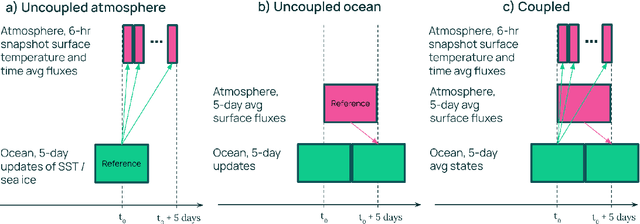
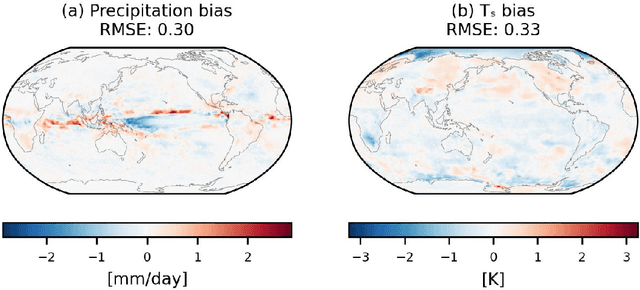
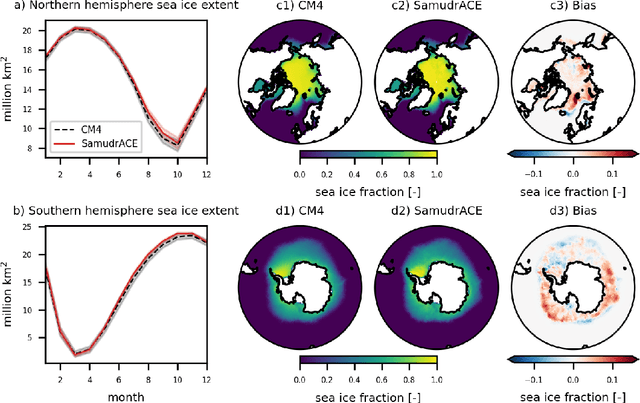
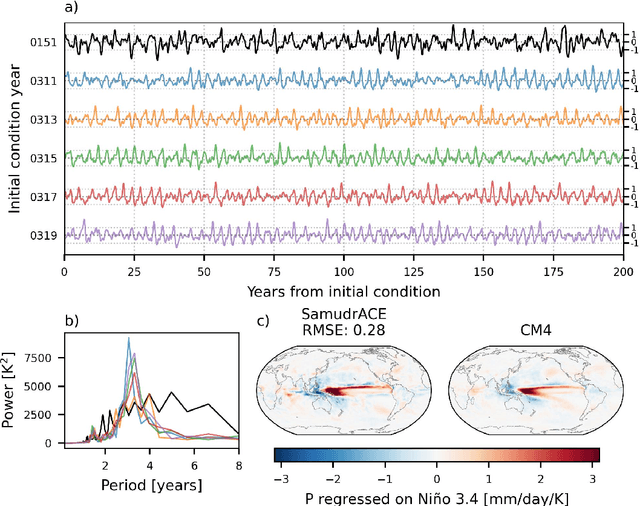
Traditional numerical global climate models simulate the full Earth system by exchanging boundary conditions between separate simulators of the atmosphere, ocean, sea ice, land surface, and other geophysical processes. This paradigm allows for distributed development of individual components within a common framework, unified by a coupler that handles translation between realms via spatial or temporal alignment and flux exchange. Following a similar approach adapted for machine learning-based emulators, we present SamudrACE: a coupled global climate model emulator which produces centuries-long simulations at 1-degree horizontal, 6-hourly atmospheric, and 5-daily oceanic resolution, with 145 2D fields spanning 8 atmospheric and 19 oceanic vertical levels, plus sea ice, surface, and top-of-atmosphere variables. SamudrACE is highly stable and has low climate biases comparable to those of its components with prescribed boundary forcing, with realistic variability in coupled climate phenomena such as ENSO that is not possible to simulate in uncoupled mode.
Fourier analysis of the physics of transfer learning for data-driven subgrid-scale models of ocean turbulence
Apr 21, 2025Transfer learning (TL) is a powerful tool for enhancing the performance of neural networks (NNs) in applications such as weather and climate prediction and turbulence modeling. TL enables models to generalize to out-of-distribution data with minimal training data from the new system. In this study, we employ a 9-layer convolutional NN to predict the subgrid forcing in a two-layer ocean quasi-geostrophic system and examine which metrics best describe its performance and generalizability to unseen dynamical regimes. Fourier analysis of the NN kernels reveals that they learn low-pass, Gabor, and high-pass filters, regardless of whether the training data are isotropic or anisotropic. By analyzing the activation spectra, we identify why NNs fail to generalize without TL and how TL can overcome these limitations: the learned weights and biases from one dataset underestimate the out-of-distribution sample spectra as they pass through the network, leading to an underestimation of output spectra. By re-training only one layer with data from the target system, this underestimation is corrected, enabling the NN to produce predictions that match the target spectra. These findings are broadly applicable to data-driven parameterization of dynamical systems.
Thermalizer: Stable autoregressive neural emulation of spatiotemporal chaos
Mar 24, 2025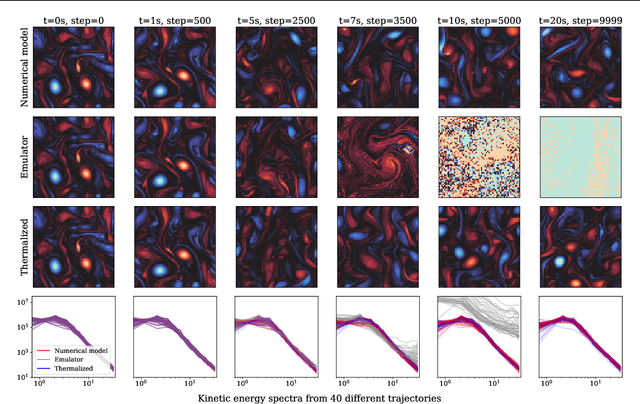
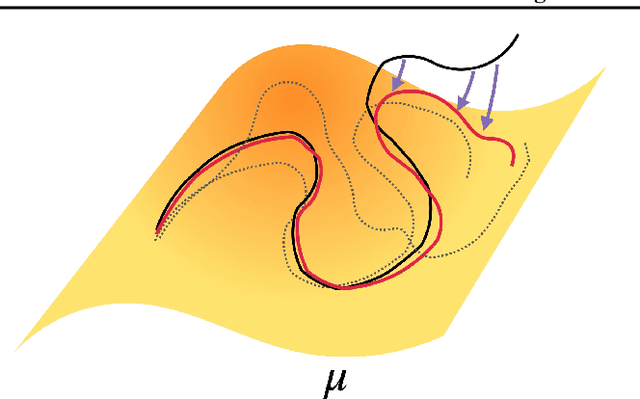
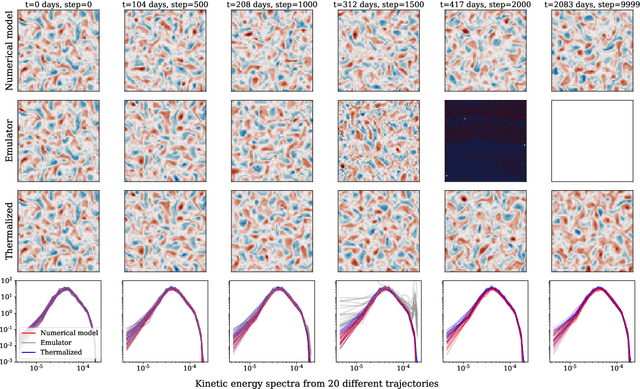
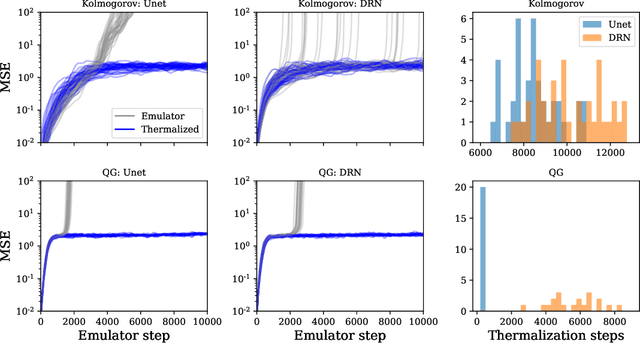
Autoregressive surrogate models (or \textit{emulators}) of spatiotemporal systems provide an avenue for fast, approximate predictions, with broad applications across science and engineering. At inference time, however, these models are generally unable to provide predictions over long time rollouts due to accumulation of errors leading to diverging trajectories. In essence, emulators operate out of distribution, and controlling the online distribution quickly becomes intractable in large-scale settings. To address this fundamental issue, and focusing on time-stationary systems admitting an invariant measure, we leverage diffusion models to obtain an implicit estimator of the score of this invariant measure. We show that this model of the score function can be used to stabilize autoregressive emulator rollouts by applying on-the-fly denoising during inference, a process we call \textit{thermalization}. Thermalizing an emulator rollout is shown to extend the time horizon of stable predictions by an order of magnitude in complex systems exhibiting turbulent and chaotic behavior, opening up a novel application of diffusion models in the context of neural emulation.