 Add to Chrome
 Add to Firefox
 Add to Edge
Calibration of a neural network ocean closure for improved mean state and variability
Apr 07, 2026
Global ocean models exhibit biases in the mean state and variability, particularly at coarse resolution, where mesoscale eddies are unresolved. To address these biases, parameterization coefficients are typically tuned ad hoc. Here, we formulate parameter tuning as a calibration problem using Ensemble Kalman Inversion (EKI). We optimize parameters of a neural network parameterization of mesoscale eddies in two idealized ocean models at coarse resolution. The calibrated parameterization reduces errors in the time-averaged fluid interfaces and their variability by approximately a factor of two compared to the unparameterized model or the offline-trained parameterization. The EKI method is robust to noise in time-averaged statistics arising from chaotic ocean dynamics. Furthermore, we propose an efficient calibration protocol that bypasses integration to statistical equilibrium by carefully choosing an initial condition. These results demonstrate that systematic calibration can substantially improve coarse-resolution ocean simulations and provide a practical pathway for reducing biases in global ocean models.

FloeNet: A mass-conserving global sea ice emulator that generalizes across climates
Mar 12, 2026We introduce FloeNet, a machine-learning emulator trained on the Geophysical Fluid Dynamics Laboratory global sea ice model, SIS2. FloeNet is a mass-conserving model, emulating 6-hour mass and area budget tendencies related to sea ice and snow-on-sea-ice growth, melt, and advection. We train FloeNet using simulated data from a reanalysis-forced ice-ocean simulation and test its ability to generalize to pre-industrial control and 1% CO2 climates. FloeNet outperforms a non-conservative model at reproducing sea ice and snow-on-sea-ice mean state, trends, and inter-annual variability, with volume anomaly correlations above 0.96 in the Antarctic and 0.76 in the Arctic, across all forcings. FloeNet also produces the correct thermodynamic vs dynamic response to forcing, enabling physical interpretability of emulator output. Finally, we show that FloeNet outputs high-fidelity coupling-related variables, including ice-surface skin temperature, ice-to-ocean salt flux, and melting energy fluxes. We hypothesize that FloeNet will improve polar climate processes within existing atmosphere and ocean emulators.
SamudrACE: Fast and Accurate Coupled Climate Modeling with 3D Ocean and Atmosphere Emulators
Sep 15, 2025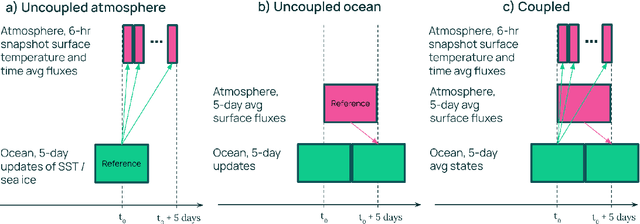
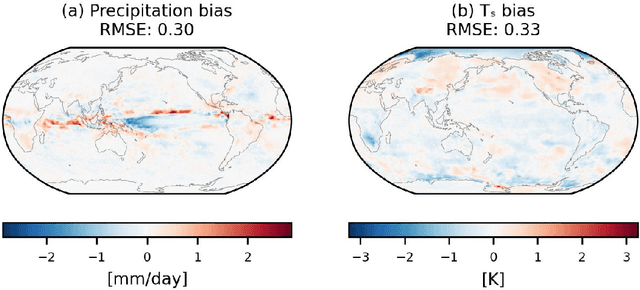
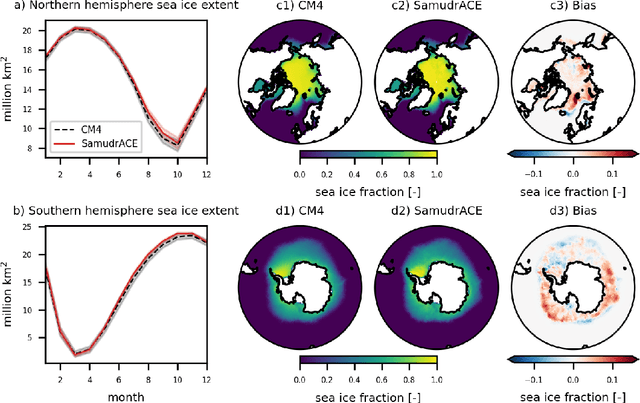
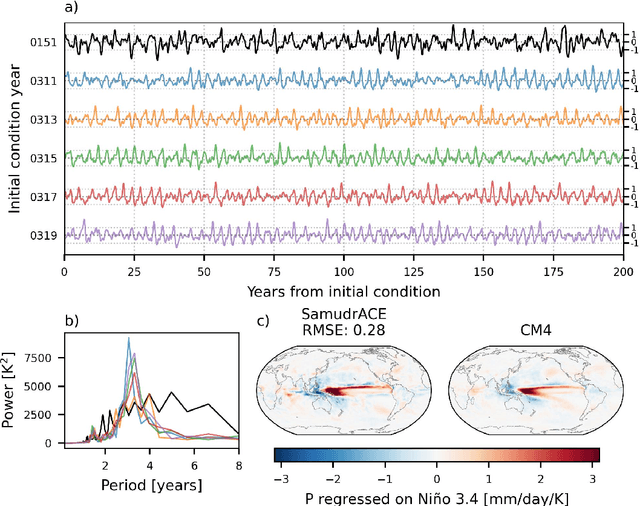
Traditional numerical global climate models simulate the full Earth system by exchanging boundary conditions between separate simulators of the atmosphere, ocean, sea ice, land surface, and other geophysical processes. This paradigm allows for distributed development of individual components within a common framework, unified by a coupler that handles translation between realms via spatial or temporal alignment and flux exchange. Following a similar approach adapted for machine learning-based emulators, we present SamudrACE: a coupled global climate model emulator which produces centuries-long simulations at 1-degree horizontal, 6-hourly atmospheric, and 5-daily oceanic resolution, with 145 2D fields spanning 8 atmospheric and 19 oceanic vertical levels, plus sea ice, surface, and top-of-atmosphere variables. SamudrACE is highly stable and has low climate biases comparable to those of its components with prescribed boundary forcing, with realistic variability in coupled climate phenomena such as ENSO that is not possible to simulate in uncoupled mode.
Samudra: An AI Global Ocean Emulator for Climate
Dec 05, 2024
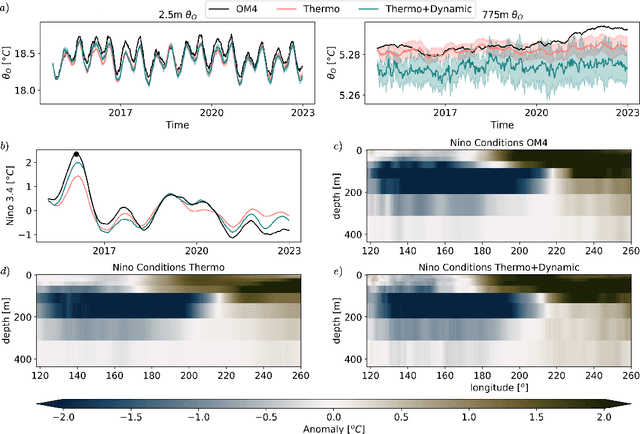

AI emulators for forecasting have emerged as powerful tools that can outperform conventional numerical predictions. The next frontier is to build emulators for long-term climate projections with robust skill across a wide range of spatiotemporal scales, a particularly important goal for the ocean. Our work builds a skillful global emulator of the ocean component of a state-of-the-art climate model. We emulate key ocean variables, sea surface height, horizontal velocities, temperature, and salinity, across their full depth. We use a modified ConvNeXt UNet architecture trained on multidepth levels of ocean data. We show that the ocean emulator - Samudra - which exhibits no drift relative to the truth, can reproduce the depth structure of ocean variables and their interannual variability. Samudra is stable for centuries and 150 times faster than the original ocean model. Samudra struggles to capture the correct magnitude of the forcing trends and simultaneously remains stable, requiring further work.