 Add to Chrome
 Add to Firefox
 Add to Edge
High-Resolution Climate Projections Using Diffusion-Based Downscaling of a Lightweight Climate Emulator
Feb 13, 2026
The proliferation of data-driven models in weather and climate sciences has marked a significant paradigm shift, with advanced models demonstrating exceptional skill in medium-range forecasting. However, these models are often limited by long-term instabilities, climatological drift, and substantial computational costs during training and inference, restricting their broader application for climate studies. Addressing these limitations, Guan et al. (2024) introduced LUCIE, a lightweight, physically consistent climate emulator utilizing a Spherical Fourier Neural Operator (SFNO) architecture. This model is able to reproduce accurate long-term statistics including climatological mean and seasonal variability. However, LUCIE's native resolution (~300 km) is inadequate for detailed regional impact assessments. To overcome this limitation, we introduce a deep learning-based downscaling framework, leveraging probabilistic diffusion-based generative models with conditional and posterior sampling frameworks. These models downscale coarse LUCIE outputs to 25 km resolution. They are trained on approximately 14,000 ERA5 timesteps spanning 2000-2009 and evaluated on LUCIE predictions from 2010 to 2020. Model performance is assessed through diverse metrics, including latitude-averaged RMSE, power spectrum, probability density functions and First Empirical Orthogonal Function of the zonal wind. We observe that the proposed approach is able to preserve the coarse-grained dynamics from LUCIE while generating fine-scaled climatological statistics at ~28km resolution.

Fourier analysis of the physics of transfer learning for data-driven subgrid-scale models of ocean turbulence
Apr 21, 2025Transfer learning (TL) is a powerful tool for enhancing the performance of neural networks (NNs) in applications such as weather and climate prediction and turbulence modeling. TL enables models to generalize to out-of-distribution data with minimal training data from the new system. In this study, we employ a 9-layer convolutional NN to predict the subgrid forcing in a two-layer ocean quasi-geostrophic system and examine which metrics best describe its performance and generalizability to unseen dynamical regimes. Fourier analysis of the NN kernels reveals that they learn low-pass, Gabor, and high-pass filters, regardless of whether the training data are isotropic or anisotropic. By analyzing the activation spectra, we identify why NNs fail to generalize without TL and how TL can overcome these limitations: the learned weights and biases from one dataset underestimate the out-of-distribution sample spectra as they pass through the network, leading to an underestimation of output spectra. By re-training only one layer with data from the target system, this underestimation is corrected, enabling the NN to produce predictions that match the target spectra. These findings are broadly applicable to data-driven parameterization of dynamical systems.
Simultaneous emulation and downscaling with physically-consistent deep learning-based regional ocean emulators
Jan 09, 2025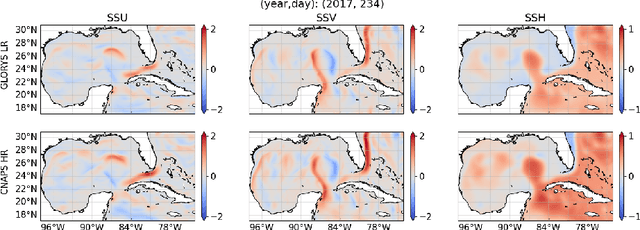

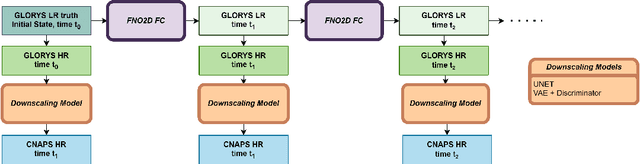
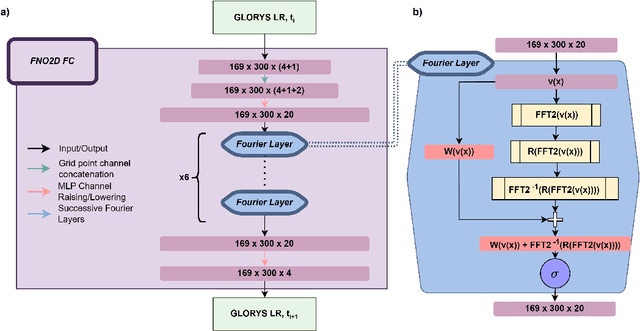
Building on top of the success in AI-based atmospheric emulation, we propose an AI-based ocean emulation and downscaling framework focusing on the high-resolution regional ocean over Gulf of Mexico. Regional ocean emulation presents unique challenges owing to the complex bathymetry and lateral boundary conditions as well as from fundamental biases in deep learning-based frameworks, such as instability and hallucinations. In this paper, we develop a deep learning-based framework to autoregressively integrate ocean-surface variables over the Gulf of Mexico at $8$ Km spatial resolution without unphysical drifts over decadal time scales and simulataneously downscale and bias-correct it to $4$ Km resolution using a physics-constrained generative model. The framework shows both short-term skills as well as accurate long-term statistics in terms of mean and variability.