 Add to Chrome
 Add to Firefox
 Add to Edge
Calibration of a neural network ocean closure for improved mean state and variability
Apr 07, 2026
Global ocean models exhibit biases in the mean state and variability, particularly at coarse resolution, where mesoscale eddies are unresolved. To address these biases, parameterization coefficients are typically tuned ad hoc. Here, we formulate parameter tuning as a calibration problem using Ensemble Kalman Inversion (EKI). We optimize parameters of a neural network parameterization of mesoscale eddies in two idealized ocean models at coarse resolution. The calibrated parameterization reduces errors in the time-averaged fluid interfaces and their variability by approximately a factor of two compared to the unparameterized model or the offline-trained parameterization. The EKI method is robust to noise in time-averaged statistics arising from chaotic ocean dynamics. Furthermore, we propose an efficient calibration protocol that bypasses integration to statistical equilibrium by carefully choosing an initial condition. These results demonstrate that systematic calibration can substantially improve coarse-resolution ocean simulations and provide a practical pathway for reducing biases in global ocean models.

Data-Driven Probabilistic Air-Sea Flux Parameterization
Mar 06, 2025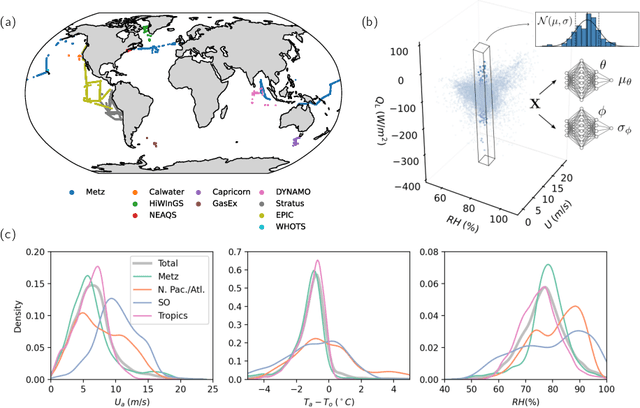
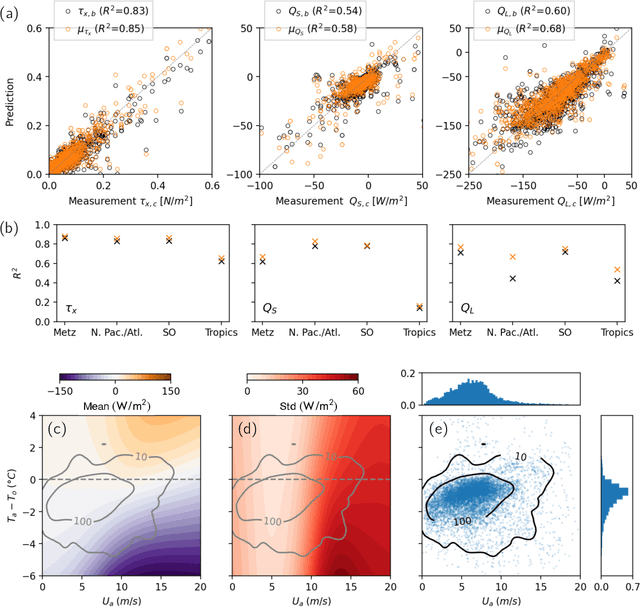
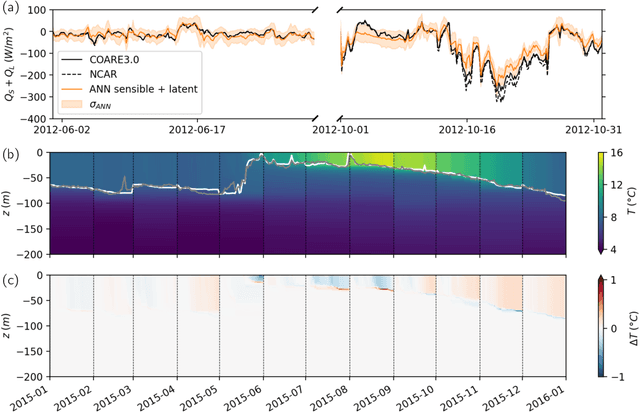
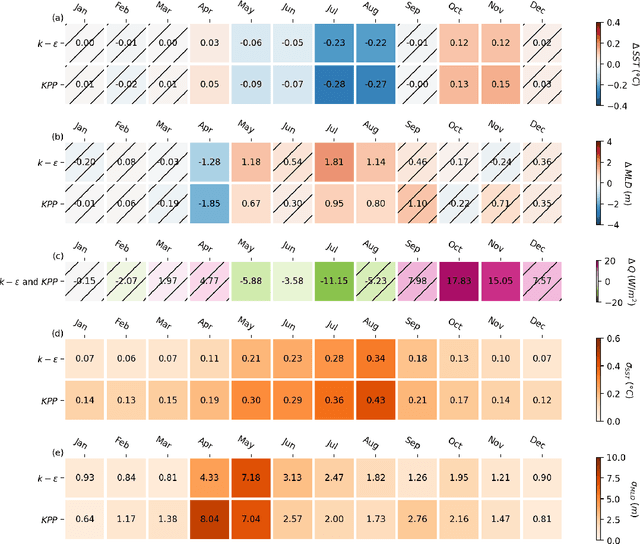
Accurately quantifying air-sea fluxes is important for understanding air-sea interactions and improving coupled weather and climate systems. This study introduces a probabilistic framework to represent the highly variable nature of air-sea fluxes, which is missing in deterministic bulk algorithms. Assuming Gaussian distributions conditioned on the input variables, we use artificial neural networks and eddy-covariance measurement data to estimate the mean and variance by minimizing negative log-likelihood loss. The trained neural networks provide alternative mean flux estimates to existing bulk algorithms, and quantify the uncertainty around the mean estimates. Stochastic parameterization of air-sea turbulent fluxes can be constructed by sampling from the predicted distributions. Tests in a single-column forced upper-ocean model suggest that changes in flux algorithms influence sea surface temperature and mixed layer depth seasonally. The ensemble spread in stochastic runs is most pronounced during spring restratification.