 Add to Chrome
 Add to Firefox
 Add to Edge
Stochastic Emulation of a Fully Coupled Preindustrial E3SMv3 Simulation
Aug 10, 2026
We present a stochastic coupled emulator of E3SM version 3, built on the SamudrACE framework, which couples an atmosphere emulator (ACE2) with a full-depth ocean emulator (Samudra). We replace the deterministic atmosphere emulator with its stochastic counterpart, ACE2S, and fine-tune the coupled system with a probabilistic objective, so that the atmosphere acts as a source of internal variability for the ocean. Trained on 105 years of a pre-industrial control simulation and evaluated on an independent 400 years, the emulator reproduces E3SMv3's mean climate state with biases much smaller than existing model-to-observation differences. Relative to a deterministic baseline, stochastic training maintains internal variability across timescales, most notably in the ENSO power spectrum, eddy-rich SST anomalies, and sea ice variability in the marginal ice zone. The emulator captures daily precipitation accurately up to the 99.99th percentile, but underestimates the rarest tropical extremes. These results show that stochastic coupled emulators can reproduce long-timescale variability with high fidelity, while extrapolation to unseen extremes remains a key challenge.

FloeNet: A mass-conserving global sea ice emulator that generalizes across climates
Mar 12, 2026We introduce FloeNet, a machine-learning emulator trained on the Geophysical Fluid Dynamics Laboratory global sea ice model, SIS2. FloeNet is a mass-conserving model, emulating 6-hour mass and area budget tendencies related to sea ice and snow-on-sea-ice growth, melt, and advection. We train FloeNet using simulated data from a reanalysis-forced ice-ocean simulation and test its ability to generalize to pre-industrial control and 1% CO2 climates. FloeNet outperforms a non-conservative model at reproducing sea ice and snow-on-sea-ice mean state, trends, and inter-annual variability, with volume anomaly correlations above 0.96 in the Antarctic and 0.76 in the Arctic, across all forcings. FloeNet also produces the correct thermodynamic vs dynamic response to forcing, enabling physical interpretability of emulator output. Finally, we show that FloeNet outputs high-fidelity coupling-related variables, including ice-surface skin temperature, ice-to-ocean salt flux, and melting energy fluxes. We hypothesize that FloeNet will improve polar climate processes within existing atmosphere and ocean emulators.
SamudrACE: Fast and Accurate Coupled Climate Modeling with 3D Ocean and Atmosphere Emulators
Sep 15, 2025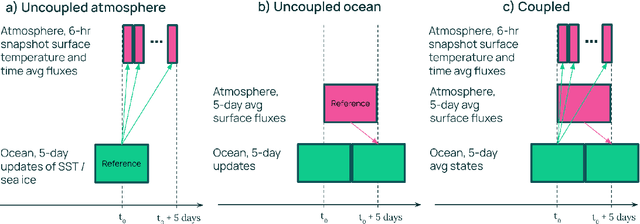
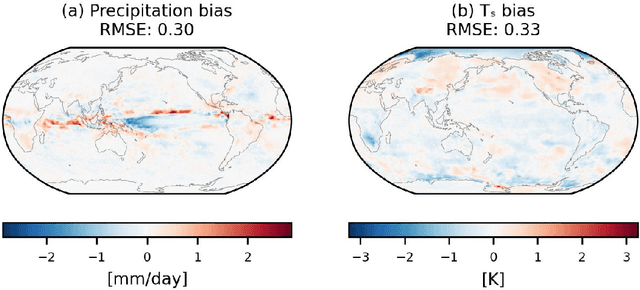
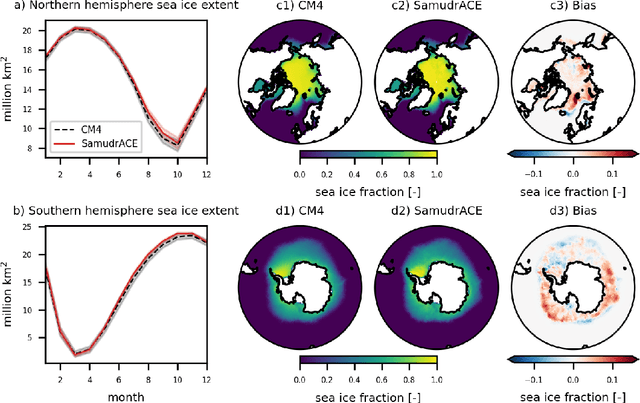
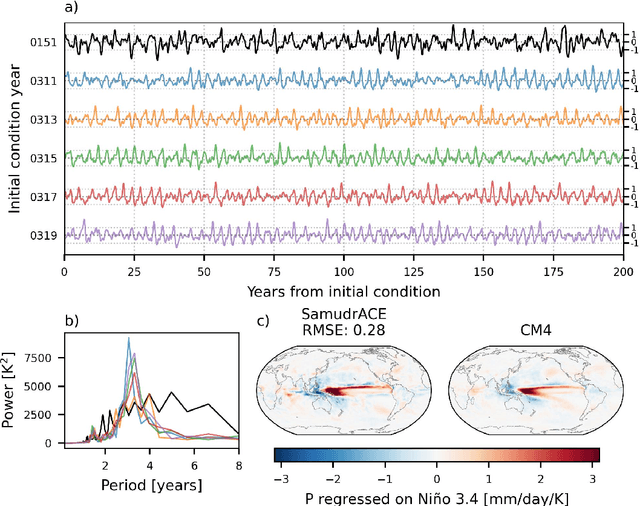
Traditional numerical global climate models simulate the full Earth system by exchanging boundary conditions between separate simulators of the atmosphere, ocean, sea ice, land surface, and other geophysical processes. This paradigm allows for distributed development of individual components within a common framework, unified by a coupler that handles translation between realms via spatial or temporal alignment and flux exchange. Following a similar approach adapted for machine learning-based emulators, we present SamudrACE: a coupled global climate model emulator which produces centuries-long simulations at 1-degree horizontal, 6-hourly atmospheric, and 5-daily oceanic resolution, with 145 2D fields spanning 8 atmospheric and 19 oceanic vertical levels, plus sea ice, surface, and top-of-atmosphere variables. SamudrACE is highly stable and has low climate biases comparable to those of its components with prescribed boundary forcing, with realistic variability in coupled climate phenomena such as ENSO that is not possible to simulate in uncoupled mode.
ACE2: Accurately learning subseasonal to decadal atmospheric variability and forced responses
Nov 18, 2024

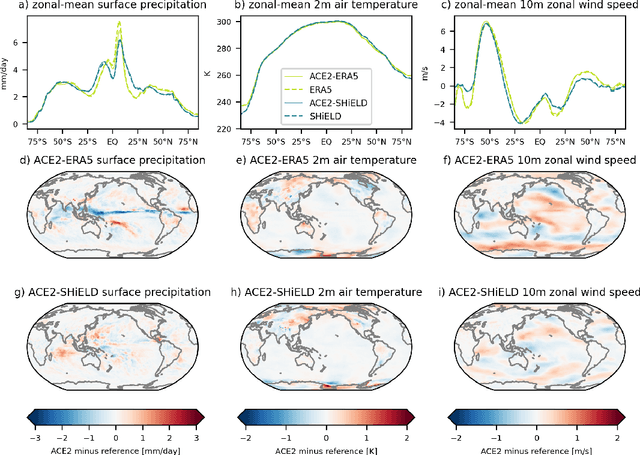
Existing machine learning models of weather variability are not formulated to enable assessment of their response to varying external boundary conditions such as sea surface temperature and greenhouse gases. Here we present ACE2 (Ai2 Climate Emulator version 2) and its application to reproducing atmospheric variability over the past 80 years on timescales from days to decades. ACE2 is a 450M-parameter autoregressive machine learning emulator, operating with 6-hour temporal resolution, 1{\deg} horizontal resolution and eight vertical layers. It exactly conserves global dry air mass and moisture and can be stepped forward stably for arbitrarily many steps with a throughput of about 1500 simulated years per wall clock day. ACE2 generates emergent phenomena such as tropical cyclones, the Madden Julian Oscillation, and sudden stratospheric warmings. Furthermore, it accurately reproduces the atmospheric response to El Ni\~no variability and global trends of temperature over the past 80 years. However, its sensitivities to separately changing sea surface temperature and carbon dioxide are not entirely realistic.