 Add to Chrome
 Add to Firefox
 Add to Edge
Eigenanalysis framework for autoregressive neural emulators of multi-scale chaotic dynamics
Aug 17, 2026
Neural autoregressive models have rapidly emerged as powerful emulators of high-dimensional chaotic systems, yet their long-term instability and error growth remain poorly understood, leading to ad-hoc solutions. Here, we develop an eigenanalysis framework that reveals the dynamical origin of this error growth. By analyzing the Jacobian of the learned one-step update map with respect to the state, we show how inference-time error growth, and thus model stability, is governed by its spectral radius. Direct-step architectures (models that predict the next state from the previous one) generically admit unstable eigenvalues with magnitudes exceeding one, explaining the rapid divergence of these widely used models. In contrast, integration-constrained models (where the time derivative is estimated and integrated with a higher-order integrator) collapse their eigenspectrum onto the unit circle, yielding neutral stability and a universal linear error-scaling law. The largest eigenvalue of this Jacobian provides an architecture-agnostic, a priori diagnostic of short-term skill, long-term stability, and spectral bias, without requiring an expensive rollout. Leveraging this theory, we introduce a stability-promoting loss that explicitly regularizes Jacobian-driven error amplification, improving both forecast accuracy and dynamical robustness. Demonstrated across $29$ models spanning two architectures, several explicit and implicit integrators, and multiple loss functions on the Kuramoto-Sivashinsky system, our results establish a theoretical foundation for the design and evaluation of neural emulators of chaotic multi-scale dynamics. More broadly, our framework is a step toward the kind of a priori stability analysis that numerical analysis provides for discretizations of differential equations and that scientific machine learning currently lacks.

Rigorous uncertainty quantification of probabilistic AI weather forecasts with conformal prediction
Jun 17, 2026Probabilistic weather forecasting is undergoing rapid transformation with artificial intelligence (AI). In traditional numerical weather prediction, computing power can limit how well ensemble forecasts approximate the unknown statistical distribution of future states. AI models facilitate larger ensembles and are trained with probabilistic considerations, ideally leading to better uncertainty quantification. Forecasts from these state-of-the-art models are often considered well-calibrated. However, here we show that the statistical coverage of such models, the ultimate measure of calibration, can struggle, especially on extreme events. To address this shortcoming, we employ conformal prediction, a class of statistical methods that mathematically guarantees coverage under no distributional assumptions, unlike previous post-processing techniques. We apply online conformal prediction to temperature and precipitation forecasts (including extremes) of three leading global weather models, GenCast, NeuralGCM, and AIFS-ENS, ensuring calibrated uncertainty at no expense to other probabilistic metrics. This post-processing method can be applied to any forecasting model.
Designing probabilistic AI monsoon forecasts to inform agricultural decision-making
Mar 10, 2026Hundreds of millions of farmers make high-stakes decisions under uncertainty about future weather. Forecasts can inform these decisions, but available choices and their risks and benefits vary between farmers. We introduce a decision-theory framework for designing useful forecasts in settings where the forecaster cannot prescribe optimal actions because farmers' circumstances are heterogeneous. We apply this framework to the case of seasonal onset of monsoon rains, a key date for planting decisions and agricultural investments in many tropical countries. We develop a system for tailoring forecasts to the requirements of this framework by blending systematically benchmarked artificial intelligence (AI) weather prediction models with a new "evolving farmer expectations" statistical model. This statistical model applies Bayesian inference to historical observations to predict time-varying probabilities of first-occurrence events throughout a season. The blended system yields more skillful Indian monsoon forecasts at longer lead times than its components or any multi-model average. In 2025, this system was deployed operationally in a government-led program that delivered subseasonal monsoon onset forecasts to 38 million Indian farmers, skillfully predicting that year's early-summer anomalous dry period. This decision-theory framework and blending system offer a pathway for developing climate adaptation tools for large vulnerable populations around the world.
Decision-oriented benchmarking to transform AI weather forecast access: Application to the Indian monsoon
Feb 03, 2026Artificial intelligence weather prediction (AIWP) models now often outperform traditional physics-based models on common metrics while requiring orders-of-magnitude less computing resources and time. Open-access AIWP models thus hold promise as transformational tools for helping low- and middle-income populations make decisions in the face of high-impact weather shocks. Yet, current approaches to evaluating AIWP models focus mainly on aggregated meteorological metrics without considering local stakeholders' needs in decision-oriented, operational frameworks. Here, we introduce such a framework that connects meteorology, AI, and social sciences. As an example, we apply it to the 150-year-old problem of Indian monsoon forecasting, focusing on benefits to rain-fed agriculture, which is highly susceptible to climate change. AIWP models skillfully predict an agriculturally relevant onset index at regional scales weeks in advance when evaluated out-of-sample using deterministic and probabilistic metrics. This framework informed a government-led effort in 2025 to send 38 million Indian farmers AI-based monsoon onset forecasts, which captured an unusual weeks-long pause in monsoon progression. This decision-oriented benchmarking framework provides a key component of a blueprint for harnessing the power of AIWP models to help large vulnerable populations adapt to weather shocks in the face of climate variability and change.
AI-boosted rare event sampling to characterize extreme weather
Oct 31, 2025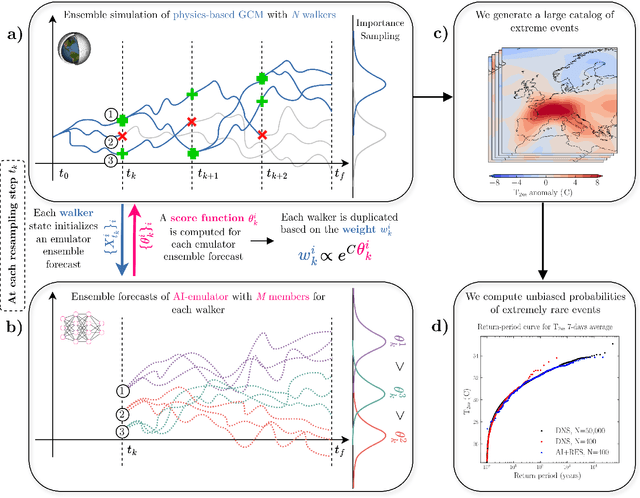
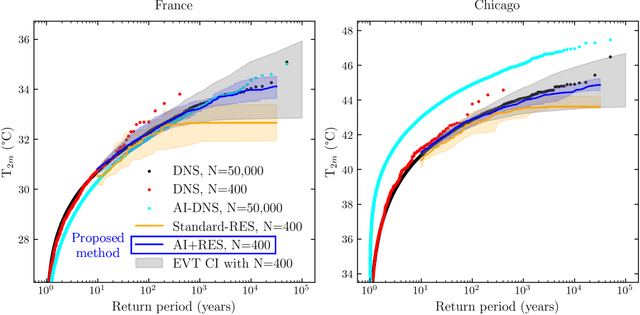
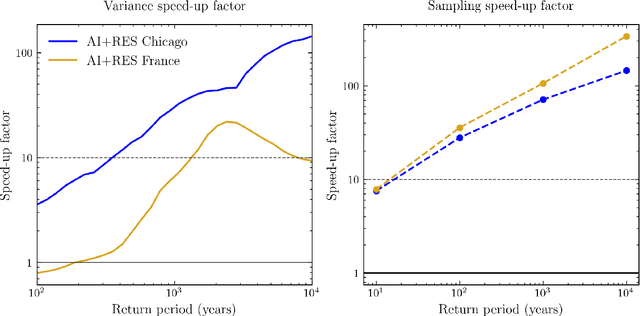
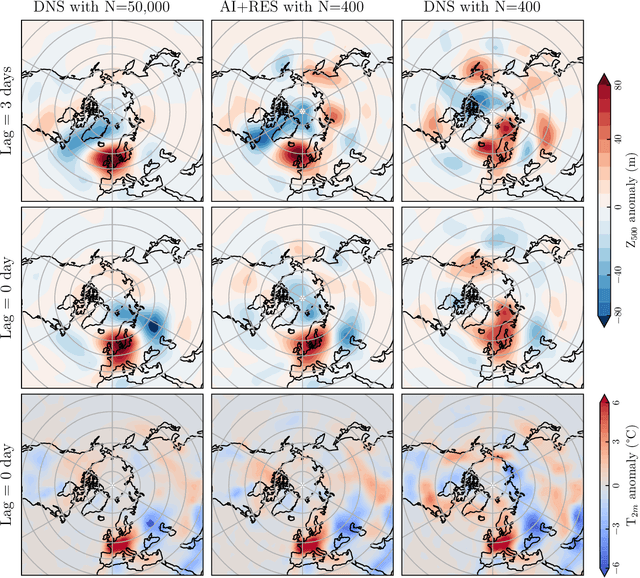
Assessing the frequency and intensity of extreme weather events, and understanding how climate change affects them, is crucial for developing effective adaptation and mitigation strategies. However, observational datasets are too short and physics-based global climate models (GCMs) are too computationally expensive to obtain robust statistics for the rarest, yet most impactful, extreme events. AI-based emulators have shown promise for predictions at weather and even climate timescales, but they struggle on extreme events with few or no examples in their training dataset. Rare event sampling (RES) algorithms have previously demonstrated success for some extreme events, but their performance depends critically on a hard-to-identify "score function", which guides efficient sampling by a GCM. Here, we develop a novel algorithm, AI+RES, which uses ensemble forecasts of an AI weather emulator as the score function to guide highly efficient resampling of the GCM and generate robust (physics-based) extreme weather statistics and associated dynamics at 30-300x lower cost. We demonstrate AI+RES on mid-latitude heatwaves, a challenging test case requiring a score function with predictive skill many days in advance. AI+RES, which synergistically integrates AI, RES, and GCMs, offers a powerful, scalable tool for studying extreme events in climate science, as well as other disciplines in science and engineering where rare events and AI emulators are active areas of research.
Benchmarking atmospheric circulation variability in an AI emulator, ACE2, and a hybrid model, NeuralGCM
Oct 06, 2025Physics-based atmosphere-land models with prescribed sea surface temperature have notable successes but also biases in their ability to represent atmospheric variability compared to observations. Recently, AI emulators and hybrid models have emerged with the potential to overcome these biases, but still require systematic evaluation against metrics grounded in fundamental atmospheric dynamics. Here, we evaluate the representation of four atmospheric variability benchmarking metrics in a fully data-driven AI emulator (ACE2-ERA5) and hybrid model (NeuralGCM). The hybrid model and emulator can capture the spectra of large-scale tropical waves and extratropical eddy-mean flow interactions, including critical levels. However, both struggle to capture the timescales associated with quasi-biennial oscillation (QBO, $\sim 28$ months) and Southern annular mode propagation ($\sim 150$ days). These dynamical metrics serve as an initial benchmarking tool to inform AI model development and understand their limitations, which may be essential for out-of-distribution applications (e.g., extrapolating to unseen climates).
Hierarchical Implicit Neural Emulators
Jun 05, 2025Neural PDE solvers offer a powerful tool for modeling complex dynamical systems, but often struggle with error accumulation over long time horizons and maintaining stability and physical consistency. We introduce a multiscale implicit neural emulator that enhances long-term prediction accuracy by conditioning on a hierarchy of lower-dimensional future state representations. Drawing inspiration from the stability properties of numerical implicit time-stepping methods, our approach leverages predictions several steps ahead in time at increasing compression rates for next-timestep refinements. By actively adjusting the temporal downsampling ratios, our design enables the model to capture dynamics across multiple granularities and enforce long-range temporal coherence. Experiments on turbulent fluid dynamics show that our method achieves high short-term accuracy and produces long-term stable forecasts, significantly outperforming autoregressive baselines while adding minimal computational overhead.
Fourier analysis of the physics of transfer learning for data-driven subgrid-scale models of ocean turbulence
Apr 21, 2025Transfer learning (TL) is a powerful tool for enhancing the performance of neural networks (NNs) in applications such as weather and climate prediction and turbulence modeling. TL enables models to generalize to out-of-distribution data with minimal training data from the new system. In this study, we employ a 9-layer convolutional NN to predict the subgrid forcing in a two-layer ocean quasi-geostrophic system and examine which metrics best describe its performance and generalizability to unseen dynamical regimes. Fourier analysis of the NN kernels reveals that they learn low-pass, Gabor, and high-pass filters, regardless of whether the training data are isotropic or anisotropic. By analyzing the activation spectra, we identify why NNs fail to generalize without TL and how TL can overcome these limitations: the learned weights and biases from one dataset underestimate the out-of-distribution sample spectra as they pass through the network, leading to an underestimation of output spectra. By re-training only one layer with data from the target system, this underestimation is corrected, enabling the NN to produce predictions that match the target spectra. These findings are broadly applicable to data-driven parameterization of dynamical systems.
Can AI weather models predict out-of-distribution gray swan tropical cyclones?
Oct 19, 2024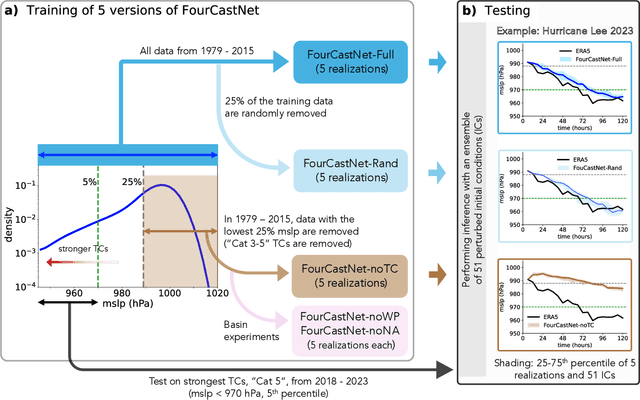
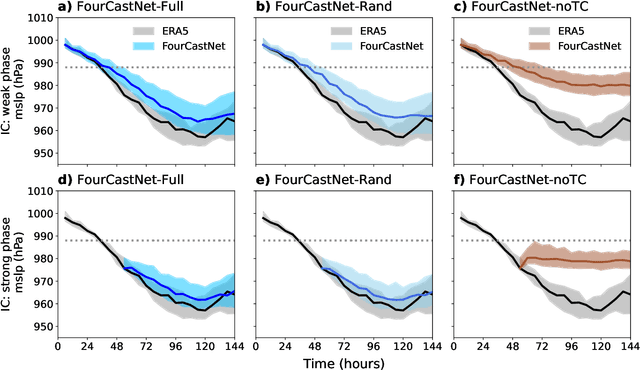
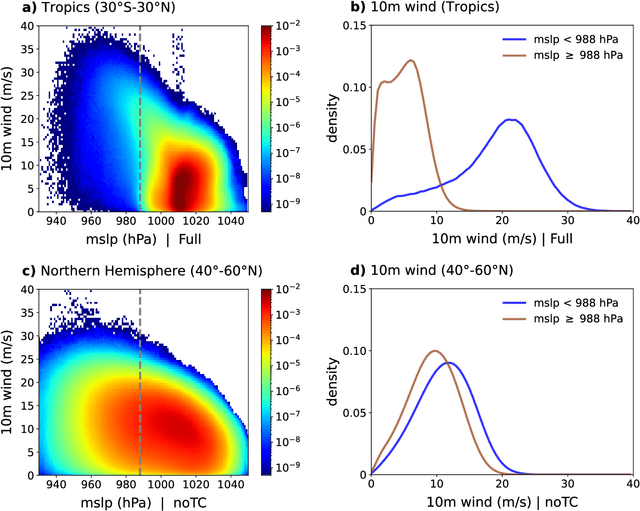
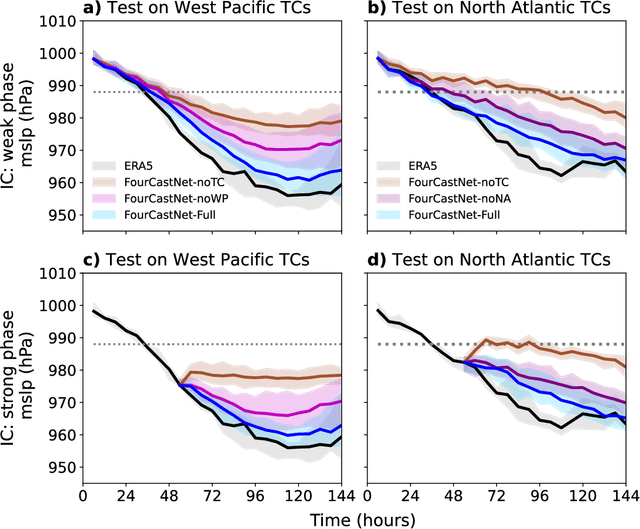
Predicting gray swan weather extremes, which are possible but so rare that they are absent from the training dataset, is a major concern for AI weather/climate models. An important open question is whether AI models can extrapolate from weaker weather events present in the training set to stronger, unseen weather extremes. To test this, we train independent versions of the AI model FourCastNet on the 1979-2015 ERA5 dataset with all data, or with Category 3-5 tropical cyclones (TCs) removed, either globally or only over the North Atlantic or Western Pacific basin. We then test these versions of FourCastNet on 2018-2023 Category 5 TCs (gray swans). All versions yield similar accuracy for global weather, but the one trained without Category 3-5 TCs cannot accurately forecast Category 5 TCs, indicating that these models cannot extrapolate from weaker storms. The versions trained without Category 3-5 TCs in one basin show some skill forecasting Category 5 TCs in that basin, suggesting that FourCastNet can generalize across tropical basins. This is encouraging and surprising because regional information is implicitly encoded in inputs. No version satisfies gradient-wind balance, implying that enforcing such physical constraints may not improve generalizability to gray swans. Given that current state-of-the-art AI weather/climate models have similar learning strategies, we expect our findings to apply to other models and extreme events. Our work demonstrates that novel learning strategies are needed for AI weather/climate models to provide early warning or estimated statistics for the rarest, most impactful weather extremes.
On the importance of learning non-local dynamics for stable data-driven climate modeling: A 1D gravity wave-QBO testbed
Jul 07, 2024Machine learning (ML) techniques, especially neural networks (NNs), have shown promise in learning subgrid-scale (SGS) parameterizations for climate modeling. However, a major problem with data-driven parameterizations, particularly those learned with supervised algorithms, is instability when integrated with numerical solvers of large-scale processes. Current remedies are often ad-hoc and lack a theoretical foundation. Here, we combine ML theory and climate physics to address a source of instability in NN-based parameterization. We demonstrate the importance of learning spatially non-local dynamics using a 1D model of the quasi-biennial oscillation (QBO) with gravity wave (GW) parameterization as a testbed. While common offline metrics fail to identify shortcomings in learning non-local dynamics, we show that the receptive field (RF)-the region of the input an NN uses to predict an output-can identify instability a-priori. We find that NN-based parameterizations that seem to accurately predict GW forcings from wind profiles ($\mathbf{R^2 \approx 0.99}$) cause unstable simulations when RF is too small to capture the non-local dynamics, while NNs of the same size but large-enough RF are stable. Some architectures, e.g., Fourier neural operators, have inherently large RF. We also demonstrate that learning non-local dynamics can be crucial for the stability and accuracy of a data-driven spatiotemporal emulator of the entire zonal wind field. Given the ubiquity of non-local dynamics in the climate system, we expect the use of effective RF, which can be computed for any NN architecture, to be important for many applications. This work highlights the need to integrate ML theory with physics for designing/analyzing data-driven algorithms for weather/climate modeling.