 Add to Chrome
 Add to Firefox
 Add to Edge
Examining Fast Radiative Feedbacks Using Machine-Learning Weather Emulators
Feb 17, 2026
The response of the climate system to increased greenhouse gases and other radiative perturbations is governed by a combination of fast and slow feedbacks. Slow feedbacks are typically activated in response to changes in ocean temperatures on decadal timescales and manifest as changes in climatic state with no recent historical analogue. However, fast feedbacks are activated in response to rapid atmospheric physical processes on weekly timescales, and they are already operative in the present-day climate. This distinction implies that the physics of fast radiative feedbacks is present in the historical meteorological reanalyses used to train many recent successful machine-learning-based (ML) emulators of weather and climate. In addition, these feedbacks are functional under the historical boundary conditions pertaining to the top-of-atmosphere radiative balance and sea-surface temperatures. Together, these factors imply that we can use historically trained ML weather emulators to study the response of radiative-convective equilibrium (RCE), and hence the global hydrological cycle, to perturbations in carbon dioxide and other well-mixed greenhouse gases. Without retraining on prospective Earth system conditions, we use ML weather emulators to quantify the fast precipitation response to reduced and elevated carbon dioxed concentrations with no recent historical precedent. We show that the responses from historically trained emulators agree with those produced by full-physics Earth System Models (ESMs). In conclusion, we discuss the prospects for and advantages from using ESMs and ML emulators to study fast processes in global climate.

SamudrACE: Fast and Accurate Coupled Climate Modeling with 3D Ocean and Atmosphere Emulators
Sep 15, 2025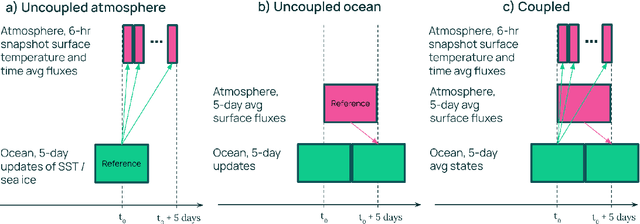
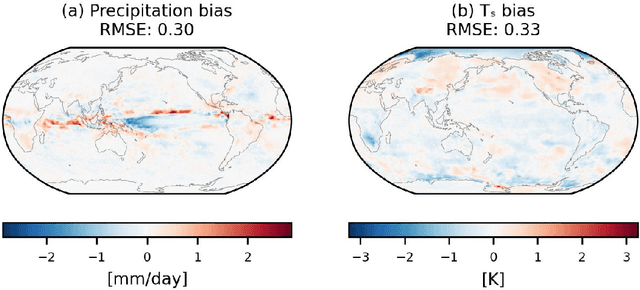
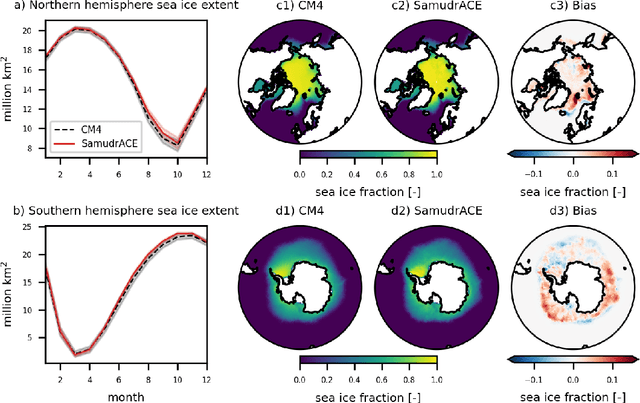
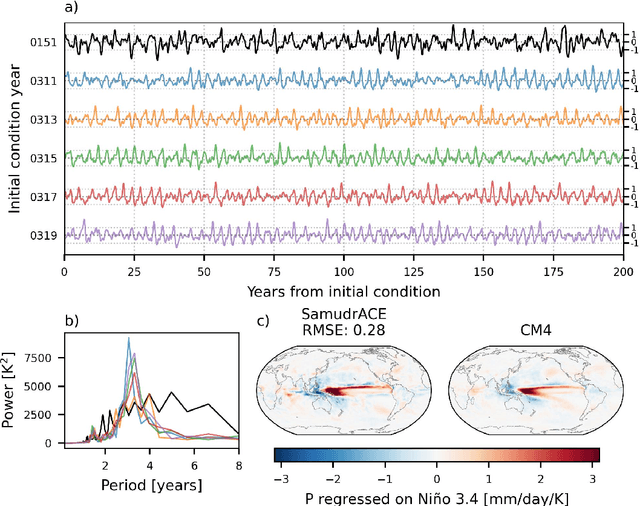
Traditional numerical global climate models simulate the full Earth system by exchanging boundary conditions between separate simulators of the atmosphere, ocean, sea ice, land surface, and other geophysical processes. This paradigm allows for distributed development of individual components within a common framework, unified by a coupler that handles translation between realms via spatial or temporal alignment and flux exchange. Following a similar approach adapted for machine learning-based emulators, we present SamudrACE: a coupled global climate model emulator which produces centuries-long simulations at 1-degree horizontal, 6-hourly atmospheric, and 5-daily oceanic resolution, with 145 2D fields spanning 8 atmospheric and 19 oceanic vertical levels, plus sea ice, surface, and top-of-atmosphere variables. SamudrACE is highly stable and has low climate biases comparable to those of its components with prescribed boundary forcing, with realistic variability in coupled climate phenomena such as ENSO that is not possible to simulate in uncoupled mode.