 Add to Chrome
 Add to Firefox
 Add to Edge
Learning from Unreachable Rewards: Hint-Conditioned Reinforcement Learning for Generative Recommendation
Aug 15, 2026
Semantic-ID generative recommenders represent each item as a short sequence of discrete semantic tokens and predict the next item by autoregressively generating this token sequence. This paradigm enables a unified generation interface for item IDs, histories, and item text, but it also creates a structured optimization bottleneck during reward-based post-training: when an early semantic token enters the wrong branch of the item-token space, finite rollout groups rarely reach the ground-truth item, so group-relative optimization receives identical zero rewards and produces no useful advantage. We propose Hint-Conditioned Generative Recommendation (HCGRec), a semantic-ID generative recommendation framework that recovers learning signal for such hard training instances. HCGRec diagnoses each instance with checkpoint rollouts and supplies a minimal target-prefix hint only when the current generator cannot reach the correct item. The model then generates the unhinted suffix under the hinted semantic branch, turning zero-reward groups into informative comparisons over item-token completions. Hinting also changes token identity: hinted prefix tokens are oracle-provided item context, while unhinted suffix tokens are sampled generation actions. We therefore introduce hint-aware credit decomposition, using supervised learning to preserve item-semantic and prefix-structure alignment for hinted tokens and GRPO to optimize the sampled suffix. Experiments on sequential recommendation benchmarks show that HCGRec substantially improves over supervised fine-tuning and vanilla reward-based post-training, while reducing zero-advantage training samples from over 70% to below 20%. The code is accessible at https://github.com/WncFht/GRec.

HCGRec: Hint-Conditioned Generative Recommendation with Semantic IDs
Aug 12, 2026Semantic-ID generative recommenders represent each item as a short sequence of discrete semantic tokens and predict the next item by autoregressively generating this token sequence. This paradigm enables a unified generation interface for item IDs, histories, and item text, but it also creates a structured optimization bottleneck during reward-based post-training: when an early semantic token enters the wrong branch of the item-token space, finite rollout groups rarely reach the ground-truth item, so group-relative optimization receives identical zero rewards and produces no useful advantage. We propose Hint-Conditioned Generative Recommendation (HCGRec), a semantic-ID generative recommendation framework that recovers learning signal for such hard training instances. HCGRec diagnoses each instance with checkpoint rollouts and supplies a minimal target-prefix hint only when the current generator cannot reach the correct item. The model then generates the unhinted suffix under the hinted semantic branch, turning zero-reward groups into informative comparisons over item-token completions. Hinting also changes token identity: hinted prefix tokens are oracle-provided item context, while unhinted suffix tokens are sampled generation actions. We therefore introduce hint-aware credit decomposition, using supervised learning to preserve item-semantic and prefix-structure alignment for hinted tokens and GRPO to optimize the sampled suffix. Experiments on sequential recommendation benchmarks show that HCGRec substantially improves over supervised fine-tuning and vanilla reward-based post-training, while reducing zero-advantage training samples from over 70% to below 20%. The code is accessible at https://github.com/WncFht/GRec.
A Sequence Tagging based Framework for Few-Shot Relation Extraction
Aug 17, 2022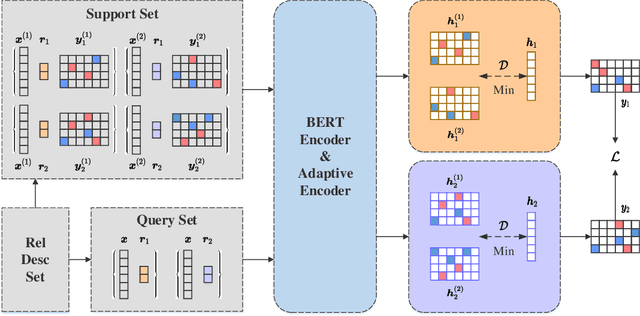
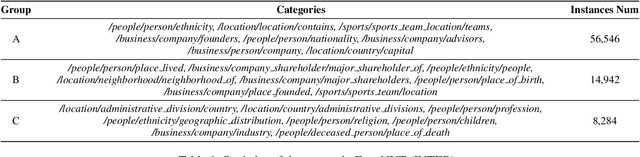
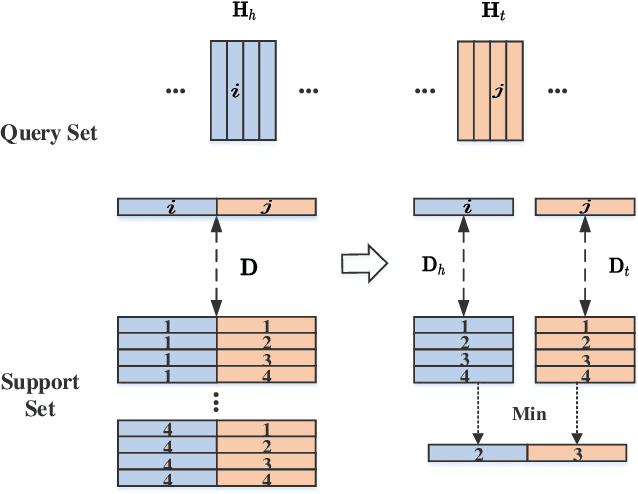
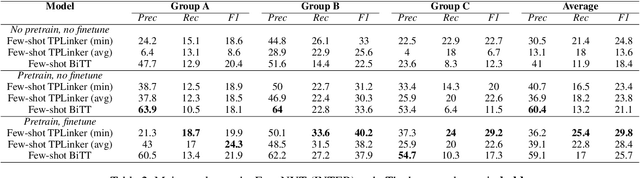
Relation Extraction (RE) refers to extracting the relation triples in the input text. Existing neural work based systems for RE rely heavily on manually labeled training data, but there are still a lot of domains where sufficient labeled data does not exist. Inspired by the distance-based few-shot named entity recognition methods, we put forward the definition of the few-shot RE task based on the sequence tagging joint extraction approaches, and propose a few-shot RE framework for the task. Besides, we apply two actual sequence tagging models to our framework (called Few-shot TPLinker and Few-shot BiTT), and achieves solid results on two few-shot RE tasks constructed from a public dataset.
BiTT: Bidirectional Tree Tagging for Joint Extraction of Overlapping Entities and Relations
Sep 07, 2020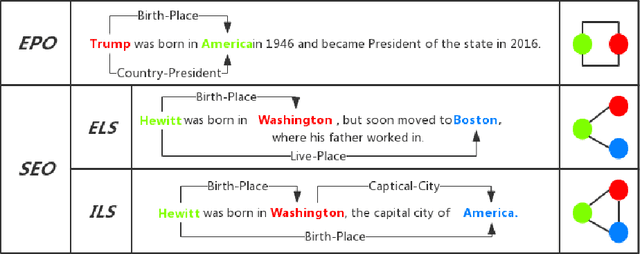
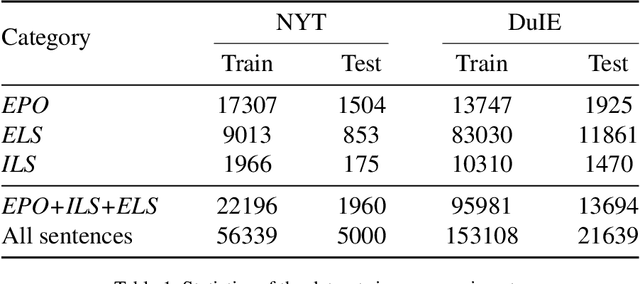
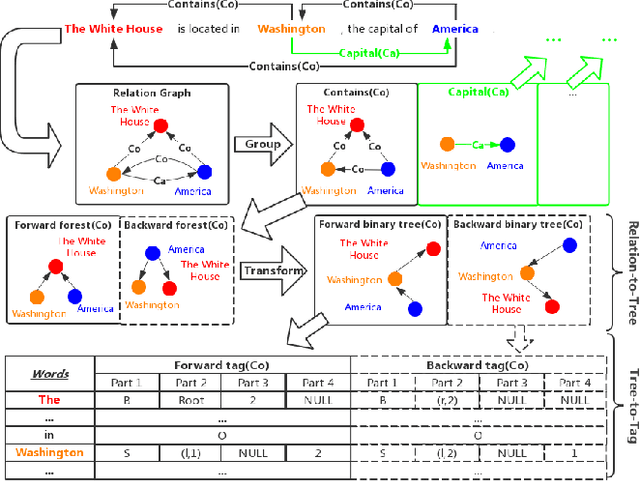
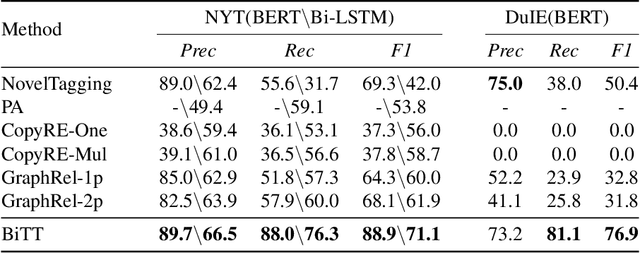
Joint extraction refers to extracting triples, composed of entities and relations, simultaneously from the text with a single model. However, most existing methods fail to extract all triples accurately and efficiently from sentences with overlapping issue, i.e., the same entity is included in multiple triples. In this paper, we propose a novel scheme called Bidirectional Tree Tagging (BiTT) to label overlapping triples in text. In BiTT, the triples with the same relation category in a sentence are especially represented as two binary trees, each of which is converted into a word-level tags sequence to label each word. Based on BiTT scheme, we develop an end-to-end extraction framework to predict the BiTT tags and further extract triples efficiently. We adopt the Bi-LSTM and the BERT as the encoder in our framework respectively, and obtain promising results in public English as well as Chinese datasets.