 Add to Chrome
 Add to Firefox
 Add to Edge
TruthLens: Object Hallucination Detection via Self-Evaluating Truthfulness Scores in LVLMs
Aug 06, 2026
Despite the remarkable progress of large vision language models (LVLMs), object hallucination remains a fundamental challenge that hinders their trustworthy deployment. A key finding motivates our work: real and hallucinated object tokens are clearly separable in hidden representations, yet this separability is largely lost at the language-modeling (LM) head. We propose TruthLens, a self-evaluation framework that teaches the LM head to expose a per-object truthfulness signal without any auxiliary model or additional inference cost. Concretely, a rarely-used special token is repurposed as a reference token. For each object-token position, we extract the log-probability assigned to this special token by the LM head, and define its difference from a predefined constant as the truthfulness score. The model is then fine-tuned with an MSE objective that drives scores toward 1 for real objects and 0 for hallucinated ones, while a divergence constraint preserves the original generation capability. Despite being trained on only a limited set of object categories, TruthLens generalizes effectively to benchmarks with substantially larger label spaces. Extensive experiments across multiple LVLMs demonstrate state-of-the-art performance; notably, on Qwen2.5-VL-7B, TruthLens outperforms the previous best method on MS-COCO by over 17\% in AUROC. Our code is available at https://github.com/wyqstan/TruthLens.

DynProto: Dynamic Prototype Evolution for Out-of-Distribution Detection
Apr 26, 2026Recent studies show that using potential out-of-distribution (OOD) labels from large corpora as auxiliary information can improve OOD detection in vision-language models (VLMs). However, these methods often fail when real-world OOD samples fall outside the predefined OOD label set. To address this limitation, we propose DynProto, a novel approach that learns OOD prototypes dynamically during testing using only in-distribution (ID) information. DynProto is inspired by a key observation: OOD samples predicted as the same ID class tend to cluster in the feature space. With this insight, we leverage easy-to-detect OOD samples as ``anchors'' to find their harder-to-detect, similar counterparts. To this end, DynProto introduces two modules: \textbf{Coarse OOD Pattern Capturing Module} caches OOD patterns that are easily confused with each ID class during testing, and \textbf{Fine-grained OOD Pattern Refinement Module} subsequently clusters these patterns within each cache and aggregates them into representative OOD prototypes. By measuring similarity to ID and dynamic OOD prototypes, DynProto enables accurate OOD detection. DynProto significantly outperforms prior methods across multiple benchmarks. On ImageNet OOD benchmark, DynProto reduces FPR95 by 11.60\% and improves AUROC by 4.70\%. Moreover, the framework is architecture-agnostic and can be integrated into various backbones.
DCAC: Dynamic Class-Aware Cache Creates Stronger Out-of-Distribution Detectors
Jan 18, 2026Out-of-distribution (OOD) detection remains a fundamental challenge for deep neural networks, particularly due to overconfident predictions on unseen OOD samples during testing. We reveal a key insight: OOD samples predicted as the same class, or given high probabilities for it, are visually more similar to each other than to the true in-distribution (ID) samples. Motivated by this class-specific observation, we propose DCAC (Dynamic Class-Aware Cache), a training-free, test-time calibration module that maintains separate caches for each ID class to collect high-entropy samples and calibrate the raw predictions of input samples. DCAC leverages cached visual features and predicted probabilities through a lightweight two-layer module to mitigate overconfident predictions on OOD samples. This module can be seamlessly integrated with various existing OOD detection methods across both unimodal and vision-language models while introducing minimal computational overhead. Extensive experiments on multiple OOD benchmarks demonstrate that DCAC significantly enhances existing methods, achieving substantial improvements, i.e., reducing FPR95 by 6.55% when integrated with ASH-S on ImageNet OOD benchmark.
Hierarchical Vision-Language Learning for Medical Out-of-Distribution Detection
Aug 25, 2025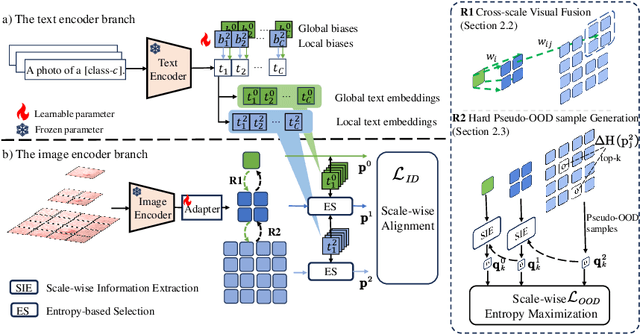
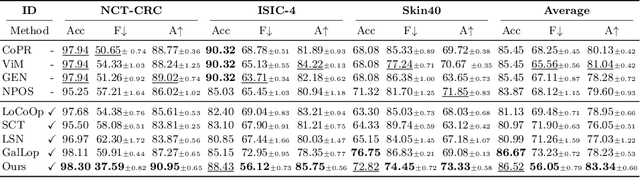
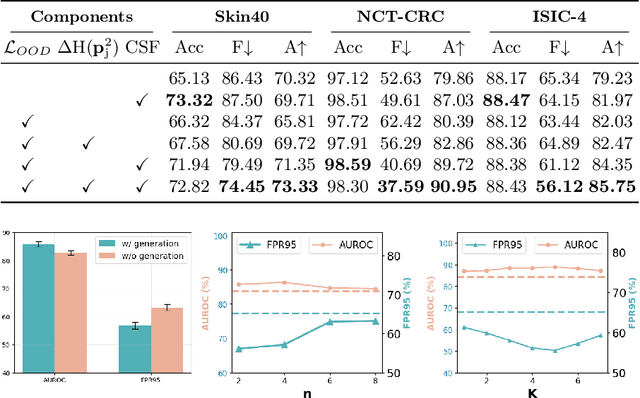
In trustworthy medical diagnosis systems, integrating out-of-distribution (OOD) detection aims to identify unknown diseases in samples, thereby mitigating the risk of misdiagnosis. In this study, we propose a novel OOD detection framework based on vision-language models (VLMs), which integrates hierarchical visual information to cope with challenging unknown diseases that resemble known diseases. Specifically, a cross-scale visual fusion strategy is proposed to couple visual embeddings from multiple scales. This enriches the detailed representation of medical images and thus improves the discrimination of unknown diseases. Moreover, a cross-scale hard pseudo-OOD sample generation strategy is proposed to benefit OOD detection maximally. Experimental evaluations on three public medical datasets support that the proposed framework achieves superior OOD detection performance compared to existing methods. The source code is available at https://openi.pcl.ac.cn/OpenMedIA/HVL.
Lite-SAM Is Actually What You Need for Segment Everything
Jul 12, 2024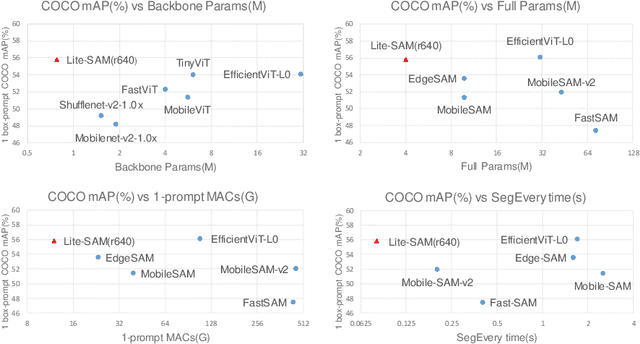
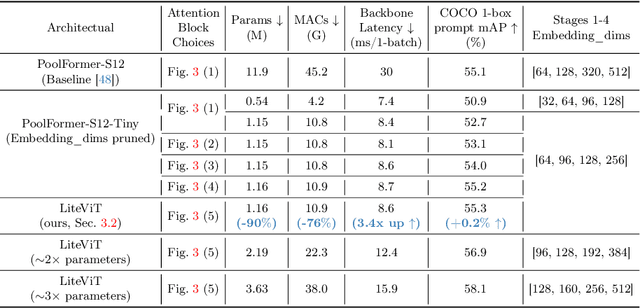
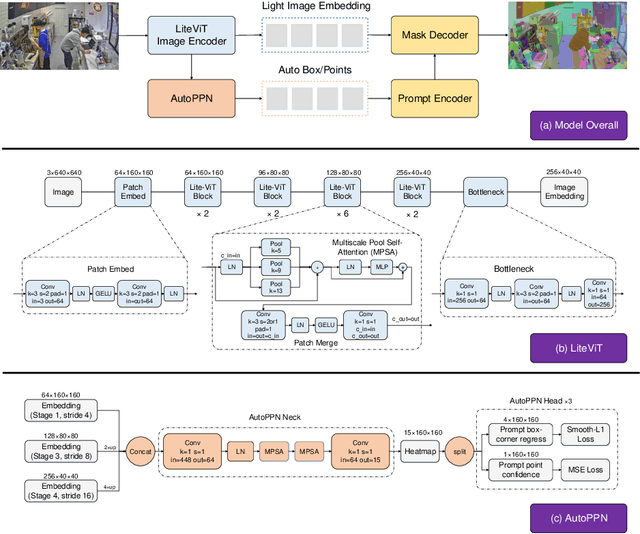
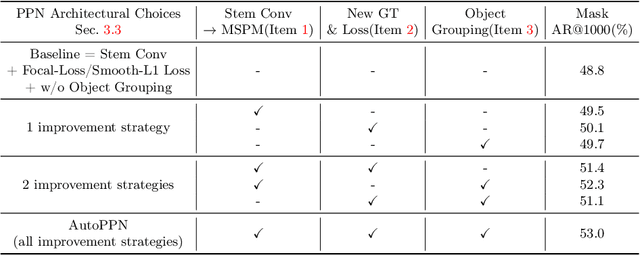
This paper introduces Lite-SAM, an efficient end-to-end solution for the SegEvery task designed to reduce computational costs and redundancy. Lite-SAM is composed of four main components: a streamlined CNN-Transformer hybrid encoder (LiteViT), an automated prompt proposal network (AutoPPN), a traditional prompt encoder, and a mask decoder. All these components are integrated within the SAM framework. Our LiteViT, a high-performance lightweight backbone network, has only 1.16M parameters, which is a 23% reduction compared to the lightest existing backbone network Shufflenet. We also introduce AutoPPN, an innovative end-to-end method for prompt boxes and points generation. This is an improvement over traditional grid search sampling methods, and its unique design allows for easy integration into any SAM series algorithm, extending its usability. we have thoroughly benchmarked Lite-SAM across a plethora of both public and private datasets. The evaluation encompassed a broad spectrum of universal metrics, including the number of parameters, SegEvery execution time, and accuracy. The findings reveal that Lite-SAM, operating with a lean 4.2M parameters, significantly outpaces its counterparts, demonstrating performance improvements of 43x, 31x, 20x, 21x, and 1.6x over SAM, MobileSAM, Edge-SAM, EfficientViT-SAM, and MobileSAM-v2 respectively, all the while maintaining competitive accuracy. This underscores Lite-SAM's prowess in achieving an optimal equilibrium between performance and precision, thereby setting a new state-of-the-art(SOTA) benchmark in the domain.