 Add to Chrome
 Add to Firefox
 Add to Edge
Arm-Aware Guided Dexterous Grasp Generation with Arm-Agnostic Grasp Models
Aug 17, 2026
Dexterous grasp generation that considers arm-related constraints is crucial in real-world scenarios involving arm environment collision avoidance, workspace boundary grasps, and consecutive grasping. Existing hand-centric grasp models, which primarily focus on the floating hand's pose, are insufficient for such cases. Conventional arm-aware methods either rely on rejection sampling to discard infeasible samples or require retraining on arm-specific data, leading to low sample efficiency under adverse conditions or limited generalization across different robots and environments. To overcome these limitations, this letter presents an arm-aware dexterous grasp generation framework that leverages pretrained arm-agnostic grasp models while integrating arm and environmental information only at inference time. Specifically, we formulate arm-aware constrained grasp generation as a joint optimization of hand pose and arm configuration, and derive closed-form gradients for arm-related constraints. Assuming the hand pose distribution is represented by a diffusion model, we prove that gradient-based optimization is equivalent to guided diffusion sampling, steering near-feasible samples toward the feasible region. Through comprehensive evaluation involving 10k objects across 6 scenarios, we demonstrate that the proposed framework generates feasible grasps in highly constrained settings with significantly higher probability, highlighting its advantages in real-world applications. Supplementary materials and appendix are available at https://arm-aware-dexgrasp.github.io/.

HUGS: Guiding Unified Dexterous Grasp Synthesis Across Modes and Scales via Learned Human Priors
Jul 06, 2026Dexterous grasping across diverse object scales requires contact modes ranging from two-finger pinches to bimanual grasps. Existing dexterous grasp synthesis methods reduce the high-dimensional optimization space with manually designed expected contacts and initialization heuristics, which struggle to balance synthesis success rate and diversity. We present HUGS (Human-prior-guided Unified Dexterous Grasp Synthesis), a human-prior-guided framework for unified dexterous grasp synthesis across modes and scales. Instead of directly retargeting human demonstrations, HUGS learns an object-conditioned human prior that captures human grasp preferences and guides downstream force-closure-aware optimization. The prior is trained on a compact self-collected human grasp dataset with 1.8K grasps over 304 objects, providing broad coverage of object scales and contact modes. During synthesis, HUGS adaptively proposes contact modes and wrist initializations, substantially improving the balance between contact-mode coverage and synthesis success rate over heuristic-based methods. With HUGS, we synthesize 3.2M robotic grasps over 157K scenes, spanning object half-diagonal lengths from 2 cm to 30 cm and modes from two-finger to bimanual grasps. Models trained on the synthesized dataset autonomously select appropriate contact modes in the real world, enabling grasping from screws to large boxes.
EmbodiSteer: Steering Embodiment-Agnostic Visuomotor Policies with Joint-Space Guidance for Zero-Shot Cross-Embodiment Deployment
Jun 11, 2026Scalable robot imitation learning relies on large-scale heterogeneous data from diverse robots or body-free data, making Cartesian end-effector actions a key interface for embodiment-agnostic policy learning. However, end-effector-only abstraction leaves Cartesian policies unaware of the deployed robot body, making them brittle under robot-specific constraints such as whole-body collision avoidance. To overcome this limitation, we present EmbodiSteer, a training-free framework that steers embodiment-agnostic visuomotor policies toward zero-shot, embodiment-aware deployment. EmbodiSteer keeps policy learning in Cartesian space while efficiently lifting inference-time diffusion sampling into the target robot's joint space via forward kinematics and Jacobian-based updates. With whole-body collision-aware guidance over joint trajectories after each denoising step, the arm can be steered away from collisions while preserving learned end-effector behavior. Compared with Cartesian-only execution, EmbodiSteer reduces collision rate by 46.1% and improves task success rate by 28.5% across 9 simulated robots, and further achieves 90.0% collision rate reduction and 36.7% success rate increase on two physical robots in highly constrained scenarios. Our project page is at https://frankwang67.github.io/EmbodiSteer-Page.
Kinematics-Aware Diffusion Policy with Consistent 3D Observation and Action Space for Whole-Arm Robotic Manipulation
Dec 19, 2025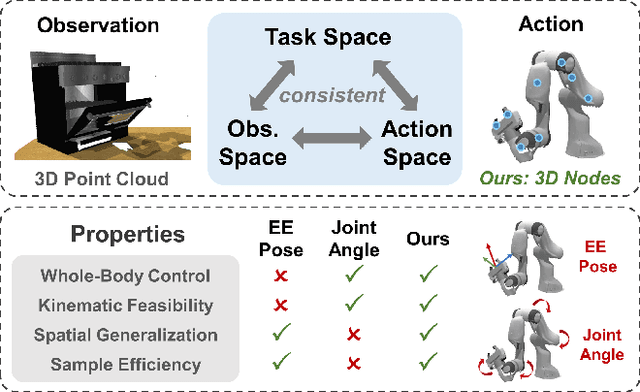
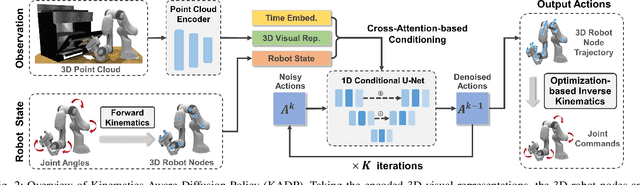

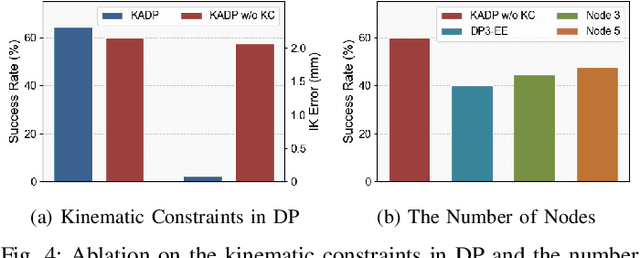
Whole-body control of robotic manipulators with awareness of full-arm kinematics is crucial for many manipulation scenarios involving body collision avoidance or body-object interactions, which makes it insufficient to consider only the end-effector poses in policy learning. The typical approach for whole-arm manipulation is to learn actions in the robot's joint space. However, the unalignment between the joint space and actual task space (i.e., 3D space) increases the complexity of policy learning, as generalization in task space requires the policy to intrinsically understand the non-linear arm kinematics, which is difficult to learn from limited demonstrations. To address this issue, this letter proposes a kinematics-aware imitation learning framework with consistent task, observation, and action spaces, all represented in the same 3D space. Specifically, we represent both robot states and actions using a set of 3D points on the arm body, naturally aligned with the 3D point cloud observations. This spatially consistent representation improves the policy's sample efficiency and spatial generalizability while enabling full-body control. Built upon the diffusion policy, we further incorporate kinematics priors into the diffusion processes to guarantee the kinematic feasibility of output actions. The joint angle commands are finally calculated through an optimization-based whole-body inverse kinematics solver for execution. Simulation and real-world experimental results demonstrate higher success rates and stronger spatial generalizability of our approach compared to existing methods in body-aware manipulation policy learning.
UniStateDLO: Unified Generative State Estimation and Tracking of Deformable Linear Objects Under Occlusion for Constrained Manipulation
Dec 19, 2025Perception of deformable linear objects (DLOs), such as cables, ropes, and wires, is the cornerstone for successful downstream manipulation. Although vision-based methods have been extensively explored, they remain highly vulnerable to occlusions that commonly arise in constrained manipulation environments due to surrounding obstacles, large and varying deformations, and limited viewpoints. Moreover, the high dimensionality of the state space, the lack of distinctive visual features, and the presence of sensor noises further compound the challenges of reliable DLO perception. To address these open issues, this paper presents UniStateDLO, the first complete DLO perception pipeline with deep-learning methods that achieves robust performance under severe occlusion, covering both single-frame state estimation and cross-frame state tracking from partial point clouds. Both tasks are formulated as conditional generative problems, leveraging the strong capability of diffusion models to capture the complex mapping between highly partial observations and high-dimensional DLO states. UniStateDLO effectively handles a wide range of occlusion patterns, including initial occlusion, self-occlusion, and occlusion caused by multiple objects. In addition, it exhibits strong data efficiency as the entire network is trained solely on a large-scale synthetic dataset, enabling zero-shot sim-to-real generalization without any real-world training data. Comprehensive simulation and real-world experiments demonstrate that UniStateDLO outperforms all state-of-the-art baselines in both estimation and tracking, producing globally smooth yet locally precise DLO state predictions in real time, even under substantial occlusions. Its integration as the front-end module in a closed-loop DLO manipulation system further demonstrates its ability to support stable feedback control in complex, constrained 3-D environments.
UltraDP: Generalizable Carotid Ultrasound Scanning with Force-Aware Diffusion Policy
Nov 19, 2025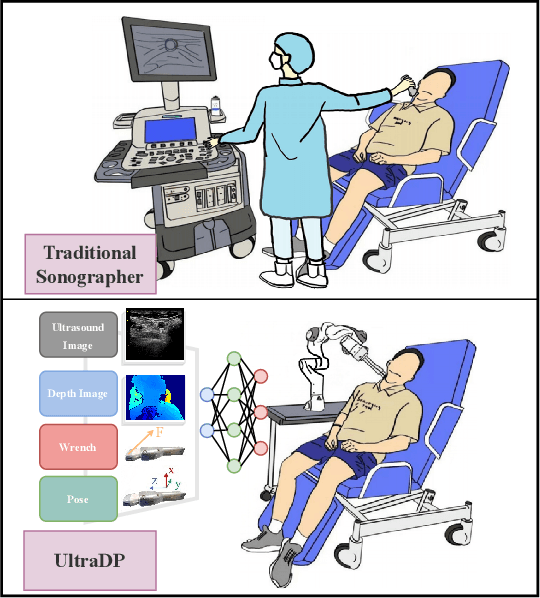
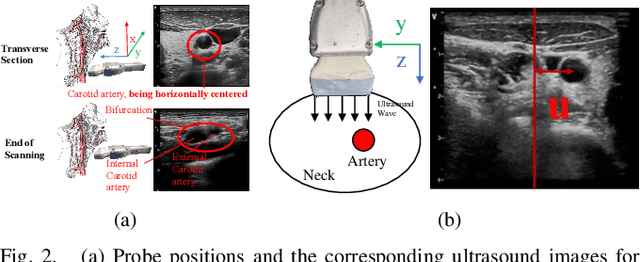
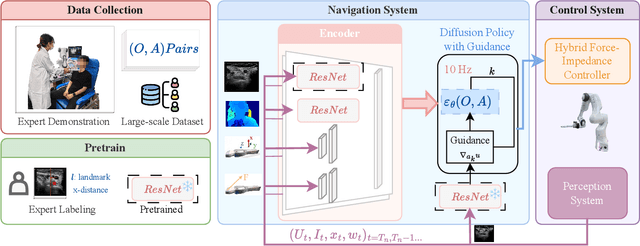
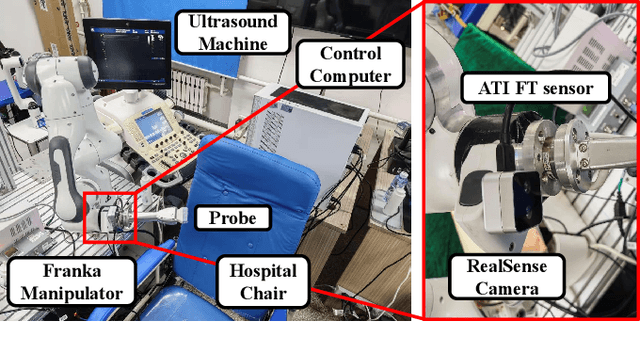
Ultrasound scanning is a critical imaging technique for real-time, non-invasive diagnostics. However, variations in patient anatomy and complex human-in-the-loop interactions pose significant challenges for autonomous robotic scanning. Existing ultrasound scanning robots are commonly limited to relatively low generalization and inefficient data utilization. To overcome these limitations, we present UltraDP, a Diffusion-Policy-based method that receives multi-sensory inputs (ultrasound images, wrist camera images, contact wrench, and probe pose) and generates actions that are fit for multi-modal action distributions in autonomous ultrasound scanning of carotid artery. We propose a specialized guidance module to enable the policy to output actions that center the artery in ultrasound images. To ensure stable contact and safe interaction between the robot and the human subject, a hybrid force-impedance controller is utilized to drive the robot to track such trajectories. Also, we have built a large-scale training dataset for carotid scanning comprising 210 scans with 460k sample pairs from 21 volunteers of both genders. By exploring our guidance module and DP's strong generalization ability, UltraDP achieves a 95% success rate in transverse scanning on previously unseen subjects, demonstrating its effectiveness.
Generalizable whole-body global manipulation of deformable linear objects by dual-arm robot in 3-D constrained environments
Oct 15, 2023Constrained environments are common in practical applications of manipulating deformable linear objects (DLOs), where movements of both DLOs and robots should be constrained. This task is high-dimensional and highly constrained owing to the highly deformable DLOs, dual-arm robots with high degrees of freedom, and 3-D complex environments, which render global planning challenging. Furthermore, accurate DLO models needed by planning are often unavailable owing to their strong nonlinearity and diversity, resulting in unreliable planned paths. This article focuses on the global moving and shaping of DLOs in constrained environments by dual-arm robots. The main objectives are 1) to efficiently and accurately accomplish this task, and 2) to achieve generalizable and robust manipulation of various DLOs. To this end, we propose a complementary framework with whole-body planning and control using appropriate DLO model representations. First, a global planner is proposed to efficiently find feasible solutions based on a simplified DLO energy model, which considers the full system states and all constraints to plan more reliable paths. Then, a closed-loop manipulation scheme is proposed to compensate for the modeling errors and enhance the robustness and accuracy, which incorporates a model predictive controller that real-time adjusts the robot motion based on an adaptive DLO motion model. The key novelty is that our framework can efficiently solve the high-dimensional problem subject to multiple constraints and generalize to various DLOs without elaborate model identifications. Experiments demonstrate that our framework can accomplish considerably more complicated tasks than existing works, with significantly higher efficiency, generalizability, and reliability.
Learning to Occlusion-Robustly Estimate 3-D States of Deformable Linear Objects from Single-Frame Point Clouds
Oct 04, 2022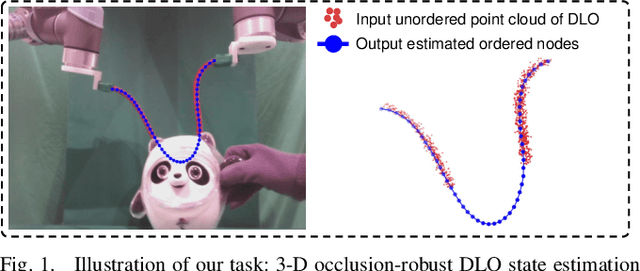
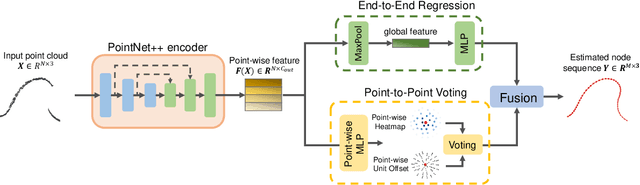
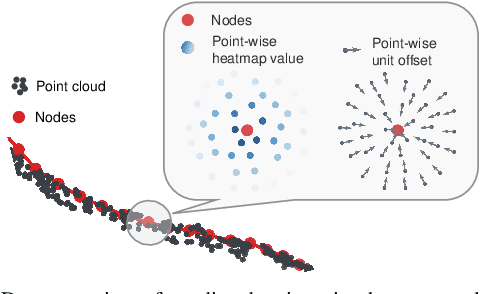
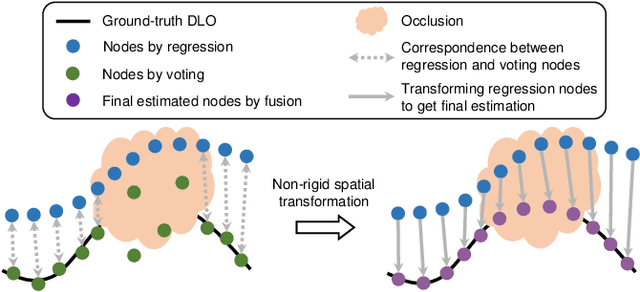
Accurately and robustly estimating the state of deformable linear objects (DLOs), such as ropes and wires, is crucial for DLO manipulation and other applications. However, it remains a challenging open issue due to the high dimensionality of the state space, frequent occlusion, and noises. This paper focuses on learning to robustly estimate the states of DLOs from single-frame point clouds in the presence of occlusions using a data-driven method. We propose a novel two-branch network architecture to exploit global and local information of input point cloud respectively and design a fusion module to effectively leverage both the advantages. Simulation and real-world experimental results demonstrate that our method can generate globally smooth and locally precise DLO state estimation results even with heavily occluded point clouds, which can be directly applied to real-world robotic manipulation of DLOs in 3-D space.
A Coarse-to-Fine Framework for Dual-Arm Manipulation of Deformable Linear Objects with Whole-Body Obstacle Avoidance
Sep 22, 2022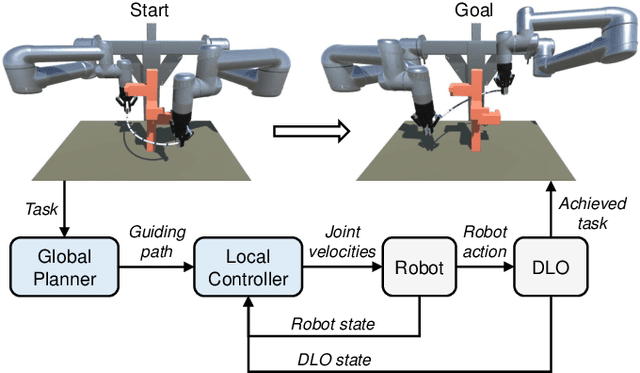
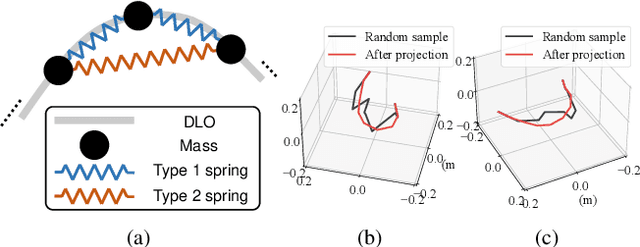
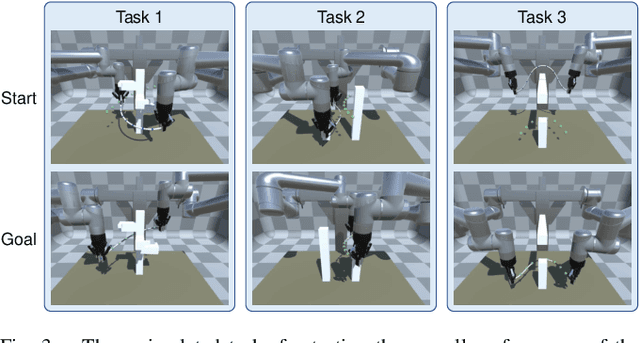
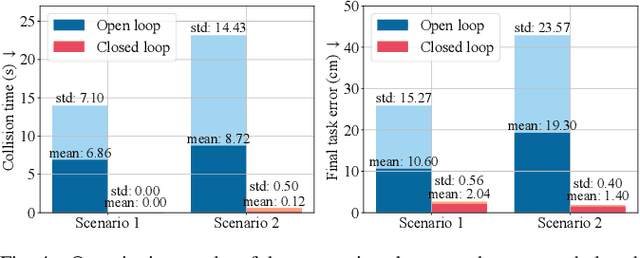
Manipulating deformable linear objects (DLOs) to achieve desired shapes in constrained environments with obstacles is a meaningful but challenging tasks. Global planning is necessary for such a highly-constrained task; however, accurate models of DLOs required by planners are difficult to obtain owing to their deformable nature, and the inevitable modeling errors significantly affect the planning results, probably resulting in task failure if the robot simply executes the planned path in an open-loop manner. In this paper, we propose a coarse-to-fine framework to combine global planning and local control for dual-arm manipulation of DLOs, capable of precisely achieving desired configurations and avoiding potential collisions between the DLO, robot, and obstacles. Specifically, the global planner refers to a simple yet effective DLO energy model and computes a coarse path to guarantee the feasibility of the task; then the local controller follows that path as guidance and further shapes it with closed-loop feedback to compensate for the planning errors and guarantee the accuracy of the task. Both simulations and real-world experiments demonstrate that our framework can robustly achieve desired DLO configurations in constrained environments with imprecise DLO models. which may not be reliably achieved by only planning or control.
Global Model Learning for Large Deformation Control of Elastic Deformable Linear Objects: An Efficient and Adaptive Approach
May 09, 2022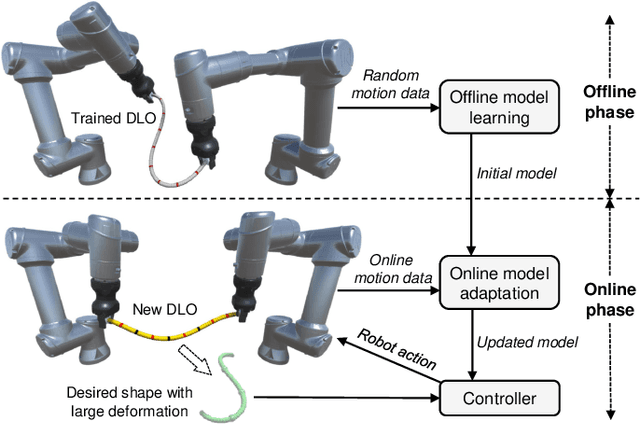
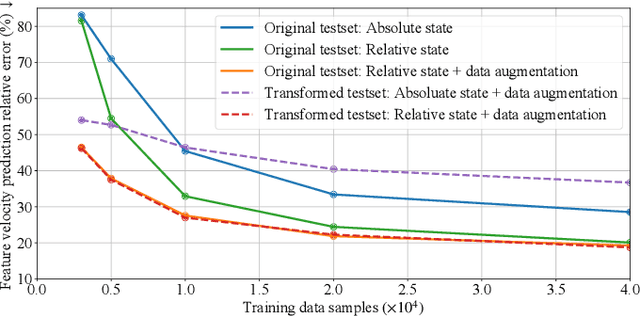
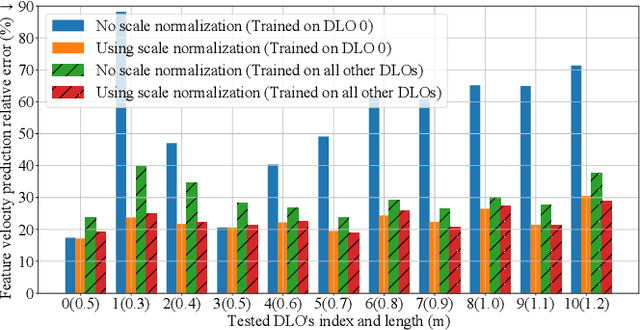
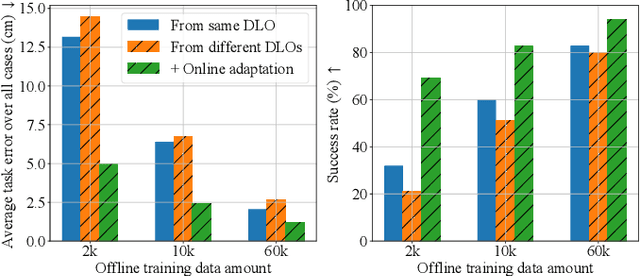
Robotic manipulation of deformable linear objects (DLOs) has broad application prospects in many fields. However, a key issue is to obtain the exact deformation models (i.e., how robot motion affects DLO deformation), which are hard to theoretically calculate and vary among different DLOs. Thus, shape control of DLOs is challenging, especially for large deformation control which requires global and more accurate models. In this paper, we propose a coupled offline and online data-driven method for efficiently learning a global deformation model, allowing for both accurate modeling through offline learning and further updating for new DLOs via online adaptation. Specifically, the model approximated by a neural network is first trained offline on random data, then seamlessly migrated to the online phase, and further updated online during actual manipulation. Several strategies are introduced to improve the model's efficiency and generalization ability. We propose a convex-optimization-based controller, and analyze the system's stability using the Lyapunov method. Detailed simulations and real-world experiments demonstrate that our method can efficiently and precisely estimate the deformation model, and achieve large deformation control of untrained DLOs in 2D and 3D dual-arm manipulation tasks better than the existing methods. It accomplishes all 24 tasks with different desired shapes on different DLOs in the real world, using only simulation data for the offline learning.