 Add to Chrome
 Add to Firefox
 Add to Edge
Arm-Aware Guided Dexterous Grasp Generation with Arm-Agnostic Grasp Models
Aug 17, 2026
Dexterous grasp generation that considers arm-related constraints is crucial in real-world scenarios involving arm environment collision avoidance, workspace boundary grasps, and consecutive grasping. Existing hand-centric grasp models, which primarily focus on the floating hand's pose, are insufficient for such cases. Conventional arm-aware methods either rely on rejection sampling to discard infeasible samples or require retraining on arm-specific data, leading to low sample efficiency under adverse conditions or limited generalization across different robots and environments. To overcome these limitations, this letter presents an arm-aware dexterous grasp generation framework that leverages pretrained arm-agnostic grasp models while integrating arm and environmental information only at inference time. Specifically, we formulate arm-aware constrained grasp generation as a joint optimization of hand pose and arm configuration, and derive closed-form gradients for arm-related constraints. Assuming the hand pose distribution is represented by a diffusion model, we prove that gradient-based optimization is equivalent to guided diffusion sampling, steering near-feasible samples toward the feasible region. Through comprehensive evaluation involving 10k objects across 6 scenarios, we demonstrate that the proposed framework generates feasible grasps in highly constrained settings with significantly higher probability, highlighting its advantages in real-world applications. Supplementary materials and appendix are available at https://arm-aware-dexgrasp.github.io/.

HUGS: Guiding Unified Dexterous Grasp Synthesis Across Modes and Scales via Learned Human Priors
Jul 06, 2026Dexterous grasping across diverse object scales requires contact modes ranging from two-finger pinches to bimanual grasps. Existing dexterous grasp synthesis methods reduce the high-dimensional optimization space with manually designed expected contacts and initialization heuristics, which struggle to balance synthesis success rate and diversity. We present HUGS (Human-prior-guided Unified Dexterous Grasp Synthesis), a human-prior-guided framework for unified dexterous grasp synthesis across modes and scales. Instead of directly retargeting human demonstrations, HUGS learns an object-conditioned human prior that captures human grasp preferences and guides downstream force-closure-aware optimization. The prior is trained on a compact self-collected human grasp dataset with 1.8K grasps over 304 objects, providing broad coverage of object scales and contact modes. During synthesis, HUGS adaptively proposes contact modes and wrist initializations, substantially improving the balance between contact-mode coverage and synthesis success rate over heuristic-based methods. With HUGS, we synthesize 3.2M robotic grasps over 157K scenes, spanning object half-diagonal lengths from 2 cm to 30 cm and modes from two-finger to bimanual grasps. Models trained on the synthesized dataset autonomously select appropriate contact modes in the real world, enabling grasping from screws to large boxes.
CoorGrasp: Coordinated Contact Control for Adaptive Dexterous Grasping Under Uncertainty
Jul 03, 2026While recent research has focused heavily on dexterous grasp pose generation, less attention has been devoted to the execution of planned grasps. Under shape and position uncertainty, open-loop execution often yields uncoordinated contacts, causing undesired in-hand object motion and even grasp failures. To address this, this paper proposes a tactile-driven model predictive controller for adaptive and delicate execution of diverse dexterous grasps. Our approach emphasizes multi-contact coordination across both approaching and grasping phases, with three key novelties: (i) coordination-aware phase separation, (ii) arm-hand coordination to compensate for position errors, and (iii) adaptive force coordination to increase contact forces in a balanced manner. An analytical model is employed to relate contact forces to robot joint motions for predictive control. Our formulation imposes no restrictions on grasp types or contact configurations and integrates seamlessly with state-of-the-art grasp pose generation methods. We validate the approach through large-scale simulations involving 15k grasps across 478 objects on three robotic hands, and real-world experiments on 8 objects. Results demonstrate that our method achieves higher grasp success rates and reduced undesired object movements.
Kinematics-Aware Diffusion Policy with Consistent 3D Observation and Action Space for Whole-Arm Robotic Manipulation
Dec 19, 2025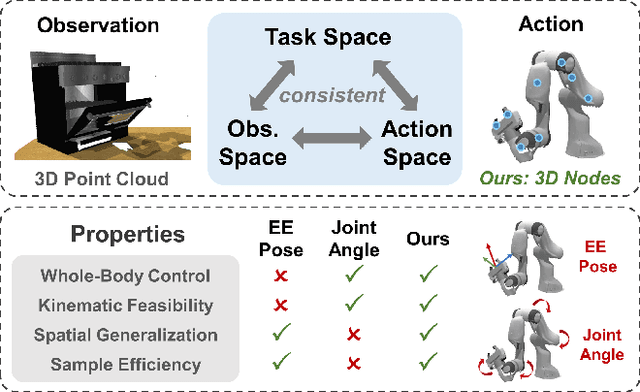
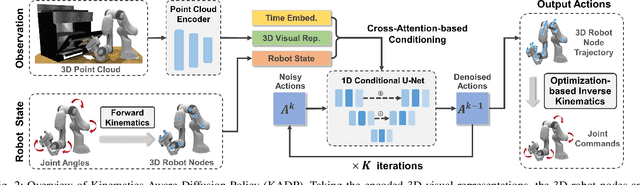

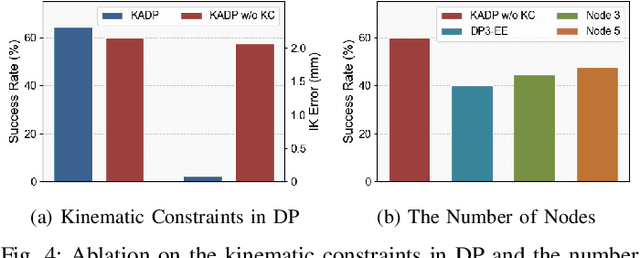
Whole-body control of robotic manipulators with awareness of full-arm kinematics is crucial for many manipulation scenarios involving body collision avoidance or body-object interactions, which makes it insufficient to consider only the end-effector poses in policy learning. The typical approach for whole-arm manipulation is to learn actions in the robot's joint space. However, the unalignment between the joint space and actual task space (i.e., 3D space) increases the complexity of policy learning, as generalization in task space requires the policy to intrinsically understand the non-linear arm kinematics, which is difficult to learn from limited demonstrations. To address this issue, this letter proposes a kinematics-aware imitation learning framework with consistent task, observation, and action spaces, all represented in the same 3D space. Specifically, we represent both robot states and actions using a set of 3D points on the arm body, naturally aligned with the 3D point cloud observations. This spatially consistent representation improves the policy's sample efficiency and spatial generalizability while enabling full-body control. Built upon the diffusion policy, we further incorporate kinematics priors into the diffusion processes to guarantee the kinematic feasibility of output actions. The joint angle commands are finally calculated through an optimization-based whole-body inverse kinematics solver for execution. Simulation and real-world experimental results demonstrate higher success rates and stronger spatial generalizability of our approach compared to existing methods in body-aware manipulation policy learning.
Flow-Aware Navigation of Magnetic Micro-Robots in Complex Fluids via PINN-Based Prediction
Mar 14, 2025While magnetic micro-robots have demonstrated significant potential across various applications, including drug delivery and microsurgery, the open issue of precise navigation and control in complex fluid environments is crucial for in vivo implementation. This paper introduces a novel flow-aware navigation and control strategy for magnetic micro-robots that explicitly accounts for the impact of fluid flow on their movement. First, the proposed method employs a Physics-Informed U-Net (PI-UNet) to refine the numerically predicted fluid velocity using local observations. Then, the predicted velocity is incorporated in a flow-aware A* path planning algorithm, ensuring efficient navigation while mitigating flow-induced disturbances. Finally, a control scheme is developed to compensate for the predicted fluid velocity, thereby optimizing the micro-robot's performance. A series of simulation studies and real-world experiments are conducted to validate the efficacy of the proposed approach. This method enhances both planning accuracy and control precision, expanding the potential applications of magnetic micro-robots in fluid-affected environments typical of many medical scenarios.
Robotic In-Hand Manipulation for Large-Range Precise Object Movement: The RGMC Champion Solution
Feb 11, 2025In-hand manipulation using multiple dexterous fingers is a critical robotic skill that can reduce the reliance on large arm motions, thereby saving space and energy. This letter focuses on in-grasp object movement, which refers to manipulating an object to a desired pose through only finger motions within a stable grasp. The key challenge lies in simultaneously achieving high precision and large-range movements while maintaining a constant stable grasp. To address this problem, we propose a simple and practical approach based on kinematic trajectory optimization with no need for pretraining or object geometries, which can be easily applied to novel objects in real-world scenarios. Adopting this approach, we won the championship for the in-hand manipulation track at the 9th Robotic Grasping and Manipulation Competition (RGMC) held at ICRA 2024. Implementation details, discussion, and further quantitative experimental results are presented in this letter, which aims to comprehensively evaluate our approach and share our key takeaways from the competition. Supplementary materials including video and code are available at https://rgmc-xl-team.github.io/ingrasp_manipulation .
Non-contact Dexterous Micromanipulation with Multiple Optoelectronic Robots
Oct 30, 2024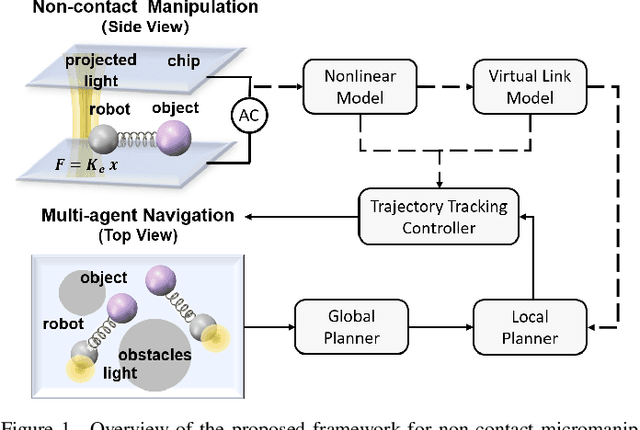
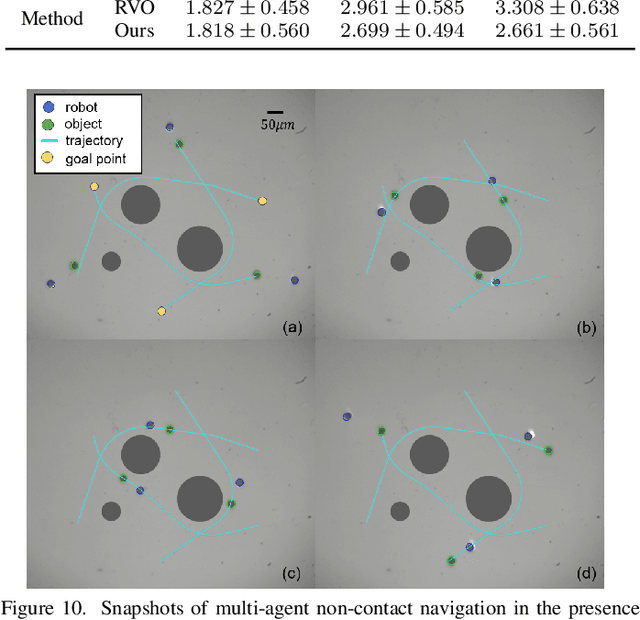
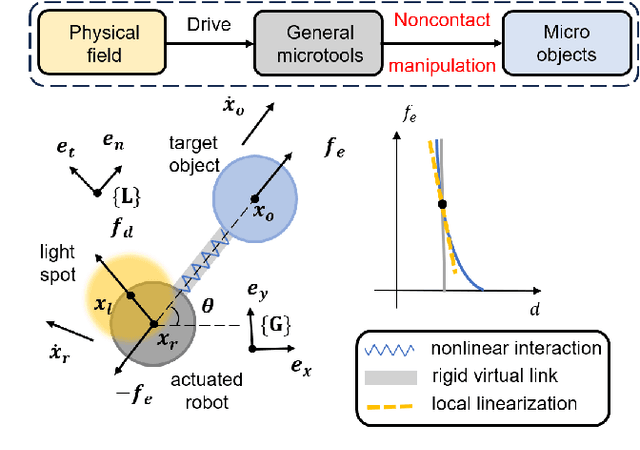
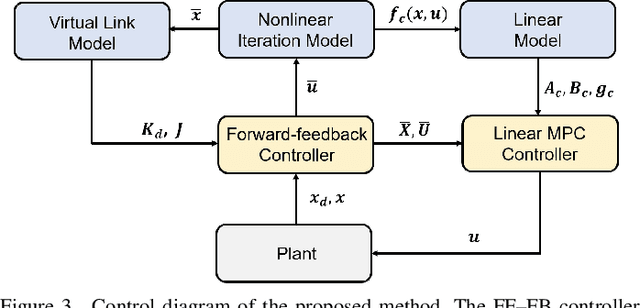
Micromanipulation systems leverage automation and robotic technologies to improve the precision, repeatability, and efficiency of various tasks at the microscale. However, current approaches are typically limited to specific objects or tasks, which necessitates the use of custom tools and specialized grasping methods. This paper proposes a novel non-contact micromanipulation method based on optoelectronic technologies. The proposed method utilizes repulsive dielectrophoretic forces generated in the optoelectronic field to drive a microrobot, enabling the microrobot to push the target object in a cluttered environment without physical contact. The non-contact feature can minimize the risks of potential damage, contamination, or adhesion while largely improving the flexibility of manipulation. The feature enables the use of a general tool for indirect object manipulation, eliminating the need for specialized tools. A series of simulation studies and real-world experiments -- including non-contact trajectory tracking, obstacle avoidance, and reciprocal avoidance between multiple microrobots -- are conducted to validate the performance of the proposed method. The proposed formulation provides a general and dexterous solution for a range of objects and tasks at the micro scale.
Efficient Model Learning and Adaptive Tracking Control of Magnetic Micro-Robots for Non-Contact Manipulation
Mar 21, 2024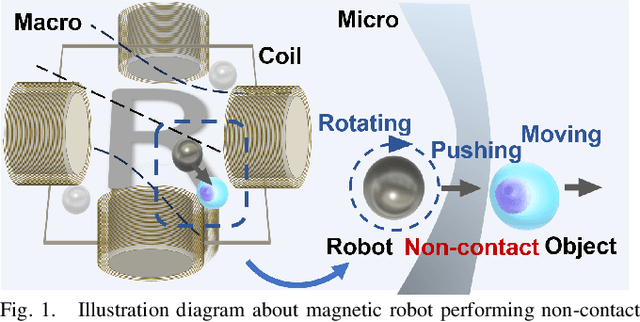

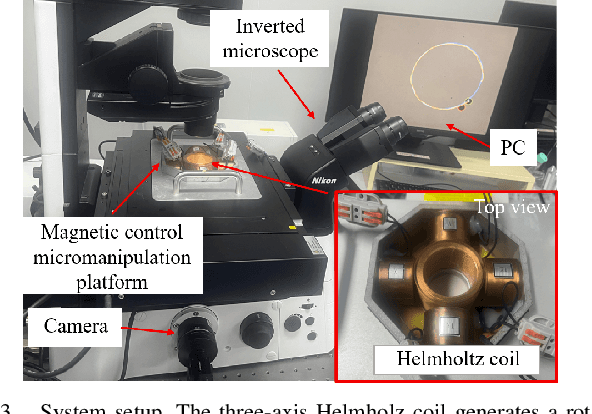
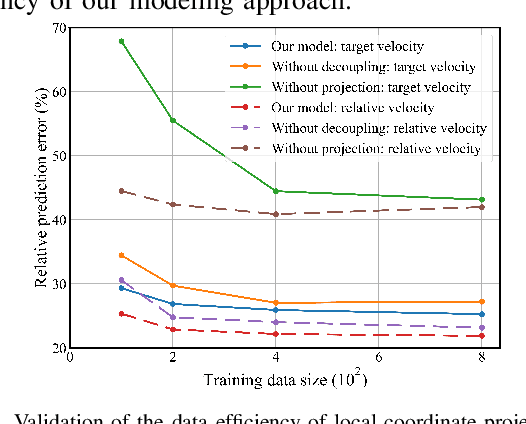
Magnetic microrobots can be navigated by an external magnetic field to autonomously move within living organisms with complex and unstructured environments. Potential applications include drug delivery, diagnostics, and therapeutic interventions. Existing techniques commonly impart magnetic properties to the target object,or drive the robot to contact and then manipulate the object, both probably inducing physical damage. This paper considers a non-contact formulation, where the robot spins to generate a repulsive field to push the object without physical contact. Under such a formulation, the main challenge is that the motion model between the input of the magnetic field and the output velocity of the target object is commonly unknown and difficult to analyze. To deal with it, this paper proposes a data-driven-based solution. A neural network is constructed to efficiently estimate the motion model. Then, an approximate model-based optimal control scheme is developed to push the object to track a time-varying trajectory, maintaining the non-contact with distance constraints. Furthermore, a straightforward planner is introduced to assess the adaptability of non-contact manipulation in a cluttered unstructured environment. Experimental results are presented to show the tracking and navigation performance of the proposed scheme.
Contact-Aware Non-prehensile Robotic Manipulation for Object Retrieval in Cluttered Environments
Mar 07, 2023Non-prehensile manipulation methods usually use a simple end effector, e.g., a single rod, to manipulate the object. Compared to the grasping method, such an end effector is compact and flexible, and hence it can perform tasks in a constrained workspace; As a trade-off, it has relatively few degrees of freedom (DoFs), resulting in an under-actuation problem with complex constraints for planning and control. This paper proposes a new non-prehensile manipulation method for the task of object retrieval in cluttered environments, using a rod-like pusher. Specifically, a candidate trajectory in a cluttered environment is first generated with an improved Rapidly-Exploring Random Tree (RRT) planner; Then, a Model Predictive Control (MPC) scheme is applied to stabilize the slider's poses through necessary contact with obstacles. Different from existing methods, the proposed approach is with the contact-aware feature, which enables the synthesized effect of active removal of obstacles, avoidance behavior, and switching contact face for improved dexterity. Hence both the feasibility and efficiency of the task are greatly promoted. The performance of the proposed method is validated in a planar object retrieval task, where the target object, surrounded by many fixed or movable obstacles, is manipulated and isolated. Both simulation and experimental results are presented.