 Add to Chrome
 Add to Firefox
 Add to Edge
A Heterogeneous Long-Micro Scale Cascading Architecture for General Aviation Health Management
Mar 27, 2026
BACKGROUND: General aviation fleet expansion demands intelligent health monitoring under computational constraints. Real-world aircraft health diagnosis requires balancing accuracy with computational constraints under extreme class imbalance and environmental uncertainty. Existing end-to-end approaches suffer from the receptive field paradox: global attention introduces excessive operational heterogeneity noise for fine-grained fault classification, while localized constraints sacrifice critical cross-temporal context essential for anomaly detection. METHODS: This paper presents an AI-driven heterogeneous cascading architecture for general aviation health management. The proposed Long-Micro Scale Diagnostician (LMSD) explicitly decouples global anomaly detection (full-sequence attention) from micro-scale fault classification (restricted receptive fields), resolving the receptive field paradox while minimizing training overhead. A knowledge distillation-based interpretability module provides physically traceable explanations for safety-critical validation. RESULTS: Experiments on the public National General Aviation Flight Information Database (NGAFID) dataset (28,935 flights, 36 categories) demonstrate 4--8% improvement in safety-critical metrics (MCWPM) with 4.2 times training acceleration and 46% model compression compared to end-to-end baselines. CONCLUSIONS: The AI-driven heterogeneous architecture offers deployable solutions for aviation equipment health management, with potential for digital twin integration in future work. The proposed framework substantiates deployability in resource-constrained aviation environments while maintaining stringent safety requirements.

Balancing Safety and Efficiency in Aircraft Health Diagnosis: A Task Decomposition Framework with Heterogeneous Long-Micro Scale Cascading and Knowledge Distillation-based Interpretability
Mar 24, 2026Whole-aircraft diagnosis for general aviation faces threefold challenges: data uncertainty, task heterogeneity, and computational inefficiency. Existing end-to-end approaches uniformly model health discrimination and fault characterization, overlooking intrinsic receptive field conflicts between global context modeling and local feature extraction, while incurring prohibitive training costs under severe class imbalance. To address these, this study proposes the Diagnosis Decomposition Framework (DDF), explicitly decoupling diagnosis into Anomaly Detection (AD) and Fault Classification (FC) subtasks via the Long-Micro Scale Diagnostician (LMSD). Employing a "long-range global screening and micro-scale local precise diagnosis" strategy, LMSD utilizes Convolutional Tokenizer with Multi-Head Self-Attention (ConvTokMHSA) for global operational pattern discrimination and Multi-Micro Kernel Network (MMK Net) for local fault feature extraction. Decoupled training separates "large-sample lightweight" and "small-sample complex" optimization pathways, significantly reducing computational overhead. Concurrently, Keyness Extraction Layer (KEL) via knowledge distillation furnishes physically traceable explanations for two-stage decisions, materializing interpretability-by-design. Experiments on the NGAFID real-world aviation dataset demonstrate approximately 4-8% improvement in Multi-Class Weighted Penalty Metric (MCWPM) over baselines with substantially reduced training time, validating comprehensive advantages in task adaptability, interpretability, and efficiency. This provides a deployable methodology for general aviation health management.
A domain adaptation neural network for digital twin-supported fault diagnosis
May 27, 2025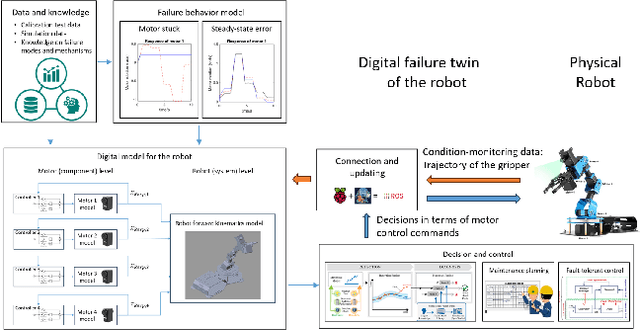
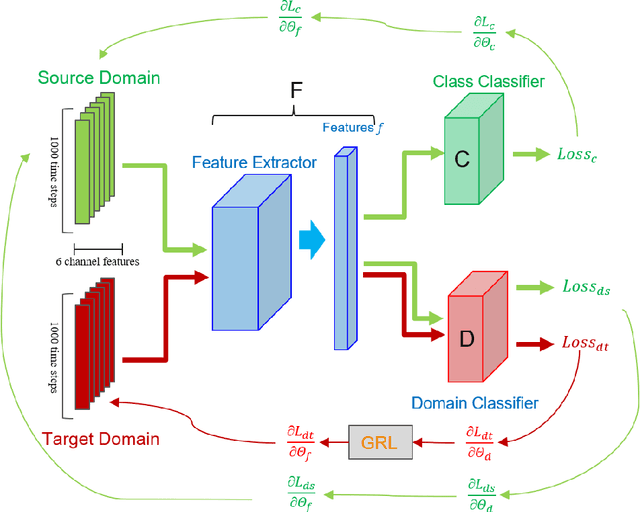
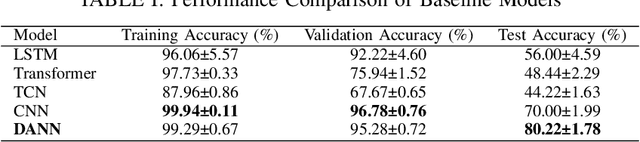
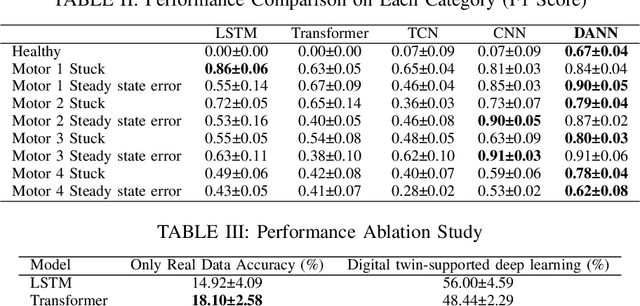
Digital twins offer a promising solution to the lack of sufficient labeled data in deep learning-based fault diagnosis by generating simulated data for model training. However, discrepancies between simulation and real-world systems can lead to a significant drop in performance when models are applied in real scenarios. To address this issue, we propose a fault diagnosis framework based on Domain-Adversarial Neural Networks (DANN), which enables knowledge transfer from simulated (source domain) to real-world (target domain) data. We evaluate the proposed framework using a publicly available robotics fault diagnosis dataset, which includes 3,600 sequences generated by a digital twin model and 90 real sequences collected from physical systems. The DANN method is compared with commonly used lightweight deep learning models such as CNN, TCN, Transformer, and LSTM. Experimental results show that incorporating domain adaptation significantly improves the diagnostic performance. For example, applying DANN to a baseline CNN model improves its accuracy from 70.00% to 80.22% on real-world test data, demonstrating the effectiveness of domain adaptation in bridging the sim-to-real gap.
Use Digital Twins to Support Fault Diagnosis From System-level Condition-monitoring Data
Nov 02, 2024
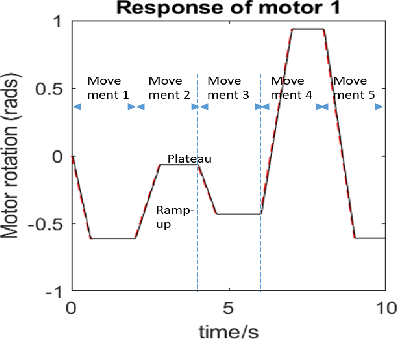
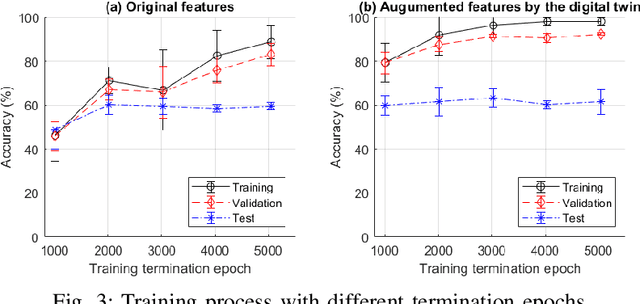
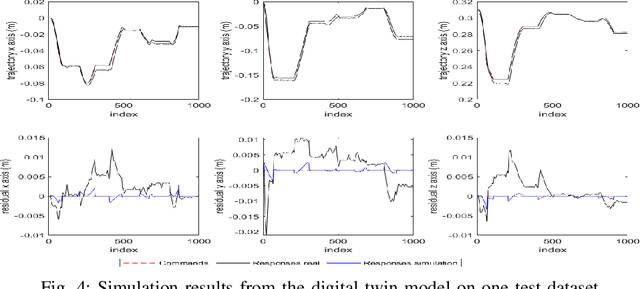
Deep learning models have created great opportunities for data-driven fault diagnosis but they require large amount of labeled failure data for training. In this paper, we propose to use a digital twin to support developing data-driven fault diagnosis model to reduce the amount of failure data used in the training process. The developed fault diagnosis models are also able to diagnose component-level failures based on system-level condition-monitoring data. The proposed framework is evaluated on a real-world robot system. The results showed that the deep learning model trained by digital twins is able to diagnose the locations and modes of 9 faults/failure from $4$ different motors. However, the performance of the model trained by a digital twin can still be improved, especially when the digital twin model has some discrepancy with the real system.