 Add to Chrome
 Add to Firefox
 Add to Edge
Cross-modal Retrieval Models for Stripped Binary Analysis
Dec 11, 2025
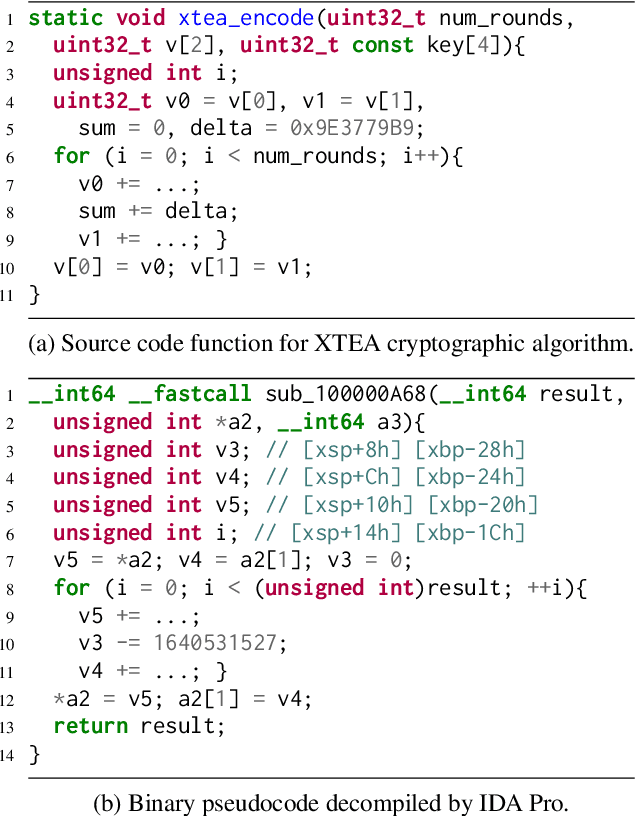
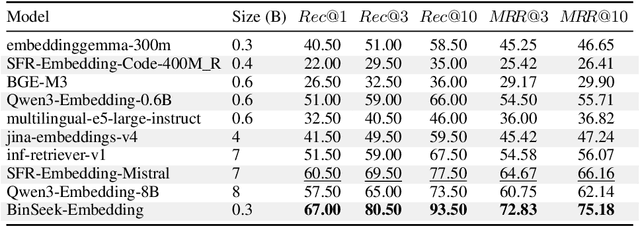
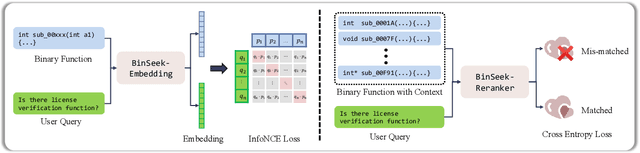
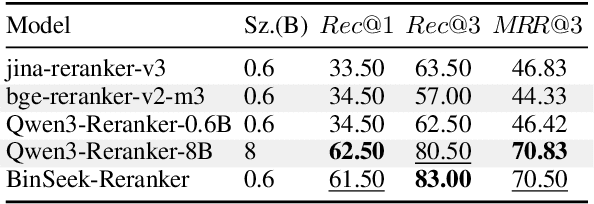
LLM-agent based binary code analysis has demonstrated significant potential across a wide range of software security scenarios, including vulnerability detection, malware analysis, etc. In agent workflow, however, retrieving the positive from thousands of stripped binary functions based on user query remains under-studied and challenging, as the absence of symbolic information distinguishes it from source code retrieval. In this paper, we introduce, BinSeek, the first two-stage cross-modal retrieval framework for stripped binary code analysis. It consists of two models: BinSeekEmbedding is trained on large-scale dataset to learn the semantic relevance of the binary code and the natural language description, furthermore, BinSeek-Reranker learns to carefully judge the relevance of the candidate code to the description with context augmentation. To this end, we built an LLM-based data synthesis pipeline to automate training construction, also deriving a domain benchmark for future research. Our evaluation results show that BinSeek achieved the state-of-the-art performance, surpassing the the same scale models by 31.42% in Rec@3 and 27.17% in MRR@3, as well as leading the advanced general-purpose models that have 16 times larger parameters.

SeqNet: An Efficient Neural Network for Automatic Malware Detection
May 08, 2022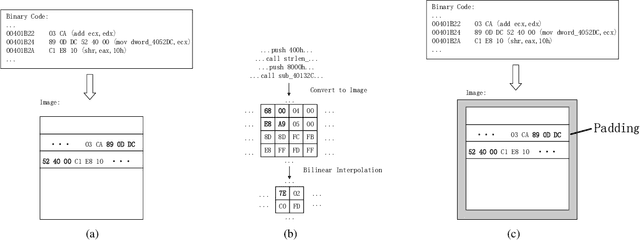

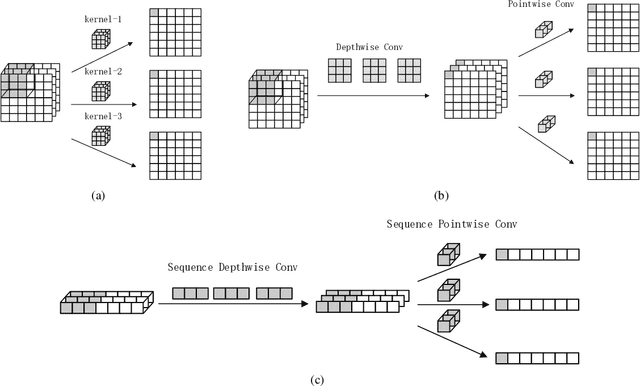
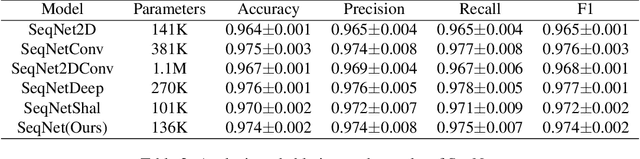
Malware continues to evolve rapidly, and more than 450,000 new samples are captured every day, which makes manual malware analysis impractical. However, existing deep learning detection models need manual feature engineering or require high computational overhead for long training processes, which might be laborious to select feature space and difficult to retrain for mitigating model aging. Therefore, a crucial requirement for a detector is to realize automatic and efficient detection. In this paper, we propose a lightweight malware detection model called SeqNet which could be trained at high speed with low memory required on the raw binaries. By avoiding contextual confusion and reducing semantic loss, SeqNet maintains the detection accuracy when reducing the number of parameters to only 136K. We demonstrate the effectiveness of our methods and the low training cost requirement of SeqNet in our experiments. Besides, we make our datasets and codes public to stimulate further academic research.
New Era of Deeplearning-Based Malware Intrusion Detection: The Malware Detection and Prediction Based On Deep Learning
Jul 19, 2019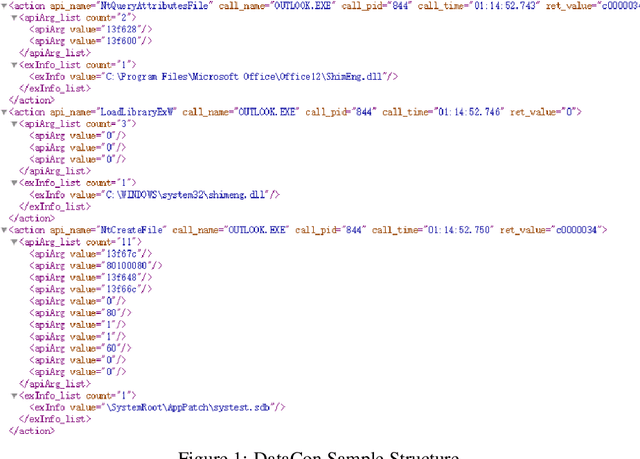
With the development of artificial intelligence algorithms like deep learning models and the successful applications in many different fields, further similar trails of deep learning technology have been made in cyber security area. It shows the preferable performance not only in academic security research but also in industry practices when dealing with part of cyber security issues by deep learning methods compared to those conventional rules. Especially for the malware detection and classification tasks, it saves generous time cost and promotes the accuracy for a total pipeline of malware detection system. In this paper, we construct special deep neural network, ie, MalDeepNet (TB-Malnet and IB-Malnet) for malware dynamic behavior classification tasks. Then we build the family clustering algorithm based on deep learning and fulfil related testing. Except that, we also design a novel malware prediction model which could detect the malware coming in future through the Mal Generative Adversarial Network (Mal-GAN) implementation. All those algorithms present fairly considerable value in related datasets afterwards.