 Add to Chrome
 Add to Firefox
 Add to Edge
LIRA: Local Cross-Layer Information Routing for Vision-Language-Action Decoding
Aug 06, 2026
Vision-Language-Action (VLA) models transform representations from pretrained vision-language models (VLMs) into robot actions, yet the interface that routes intermediate VLM features into action decoders remains underexplored. Existing designs either expose only a narrow part of the representation hierarchy or rigidly match each decoder block to one VLM layer, restricting access to complementary task evidence across depths. We introduce LIRA, a local cross-layer action-conditioning mechanism that formulates VLM-to-action conditioning as depth-aware information routing. LIRA operates on task-token features and LIRA Query features derived from intermediate VLM states, then assigns each Parallel Fusion Block a depth-aligned local window centered on its corresponding VLM layer. Parallel Fusion Blocks aggregate neighboring LIRA Query features and integrate them with task-token features and proprioceptive inputs before action prediction. This routing interface leaves the backbone architecture, action decoder, and supervised training recipe unchanged. Across LIBERO, LIBERO-Plus, CALVIN ABC$\rightarrow$D, and real-world manipulation, LIRA improves the principal aggregate metrics over the VLA-Adapter baseline under the same 0.5B-parameter configuration. In zero-shot transfer to LIBERO-Plus, LIRA increases average success from 59.1% to 78.0%, an 18.9-point gain indicating improved robustness under controlled distribution shifts.

AdaMixup: A Dynamic Defense Framework for Membership Inference Attack Mitigation
Jan 04, 2025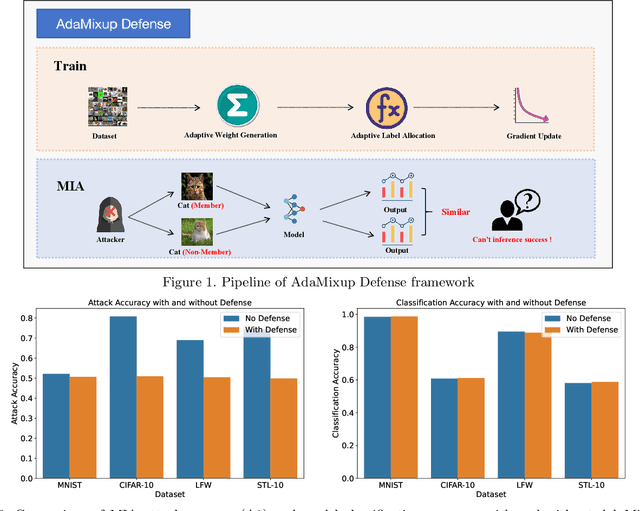
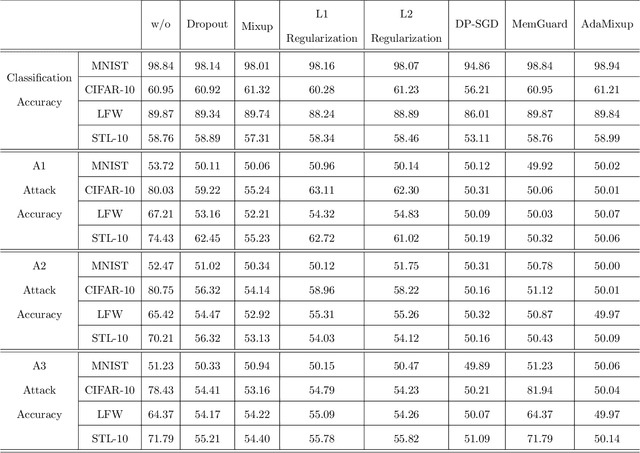
Membership inference attacks have emerged as a significant privacy concern in the training of deep learning models, where attackers can infer whether a data point was part of the training set based on the model's outputs. To address this challenge, we propose a novel defense mechanism, AdaMixup. AdaMixup employs adaptive mixup techniques to enhance the model's robustness against membership inference attacks by dynamically adjusting the mixup strategy during training. This method not only improves the model's privacy protection but also maintains high performance. Experimental results across multiple datasets demonstrate that AdaMixup significantly reduces the risk of membership inference attacks while achieving a favorable trade-off between defensive efficiency and model accuracy. This research provides an effective solution for data privacy protection and lays the groundwork for future advancements in mixup training methods.