 Add to Chrome
 Add to Firefox
 Add to Edge
GraphThink: Graph-Enhanced LLM Thinking for Long-Horizon Embodied Task Planning
Aug 08, 2026
Embodied agents using LLM-based planners often struggle with physical hallucinations, poor generalization to long-horizon tasks, and lack of environmental awareness. We propose GraphThink, a novel framework that integrates a task graph to provide structured knowledge for robust planning and a scene graph to maintain environmental memory for event-driven replanning. Specifically, the task graph guides LLM thinking through contextual prompting and iterative refinement, effectively mitigating planning hallucinations. Furthermore, within the GRPO framework, the task graph offers delicate reward design to train the LLM planner, enhancing long-horizon planning capabilities and improving generalization. Finally, an event-driven replanning module, powered by the scene graph, enables closed-loop environment awareness and error correction. GraphThink achieves state-of-the-art performance on the ALFRED benchmark. In particular, our high-level planner surpasses leading API-based LLMs on both the validation set and held-out long-horizon tasks, underscoring its robust zero-shot and few-shot capabilities. Additional evaluations further demonstrate strong out-of-distribution generalization to novel tasks and environments.

EgoProceVQA: A Novel Egocentric Procedural Understanding Task with Self-Skill-Exploration Agent
Jul 15, 2026Most daily activities are inherently procedural. However, existing evaluations for egocentric video understanding seldom address procedural understanding and largely overlook complex key-step-level reasoning under the widely used video question answering (VQA) paradigm for MLLMs. Such capabilities are crucial for building procedural AI assistants deployable on wearable devices. To bridge this gap, we introduce the Egocentric Procedural Understanding VQA task (EgoProceVQA), which systematically evaluates egocentric procedural reasoning abilities of current MLLMs and agents through six types of key-step-centric questions. Furthermore, we develop EgoProceGen, a data generation platform that efficiently constructs QA data tailored to different question types. Based on this platform, we build a benchmark with 3,600 questions, four common procedural scenarios, and 31 everyday procedural tasks. Evaluations on EgoProceVQA show that existing MLLMs and agents still have substantial room for improvement in procedural understanding. Therefore, we further propose EgoProceAgent, a self-skill-exploration agentic framework. We design a generic tool library for procedural understanding and a standardized sub-skill library shared across tools and models, enabling self-exploration without ground-truth supervision. By exploring how to compose and select sub-skills, the agent discovers effective skill strategies for diverse problems, and attains state-of-the-art performance among open-source models on multiple tasks. Together, our benchmark, generation platform, and agentic framework establish a unified foundation for EgoProceVQA. Project page: https://z1oong.github.io/EgoProceVQA/.
SG-VLA: Learning Spatially-Grounded Vision-Language-Action Models for Mobile Manipulation
Mar 24, 2026Vision-Language-Action (VLA) models show promise for robotic control, yet performance in complex household environments remains sub-optimal. Mobile manipulation requires reasoning about global scene layout, fine-grained geometry, and high-dimensional continuous actions, making standard imitation learning insufficient. We introduce a framework for learning spatially-grounded VLA models that strengthens perception and representation through auxiliary task co-training and multi-modal input enhancement. Our method addresses the challenge of controlling a 13-dimensional action space involving coordinated base motion, arm articulation, and gripper actuation. To enrich spatial understanding, the model incorporates multi-view RGB observations, depth cues, and short temporal history, providing perspectives of both global scene structure and local manipulation context. To improve representation quality, we co-train auxiliary decoders that reconstruct interpretable intermediate signals - including global robot position, joint configurations, grasp affordances, target-object relative pose, and segmentation masks - from shared visual-language features. These objectives provide dense supervision that encourages the backbone to develop spatially grounded, manipulation-aware latent representations. Through extensive evaluation on home rearrangement tasks, our approach achieves consistent improvements across picking, placing, opening, and closing operations, substantially outperforming direct imitation learning. Our findings suggest that spatial grounding through auxiliary and multi-modal learning provides a strong direction for scaling VLA models toward general-purpose domestic robots.
Astro: Activation-guided Structured Regularization for Outlier-Robust LLM Post-Training Quantization
Feb 07, 2026Weight-only post-training quantization (PTQ) is crucial for efficient Large Language Model (LLM) deployment but suffers from accuracy degradation caused by weight and activation outliers. Existing mitigation strategies often face critical limitations: they either yield insufficient outlier suppression or incur significant deployment inefficiencies, such as inference latency, heavy preprocessing, or reliance on complex operator fusion. To resolve these limitations, we leverage a key insight: over-parameterized LLMs often converge to Flat Minima, implying a vast equivalent solution space where weights can be adjusted without compromising accuracy. Building on this, we propose Astro, an Activation-guided Structured Regularization framework designed to suppress the negative effects of outliers in a hardware-friendly and efficient manner. Leveraging the activation-guided regularization objective, Astro actively reconstructs intrinsically robust weights, aggressively suppressing weight outliers corresponding to high-magnitude activations without sacrificing model accuracy. Crucially, Astro introduces zero inference latency and is orthogonal to mainstream quantization methods like GPTQ. Extensive experiments show that Astro achieves highly competitive performance; notably, on LLaMA-2-7B, it achieves better performance than complex learning-based rotation methods with almost 1/3 of the quantization time.
Breaking Immutable: Information-Coupled Prototype Elaboration for Few-Shot Object Detection
Nov 27, 2022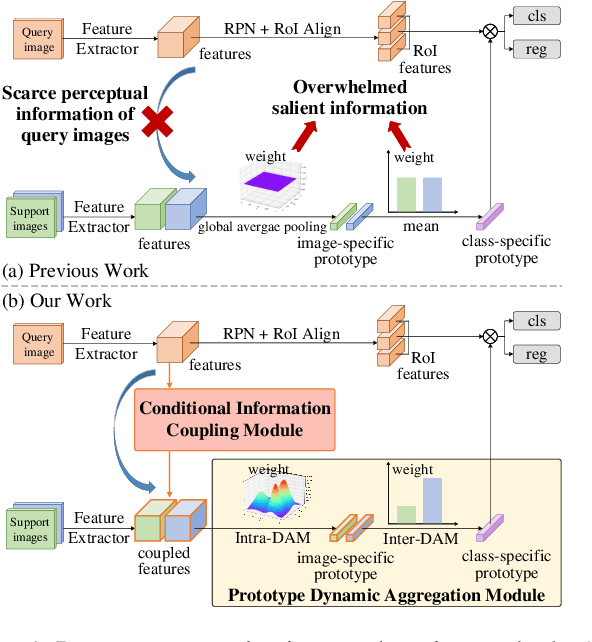

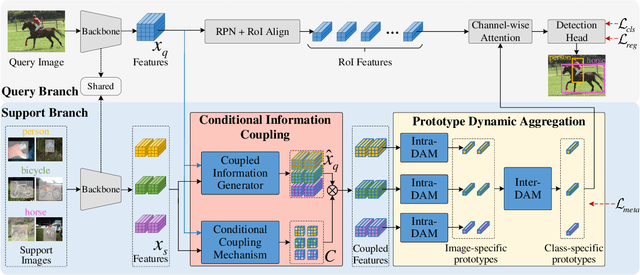

Few-shot object detection, expecting detectors to detect novel classes with a few instances, has made conspicuous progress. However, the prototypes extracted by existing meta-learning based methods still suffer from insufficient representative information and lack awareness of query images, which cannot be adaptively tailored to different query images. Firstly, only the support images are involved for extracting prototypes, resulting in scarce perceptual information of query images. Secondly, all pixels of all support images are treated equally when aggregating features into prototype vectors, thus the salient objects are overwhelmed by the cluttered background. In this paper, we propose an Information-Coupled Prototype Elaboration (ICPE) method to generate specific and representative prototypes for each query image. Concretely, a conditional information coupling module is introduced to couple information from the query branch to the support branch, strengthening the query-perceptual information in support features. Besides, we design a prototype dynamic aggregation module that dynamically adjusts intra-image and inter-image aggregation weights to highlight the salient information useful for detecting query images. Experimental results on both Pascal VOC and MS COCO demonstrate that our method achieves state-of-the-art performance in almost all settings.