 Add to Chrome
 Add to Firefox
 Add to Edge
Sparse-View Surface Reconstruction using Gaussian Splatting through High-Confidence Depth Propagation with Normal Priors
Jul 04, 2026
3D reconstruction from sparse views is a challenging task in 3D computer vision. Recent studies on 3D Gaussian Splatting (3DGS) have achieved remarkable results with sparse views in novel view synthesis, yet reconstructing high-quality geometric surfaces from sparse views remains a challenge, due to the limited geometry clues and the discreteness of Gaussians. In this paper, we propose a novel 3DGS-based method for high-fidelity surface reconstruction from sparse views. Our key insight is to introduce a normal-guided depth propagation approach, which can extend depth information from high-confidence regions to constrain the depth in low-confidence areas. Additionally, we propose an abnormal depth edge-aware regularization to address depth discontinuities caused by the discreteness of Gaussians. Extensive experiments on DTU and Tanks-and-Temples datasets demonstrate that our method outperforms the state-of-the-art methods in sparse view surface reconstruction. Project page: https://hanl2010.github.io/DP-GS.

City-Level 3D Surface Reconstruction with Viewpoint Orientation Partitioning and Scene Completion
Jul 04, 2026Multi-view 3D surface reconstruction is a longstanding challenge in computer vision. Although recent large-scale reconstruction methods based on 3D Gaussian Splatting (3DGS) achieve impressive novel-view synthesis, producing high-quality surfaces over large scenes remains difficult, due to complex geometry, long optimization, and limited memory. In this paper, we propose a novel yet simple partitioning method to efficiently and faithfully reconstruct large-scale scene surfaces. Our key insight lies in a scene partitioning method based on viewpoint orientation. This partitioning approach ensures that views with similar orientations are jointly involved for more accurate depth estimations, leading to precise surface reconstructions and balanced computation on multiple GPUs in parallel. In addition, we propose a strategy to detect and repair missing regions in the initial point cloud caused by sparse viewpoints or insufficient textures, thereby further improving the geometric quality. Extensive experiments on the GauU-Scene, MatrixCity, and UrbanScene3D datasets demonstrate that our method outperforms the state-of-the-art approaches in surface reconstruction for large-scale scenes. Project page: https://hanl2010.github.io/VOP-GS.
SGAD-SLAM: Splatting Gaussians at Adjusted Depth for Better Radiance Fields in RGBD SLAM
Mar 22, 20263D Gaussian Splatting (3DGS) has made remarkable progress in RGBD SLAM. Current methods usually use 3D Gaussians or view-tied 3D Gaussians to represent radiance fields in tracking and mapping. However, these Gaussians are either too flexible or too limited in movements, resulting in slow convergence or limited rendering quality. To resolve this issue, we adopt pixel-aligned Gaussians but allow each Gaussian to adjust its position along its ray to maximize the rendering quality, even if Gaussians are simplified to improve system scalability. To speed up the tracking, we model the depth distribution around each pixel as a Gaussian distribution, and then use these distributions to align each frame to the 3D scene quickly. We report our evaluations on widely used benchmarks, justify our designs, and show advantages over the latest methods in view rendering, camera tracking, runtime, and storage complexity. Please see our project page for code and videos at https://machineperceptionlab.github.io/SGAD-SLAM-Project .
3D Gaussian Splatting with Self-Constrained Priors for High Fidelity Surface Reconstruction
Mar 20, 2026Rendering 3D surfaces has been revolutionized within the modeling of radiance fields through either 3DGS or NeRF. Although 3DGS has shown advantages over NeRF in terms of rendering quality or speed, there is still room for improvement in recovering high fidelity surfaces through 3DGS. To resolve this issue, we propose a self-constrained prior to constrain the learning of 3D Gaussians, aiming for more accurate depth rendering. Our self-constrained prior is derived from a TSDF grid that is obtained by fusing the depth maps rendered with current 3D Gaussians. The prior measures a distance field around the estimated surface, offering a band centered at the surface for imposing more specific constraints on 3D Gaussians, such as removing Gaussians outside the band, moving Gaussians closer to the surface, and encouraging larger or smaller opacity in a geometry-aware manner. More importantly, our prior can be regularly updated by the most recent depth images which are usually more accurate and complete. In addition, the prior can also progressively narrow the band to tighten the imposed constraints. We justify our idea and report our superiority over the state-of-the-art methods in evaluations on widely used benchmarks.
Speeding Up the Learning of 3D Gaussians with Much Shorter Gaussian Lists
Mar 10, 20263D Gaussian splatting (3DGS) has become a vital tool for learning a radiance field from multiple posed images. Although 3DGS shows great advantages over NeRF in terms of rendering quality and efficiency, it remains a research challenge to further improve the efficiency of learning 3D Gaussians. To overcome this challenge, we propose novel training strategies and losses to shorten each Gaussian list used to render a pixel, which speeds up the splatting by involving fewer Gaussians along a ray. Specifically, we shrink the size of each Gaussian by resetting their scales regularly, encouraging smaller Gaussians to cover fewer nearby pixels, which shortens the Gaussian lists of pixels. Additionally, we introduce an entropy constraint on the alpha blending procedure to sharpen the weight distribution of Gaussians along each ray, which drives dominant weights larger while making minor weights smaller. As a result, each Gaussian becomes more focused on the pixels where it is dominant, which reduces its impact on nearby pixels, leading to even shorter Gaussian lists. Eventually, we integrate our method into a rendering resolution scheduler which further improves efficiency through progressive resolution increase. We evaluate our method by comparing it with state-of-the-art methods on widely used benchmarks. Our results show significant advantages over others in efficiency without sacrificing rendering quality.
Learning Compact Latent Space for Representing Neural Signed Distance Functions with High-fidelity Geometry Details
Nov 18, 2025Neural signed distance functions (SDFs) have been a vital representation to represent 3D shapes or scenes with neural networks. An SDF is an implicit function that can query signed distances at specific coordinates for recovering a 3D surface. Although implicit functions work well on a single shape or scene, they pose obstacles when analyzing multiple SDFs with high-fidelity geometry details, due to the limited information encoded in the latent space for SDFs and the loss of geometry details. To overcome these obstacles, we introduce a method to represent multiple SDFs in a common space, aiming to recover more high-fidelity geometry details with more compact latent representations. Our key idea is to take full advantage of the benefits of generalization-based and overfitting-based learning strategies, which manage to preserve high-fidelity geometry details with compact latent codes. Based on this framework, we also introduce a novel sampling strategy to sample training queries. The sampling can improve the training efficiency and eliminate artifacts caused by the influence of other SDFs. We report numerical and visual evaluations on widely used benchmarks to validate our designs and show advantages over the latest methods in terms of the representative ability and compactness.
Learning Bijective Surface Parameterization for Inferring Signed Distance Functions from Sparse Point Clouds with Grid Deformation
Mar 31, 2025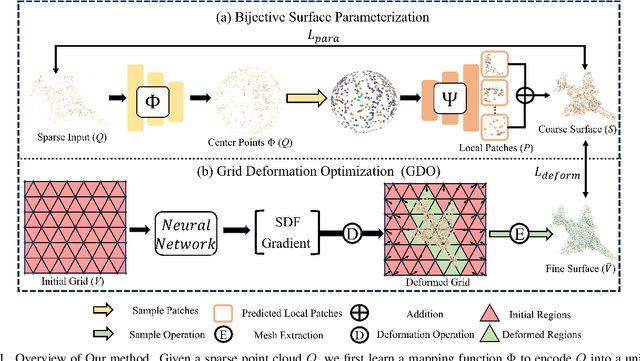
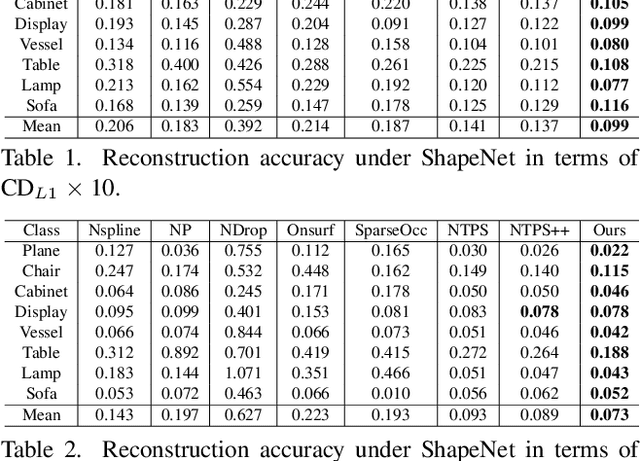
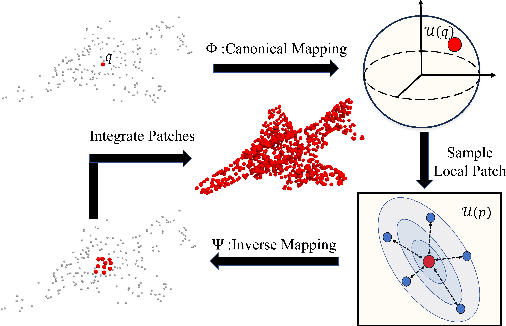
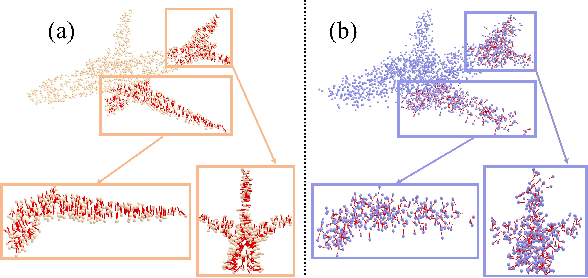
Inferring signed distance functions (SDFs) from sparse point clouds remains a challenge in surface reconstruction. The key lies in the lack of detailed geometric information in sparse point clouds, which is essential for learning a continuous field. To resolve this issue, we present a novel approach that learns a dynamic deformation network to predict SDFs in an end-to-end manner. To parameterize a continuous surface from sparse points, we propose a bijective surface parameterization (BSP) that learns the global shape from local patches. Specifically, we construct a bijective mapping for sparse points from the parametric domain to 3D local patches, integrating patches into the global surface. Meanwhile, we introduce grid deformation optimization (GDO) into the surface approximation to optimize the deformation of grid points and further refine the parametric surfaces. Experimental results on synthetic and real scanned datasets demonstrate that our method significantly outperforms the current state-of-the-art methods. Project page: https://takeshie.github.io/Bijective-SDF
GaussianUDF: Inferring Unsigned Distance Functions through 3D Gaussian Splatting
Mar 25, 2025Reconstructing open surfaces from multi-view images is vital in digitalizing complex objects in daily life. A widely used strategy is to learn unsigned distance functions (UDFs) by checking if their appearance conforms to the image observations through neural rendering. However, it is still hard to learn continuous and implicit UDF representations through 3D Gaussians splatting (3DGS) due to the discrete and explicit scene representation, i.e., 3D Gaussians. To resolve this issue, we propose a novel approach to bridge the gap between 3D Gaussians and UDFs. Our key idea is to overfit thin and flat 2D Gaussian planes on surfaces, and then, leverage the self-supervision and gradient-based inference to supervise unsigned distances in both near and far area to surfaces. To this end, we introduce novel constraints and strategies to constrain the learning of 2D Gaussians to pursue more stable optimization and more reliable self-supervision, addressing the challenges brought by complicated gradient field on or near the zero level set of UDFs. We report numerical and visual comparisons with the state-of-the-art on widely used benchmarks and real data to show our advantages in terms of accuracy, efficiency, completeness, and sharpness of reconstructed open surfaces with boundaries. Project page: https://lisj575.github.io/GaussianUDF/
Sharpening Neural Implicit Functions with Frequency Consolidation Priors
Dec 27, 2024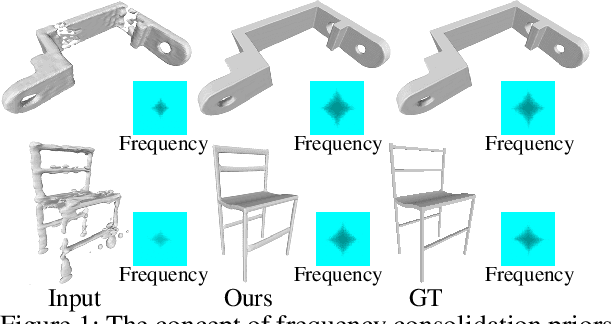


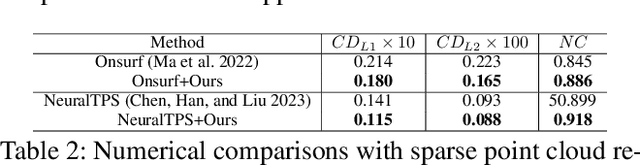
Signed Distance Functions (SDFs) are vital implicit representations to represent high fidelity 3D surfaces. Current methods mainly leverage a neural network to learn an SDF from various supervisions including signed distances, 3D point clouds, or multi-view images. However, due to various reasons including the bias of neural network on low frequency content, 3D unaware sampling, sparsity in point clouds, or low resolutions of images, neural implicit representations still struggle to represent geometries with high frequency components like sharp structures, especially for the ones learned from images or point clouds. To overcome this challenge, we introduce a method to sharpen a low frequency SDF observation by recovering its high frequency components, pursuing a sharper and more complete surface. Our key idea is to learn a mapping from a low frequency observation to a full frequency coverage in a data-driven manner, leading to a prior knowledge of shape consolidation in the frequency domain, dubbed frequency consolidation priors. To better generalize a learned prior to unseen shapes, we introduce to represent frequency components as embeddings and disentangle the embedding of the low frequency component from the embedding of the full frequency component. This disentanglement allows the prior to generalize on an unseen low frequency observation by simply recovering its full frequency embedding through a test-time self-reconstruction. Our evaluations under widely used benchmarks or real scenes show that our method can recover high frequency component and produce more accurate surfaces than the latest methods. The code, data, and pre-trained models are available at \url{https://github.com/chenchao15/FCP}.
Sensing Surface Patches in Volume Rendering for Inferring Signed Distance Functions
Dec 21, 2024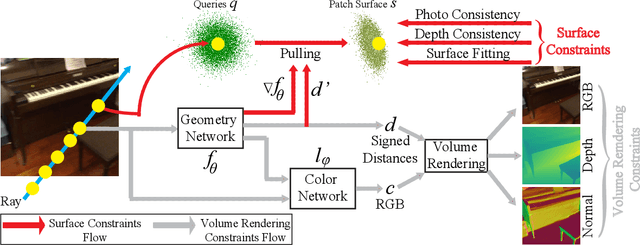
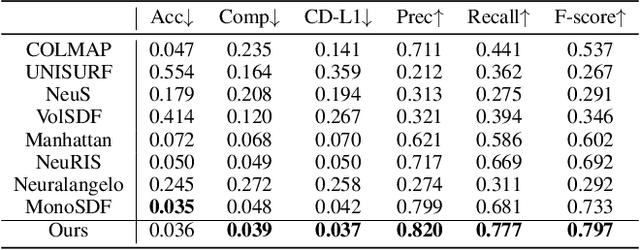
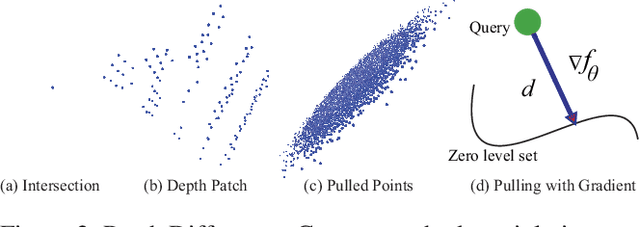
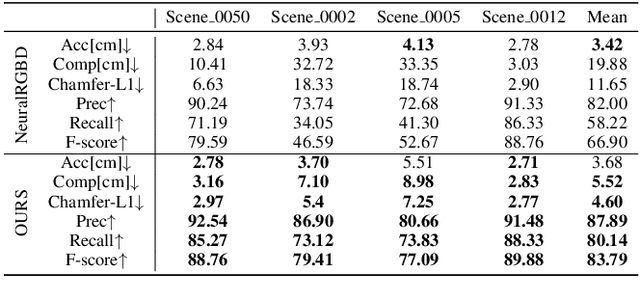
It is vital to recover 3D geometry from multi-view RGB images in many 3D computer vision tasks. The latest methods infer the geometry represented as a signed distance field by minimizing the rendering error on the field through volume rendering. However, it is still challenging to explicitly impose constraints on surfaces for inferring more geometry details due to the limited ability of sensing surfaces in volume rendering. To resolve this problem, we introduce a method to infer signed distance functions (SDFs) with a better sense of surfaces through volume rendering. Using the gradients and signed distances, we establish a small surface patch centered at the estimated intersection along a ray by pulling points randomly sampled nearby. Hence, we are able to explicitly impose surface constraints on the sensed surface patch, such as multi-view photo consistency and supervision from depth or normal priors, through volume rendering. We evaluate our method by numerical and visual comparisons on scene benchmarks. Our superiority over the latest methods justifies our effectiveness.