 Add to Chrome
 Add to Firefox
 Add to Edge
UniQuery4R: Unified 4D Scene Reconstruction from a Single Query
Aug 18, 2026
Reconstructing dynamic 4D scenes requires jointly estimating correspondence, geometry, object motion, and camera motion. Existing feed-forward methods typically predict dense task-specific maps or independently process source-target pairs, leading to unnecessary computation for sparse queries and limited feature reuse across different frame pairs. We present UniQuery4R, a query-conditioned framework that encodes a multi-frame clip once and selects the source view, target view, and continuous source-image coordinate only at decoding time via source-to-target cross-attention. Each query jointly predicts target correspondence, target-time 3D position, and scene flow, along with source depth, while camera parameters are estimated per view. This design allows the encoded clip to be reused across arbitrary source-target selections and supports both sparse inference and dense reconstruction through batched queries, without learned temporal embeddings tied to a fixed clip length. We further introduce a direction-magnitude parameterization of scene flow with separate supervision for moving and static points. Among the evaluated methods, UniQuery4R achieves the best macro-average results on WorldTrack for both scene-flow estimation and dynamic-point reconstruction.

GeoWeaver: Accurate Long-Sequence 3D Reconstruction via Hierarchical Geometric Assembly
Aug 18, 2026Long-sequence 3D reconstruction from RGB videos requires both accurate local geometry and globally consistent camera motion. Feed-forward models provide strong depth and pose predictions, but their memory cost prevents joint inference over long sequences. Chunk-wise processing improves scalability, yet independently predicted chunks often exhibit scale drift, pose errors, and point-cloud misalignment. We present GeoWeaver, a unified framework comprising a Geometric Prior Model (GPM) and Test-Time Adaptation (TTA). The GPM predicts chunk-wise depth, confidence, and camera parameters as adjustable geometric priors. TTA then performs sequential initialization, global chunk-level Sim(3) alignment, and coarse-to-fine refinement of camera poses, affine depth corrections, and intrinsics. Dense correspondences provide adjacent, cross-chunk, and long-range constraints, while a robust CDF-style objective jointly optimizes weighted 2D reprojection and 3D consistency residuals. This design preserves local geometric accuracy while correcting accumulated pose, scale, depth, and calibration errors. Experiments across diverse long-sequence benchmarks demonstrate improved camera accuracy, global consistency, and point-cloud quality. Ablations verify the contribution of each adaptation stage, and applying the same TTA procedure to different geometric prior models consistently improves their trajectory estimates, demonstrating that GeoWeaver is not tied to a specific GPM.
Comparison-Based Ordinal Learning for Proactive Driving Risk Assessment
Jul 13, 2026Real-time driving risk assessment provides an essential basis for proactive safety by identifying and quantifying the danger of ongoing road interactions before adverse outcomes occur. However, due to the scarcity of collision data and frame-level risk labels, existing driving risk assessment methods often rely on surrogate objectives, which may imperfectly align with true collision risk and not faithfully reflect the relative danger of driving interaction. This paper proposes a comparison-based ordinal risk learning framework that learns collision-relevant risk scores from pairwise supervision in driving data, directly modeling relative risk ordering without requiring numerical frame-level risk labels. We derive pairwise comparisons from three sources of event-structured driving data for such ordinal risk learning: temporal progression within safety-critical sequences, event-level contrast between dangerous and normal interactions, and physics-based counterfactual perturbations. On this basis, instantiations with three risk-scoring function parameterizations are implemented, including directly learning risk scores from comparison data, and aligning existing single or multiple surrogate-based risk models. The proposed framework is evaluated on the 100-Car and SHRP2 naturalistic driving datasets using a proactive collision warning task. Results show that the proposed framework improves high-recall risk discrimination, warning precision, and warning lead time over representative surrogate-based baselines across both in-distribution and out-of-distribution evaluations. These results suggest that the proposed framework can contribute to proactive safety research by providing more reliable risk assessment for automated driving systems and safety-critical driving interactions.
LLM Agents Enable User-Governed Personalization Beyond Platform Boundaries
May 10, 2026Personalization today is fundamentally platform-centric: services build user representations from the behavioral fragments they observe. Yet no platform can construct a complete picture of the user, as competitive incentives, legal constraints, user privacy concerns, and epistemic limits create persistent data barriers. This paper argues for a shift from platform-centric personalization to user-governed personalization, where only the user can integrate fragmented contexts across platforms and the offline world. The key asymmetry lies in data access: only users can aggregate their own cross-platform and offline information. Large language model (LLM) agents make such integration practically feasible for the first time by enabling reasoning over heterogeneous personal data and transforming users' cross-context information into actionable personalization capabilities. We provide proof-of-concept evidence that users equipped with cross-platform data exports and an off-the-shelf LLM agent can outperform single-platform personalization baselines. We conclude by outlining a research agenda for building scalable user-governed personalization systems.
GaussianGrow: Geometry-aware Gaussian Growing from 3D Point Clouds with Text Guidance
Apr 07, 20263D Gaussian Splatting has demonstrated superior performance in rendering efficiency and quality, yet the generation of 3D Gaussians still remains a challenge without proper geometric priors. Existing methods have explored predicting point maps as geometric references for inferring Gaussian primitives, while the unreliable estimated geometries may lead to poor generations. In this work, we introduce GaussianGrow, a novel approach that generates 3D Gaussians by learning to grow them from easily accessible 3D point clouds, naturally enforcing geometric accuracy in Gaussian generation. Specifically, we design a text-guided Gaussian growing scheme that leverages a multi-view diffusion model to synthesize consistent appearances from input point clouds for supervision. To mitigate artifacts caused by fusing neighboring views, we constrain novel views generated at non-preset camera poses identified in overlapping regions across different views. For completing the hard-to-observe regions, we propose to iteratively detect the camera pose by observing the largest un-grown regions in point clouds and inpainting them by inpainting the rendered view with a pretrained 2D diffusion model. The process continues until complete Gaussians are generated. We extensively evaluate GaussianGrow on text-guided Gaussian generation from synthetic and even real-scanned point clouds. Project Page: https://weiqi-zhang.github.io/GaussianGrow
MoRe: Motion-aware Feed-forward 4D Reconstruction Transformer
Mar 05, 2026Reconstructing dynamic 4D scenes remains challenging due to the presence of moving objects that corrupt camera pose estimation. Existing optimization methods alleviate this issue with additional supervision, but they are mostly computationally expensive and impractical in real-time applications. To address these limitations, we propose MoRe, a feedforward 4D reconstruction network that efficiently recovers dynamic 3D scenes from monocular videos. Built upon a strong static reconstruction backbone, MoRe employs an attention-forcing strategy to disentangle dynamic motion from static structure. To further enhance robustness, we fine-tune the model on large-scale, diverse datasets encompassing both dynamic and static scenes. Moreover, our grouped causal attention captures temporal dependencies and adapts to varying token lengths across frames, ensuring temporally coherent geometry reconstruction. Extensive experiments on multiple benchmarks demonstrate that MoRe achieves high-quality dynamic reconstructions with exceptional efficiency.
GAP: Gaussianize Any Point Clouds with Text Guidance
Aug 07, 20253D Gaussian Splatting (3DGS) has demonstrated its advantages in achieving fast and high-quality rendering. As point clouds serve as a widely-used and easily accessible form of 3D representation, bridging the gap between point clouds and Gaussians becomes increasingly important. Recent studies have explored how to convert the colored points into Gaussians, but directly generating Gaussians from colorless 3D point clouds remains an unsolved challenge. In this paper, we propose GAP, a novel approach that gaussianizes raw point clouds into high-fidelity 3D Gaussians with text guidance. Our key idea is to design a multi-view optimization framework that leverages a depth-aware image diffusion model to synthesize consistent appearances across different viewpoints. To ensure geometric accuracy, we introduce a surface-anchoring mechanism that effectively constrains Gaussians to lie on the surfaces of 3D shapes during optimization. Furthermore, GAP incorporates a diffuse-based inpainting strategy that specifically targets at completing hard-to-observe regions. We evaluate GAP on the Point-to-Gaussian generation task across varying complexity levels, from synthetic point clouds to challenging real-world scans, and even large-scale scenes. Project Page: https://weiqi-zhang.github.io/GAP.
Learning Bijective Surface Parameterization for Inferring Signed Distance Functions from Sparse Point Clouds with Grid Deformation
Mar 31, 2025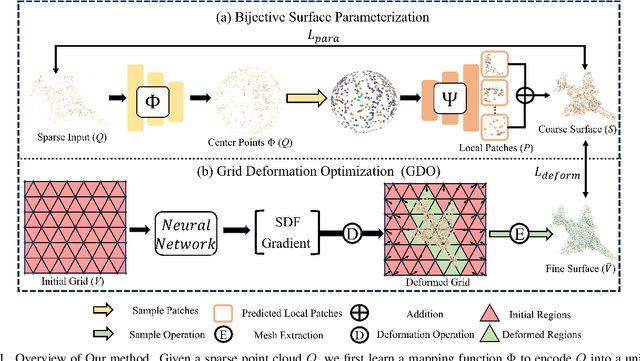
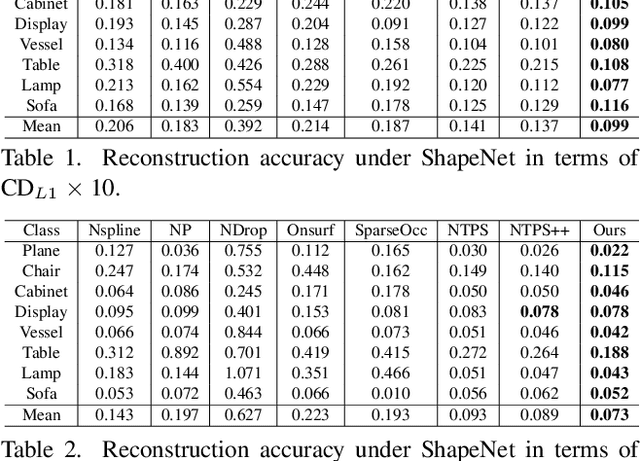
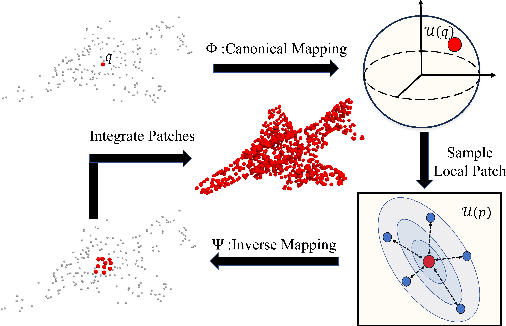
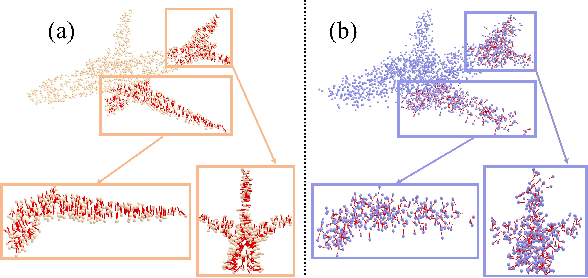
Inferring signed distance functions (SDFs) from sparse point clouds remains a challenge in surface reconstruction. The key lies in the lack of detailed geometric information in sparse point clouds, which is essential for learning a continuous field. To resolve this issue, we present a novel approach that learns a dynamic deformation network to predict SDFs in an end-to-end manner. To parameterize a continuous surface from sparse points, we propose a bijective surface parameterization (BSP) that learns the global shape from local patches. Specifically, we construct a bijective mapping for sparse points from the parametric domain to 3D local patches, integrating patches into the global surface. Meanwhile, we introduce grid deformation optimization (GDO) into the surface approximation to optimize the deformation of grid points and further refine the parametric surfaces. Experimental results on synthetic and real scanned datasets demonstrate that our method significantly outperforms the current state-of-the-art methods. Project page: https://takeshie.github.io/Bijective-SDF
Sparseformer: a Transferable Transformer with Multi-granularity Token Sparsification for Medical Time Series Classification
Mar 19, 2025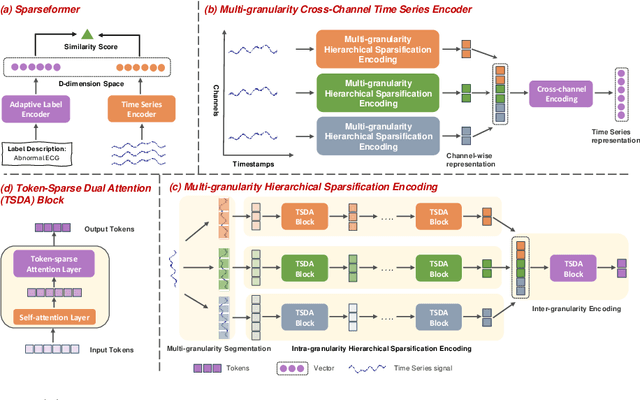
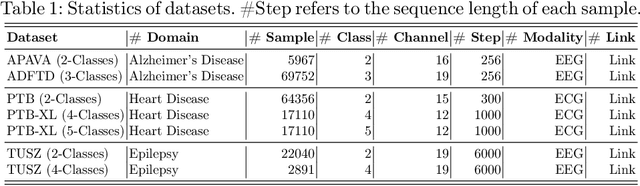
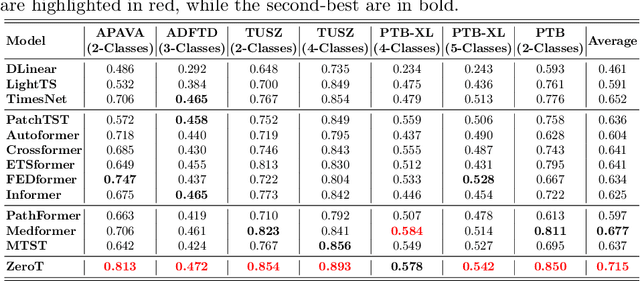
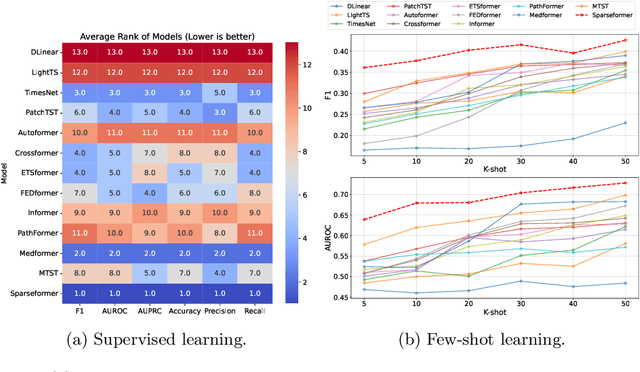
Medical time series (MedTS) classification is crucial for improved diagnosis in healthcare, and yet it is challenging due to the varying granularity of patterns, intricate inter-channel correlation, information redundancy, and label scarcity. While existing transformer-based models have shown promise in time series analysis, they mainly focus on forecasting and fail to fully exploit the distinctive characteristics of MedTS data. In this paper, we introduce Sparseformer, a transformer specifically designed for MedTS classification. We propose a sparse token-based dual-attention mechanism that enables global modeling and token compression, allowing dynamic focus on the most informative tokens while distilling redundant features. This mechanism is then applied to the multi-granularity, cross-channel encoding of medical signals, capturing intra- and inter-granularity correlations and inter-channel connections. The sparsification design allows our model to handle heterogeneous inputs of varying lengths and channels directly. Further, we introduce an adaptive label encoder to address label space misalignment across datasets, equipping our model with cross-dataset transferability to alleviate the medical label scarcity issue. Our model outperforms 12 baselines across seven medical datasets under supervised learning. In the few-shot learning experiments, our model also achieves superior average results. In addition, the in-domain and cross-domain experiments among three diagnostic scenarios demonstrate our model's zero-shot learning capability. Collectively, these findings underscore the robustness and transferability of our model in various medical applications.
MultiPull: Detailing Signed Distance Functions by Pulling Multi-Level Queries at Multi-Step
Nov 02, 2024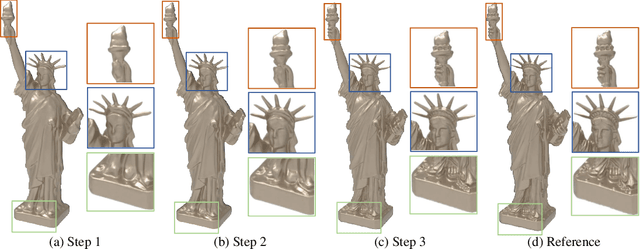


Reconstructing a continuous surface from a raw 3D point cloud is a challenging task. Recent methods usually train neural networks to overfit on single point clouds to infer signed distance functions (SDFs). However, neural networks tend to smooth local details due to the lack of ground truth signed distances or normals, which limits the performance of overfitting-based methods in reconstruction tasks. To resolve this issue, we propose a novel method, named MultiPull, to learn multi-scale implicit fields from raw point clouds by optimizing accurate SDFs from coarse to fine. We achieve this by mapping 3D query points into a set of frequency features, which makes it possible to leverage multi-level features during optimization. Meanwhile, we introduce optimization constraints from the perspective of spatial distance and normal consistency, which play a key role in point cloud reconstruction based on multi-scale optimization strategies. Our experiments on widely used object and scene benchmarks demonstrate that our method outperforms the state-of-the-art methods in surface reconstruction.