 Add to Chrome
 Add to Firefox
 Add to Edge
Habitat-GS: A High-Fidelity Navigation Simulator with Dynamic Gaussian Splatting
Apr 14, 2026
Training embodied AI agents depends critically on the visual fidelity of simulation environments and the ability to model dynamic humans. Current simulators rely on mesh-based rasterization with limited visual realism, and their support for dynamic human avatars, where available, is constrained to mesh representations, hindering agent generalization to human-populated real-world scenarios. We present Habitat-GS, a navigation-centric embodied AI simulator extended from Habitat-Sim that integrates 3D Gaussian Splatting scene rendering and drivable gaussian avatars while maintaining full compatibility with the Habitat ecosystem. Our system implements a 3DGS renderer for real-time photorealistic rendering and supports scalable 3DGS asset import from diverse sources. For dynamic human modeling, we introduce a gaussian avatar module that enables each avatar to simultaneously serve as a photorealistic visual entity and an effective navigation obstacle, allowing agents to learn human-aware behaviors in realistic settings. Experiments on point-goal navigation demonstrate that agents trained on 3DGS scenes achieve stronger cross-domain generalization, with mixed-domain training being the most effective strategy. Evaluations on avatar-aware navigation further confirm that gaussian avatars enable effective human-aware navigation. Finally, performance benchmarks validate the system's scalability across varying scene complexity and avatar counts.

DynFlowDrive: Flow-Based Dynamic World Modeling for Autonomous Driving
Mar 20, 2026Recently, world models have been incorporated into the autonomous driving systems to improve the planning reliability. Existing approaches typically predict future states through appearance generation or deterministic regression, which limits their ability to capture trajectory-conditioned scene evolution and leads to unreliable action planning. To address this, we propose DynFlowDrive, a latent world model that leverages flow-based dynamics to model the transition of world states under different driving actions. By adopting the rectifiedflow formulation, the model learns a velocity field that describes how the scene state changes under different driving actions, enabling progressive prediction of future latent states. Building upon this, we further introduce a stability-aware multi-mode trajectory selection strategy that evaluates candidate trajectories according to the stability of the induced scene transitions. Extensive experiments on the nuScenes and NavSim benchmarks demonstrate consistent improvements across diverse driving frameworks without introducing additional inference overhead. Source code will be abaliable at https://github.com/xiaolul2/DynFlowDrive.
MBD: A Model-Based Debiasing Framework Across User, Content, and Model Dimensions
Mar 15, 2026Modern recommendation systems rank candidates by aggregating multiple behavioral signals through a value model. However, many commonly used signals are inherently affected by heterogeneous biases. For example, watch time naturally favors long-form content, loop rate favors short - form content, and comment probability favors videos over images. Such biases introduce two critical issues: (1) value model scores may be systematically misaligned with users' relative preferences - for instance, a seemingly low absolute like probability may represent exceptionally strong interest for a user who rarely engages; and (2) changes in value modeling rules can trigger abrupt and undesirable ecosystem shifts. In this work, we ask a fundamental question: can biased behavioral signals be systematically transformed into unbiased signals, under a user - defined notion of ``unbiasedness'', that are both personalized and adaptive? We propose a general, model-based debiasing (MBD) framework that addresses this challenge by augmenting it with distributional modeling. By conditioning on a flexible subset of features (partial feature set), we explicitly estimate the contextual mean and variance of the engagement distribution for arbitrary cohorts (e.g., specific video lengths or user regions) directly alongside the main prediction. This integration allows the framework to convert biased raw signals into unbiased representations, enabling the construction of higher-level, calibrated signals (such as percentiles or z - scores) suitable for the value model. Importantly, the definition of unbiasedness is flexible and controllable, allowing the system to adapt to different personalization objectives and modeling preferences. Crucially, this is implemented as a lightweight, built-in branch of the existing MTML ranking model, requiring no separate serving infrastructure.
VisionTrim: Unified Vision Token Compression for Training-Free MLLM Acceleration
Jan 30, 2026Multimodal large language models (MLLMs) suffer from high computational costs due to excessive visual tokens, particularly in high-resolution and video-based scenarios. Existing token reduction methods typically focus on isolated pipeline components and often neglect textual alignment, leading to performance degradation. In this paper, we propose VisionTrim, a unified framework for training-free MLLM acceleration, integrating two effective plug-and-play modules: 1) the Dominant Vision Token Selection (DVTS) module, which preserves essential visual tokens via a global-local view, and 2) the Text-Guided Vision Complement (TGVC) module, which facilitates context-aware token merging guided by textual cues. Extensive experiments across diverse image and video multimodal benchmarks demonstrate the performance superiority of our VisionTrim, advancing practical MLLM deployment in real-world applications. The code is available at: https://github.com/hanxunyu/VisionTrim.
LADY: Linear Attention for Autonomous Driving Efficiency without Transformers
Dec 18, 2025End-to-end paradigms have demonstrated great potential for autonomous driving. Additionally, most existing methods are built upon Transformer architectures. However, transformers incur a quadratic attention cost, limiting their ability to model long spatial and temporal sequences-particularly on resource-constrained edge platforms. As autonomous driving inherently demands efficient temporal modeling, this challenge severely limits their deployment and real-time performance. Recently, linear attention mechanisms have gained increasing attention due to their superior spatiotemporal complexity. However, existing linear attention architectures are limited to self-attention, lacking support for cross-modal and cross-temporal interactions-both crucial for autonomous driving. In this work, we propose LADY, the first fully linear attention-based generative model for end-to-end autonomous driving. LADY enables fusion of long-range temporal context at inference with constant computational and memory costs, regardless of the history length of camera and LiDAR features. Additionally, we introduce a lightweight linear cross-attention mechanism that enables effective cross-modal information exchange. Experiments on the NAVSIM and Bench2Drive benchmarks demonstrate that LADY achieves state-of-the-art performance with constant-time and memory complexity, offering improved planning performance and significantly reduced computational cost. Additionally, the model has been deployed and validated on edge devices, demonstrating its practicality in resource-limited scenarios.
MambaMap: Online Vectorized HD Map Construction using State Space Model
Jul 27, 2025High-definition (HD) maps are essential for autonomous driving, as they provide precise road information for downstream tasks. Recent advances highlight the potential of temporal modeling in addressing challenges like occlusions and extended perception range. However, existing methods either fail to fully exploit temporal information or incur substantial computational overhead in handling extended sequences. To tackle these challenges, we propose MambaMap, a novel framework that efficiently fuses long-range temporal features in the state space to construct online vectorized HD maps. Specifically, MambaMap incorporates a memory bank to store and utilize information from historical frames, dynamically updating BEV features and instance queries to improve robustness against noise and occlusions. Moreover, we introduce a gating mechanism in the state space, selectively integrating dependencies of map elements in high computational efficiency. In addition, we design innovative multi-directional and spatial-temporal scanning strategies to enhance feature extraction at both BEV and instance levels. These strategies significantly boost the prediction accuracy of our approach while ensuring robust temporal consistency. Extensive experiments on the nuScenes and Argoverse2 datasets demonstrate that our proposed MambaMap approach outperforms state-of-the-art methods across various splits and perception ranges. Source code will be available at https://github.com/ZiziAmy/MambaMap.
RoPETR: Improving Temporal Camera-Only 3D Detection by Integrating Enhanced Rotary Position Embedding
Apr 18, 2025This technical report introduces a targeted improvement to the StreamPETR framework, specifically aimed at enhancing velocity estimation, a critical factor influencing the overall NuScenes Detection Score. While StreamPETR exhibits strong 3D bounding box detection performance as reflected by its high mean Average Precision our analysis identified velocity estimation as a substantial bottleneck when evaluated on the NuScenes dataset. To overcome this limitation, we propose a customized positional embedding strategy tailored to enhance temporal modeling capabilities. Experimental evaluations conducted on the NuScenes test set demonstrate that our improved approach achieves a state-of-the-art NDS of 70.86% using the ViT-L backbone, setting a new benchmark for camera-only 3D object detection.
Uncertainty-Instructed Structure Injection for Generalizable HD Map Construction
Mar 29, 2025Reliable high-definition (HD) map construction is crucial for the driving safety of autonomous vehicles. Although recent studies demonstrate improved performance, their generalization capability across unfamiliar driving scenes remains unexplored. To tackle this issue, we propose UIGenMap, an uncertainty-instructed structure injection approach for generalizable HD map vectorization, which concerns the uncertainty resampling in statistical distribution and employs explicit instance features to reduce excessive reliance on training data. Specifically, we introduce the perspective-view (PV) detection branch to obtain explicit structural features, in which the uncertainty-aware decoder is designed to dynamically sample probability distributions considering the difference in scenes. With probabilistic embedding and selection, UI2DPrompt is proposed to construct PV-learnable prompts. These PV prompts are integrated into the map decoder by designed hybrid injection to compensate for neglected instance structures. To ensure real-time inference, a lightweight Mimic Query Distillation is designed to learn from PV prompts, which can serve as an efficient alternative to the flow of PV branches. Extensive experiments on challenging geographically disjoint (geo-based) data splits demonstrate that our UIGenMap achieves superior performance, with +5.7 mAP improvement on the nuScenes dataset. Source code will be available at https://github.com/xiaolul2/UIGenMap.
ReliOcc: Towards Reliable Semantic Occupancy Prediction via Uncertainty Learning
Sep 26, 2024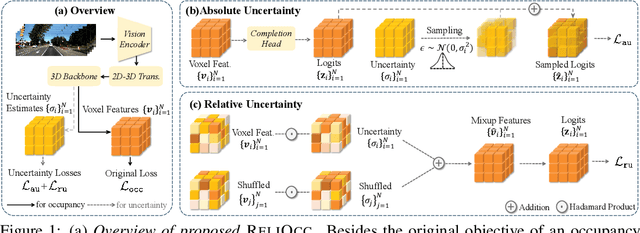
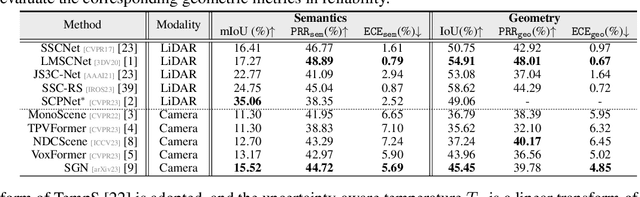
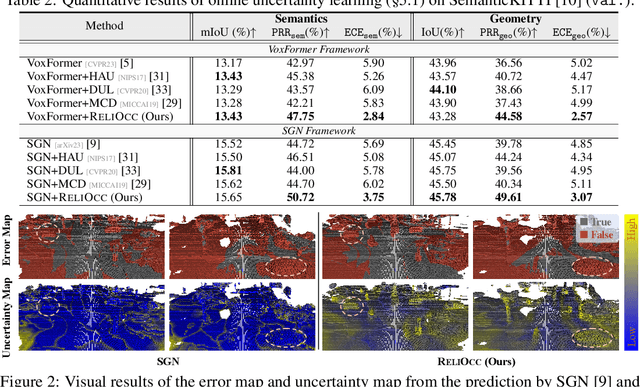
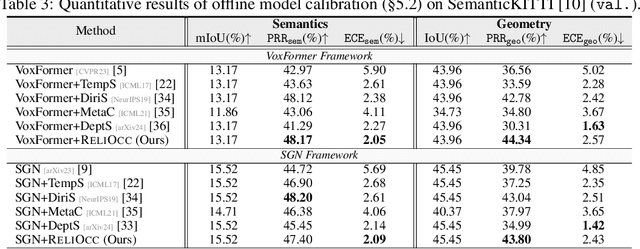
Vision-centric semantic occupancy prediction plays a crucial role in autonomous driving, which requires accurate and reliable predictions from low-cost sensors. Although having notably narrowed the accuracy gap with LiDAR, there is still few research effort to explore the reliability in predicting semantic occupancy from camera. In this paper, we conduct a comprehensive evaluation of existing semantic occupancy prediction models from a reliability perspective for the first time. Despite the gradual alignment of camera-based models with LiDAR in term of accuracy, a significant reliability gap persists. To addresses this concern, we propose ReliOcc, a method designed to enhance the reliability of camera-based occupancy networks. ReliOcc provides a plug-and-play scheme for existing models, which integrates hybrid uncertainty from individual voxels with sampling-based noise and relative voxels through mix-up learning. Besides, an uncertainty-aware calibration strategy is devised to further enhance model reliability in offline mode. Extensive experiments under various settings demonstrate that ReliOcc significantly enhances model reliability while maintaining the accuracy of both geometric and semantic predictions. Importantly, our proposed approach exhibits robustness to sensor failures and out of domain noises during inference.
MV-DETR: Multi-modality indoor object detection by Multi-View DEtecton TRansformers
Aug 13, 2024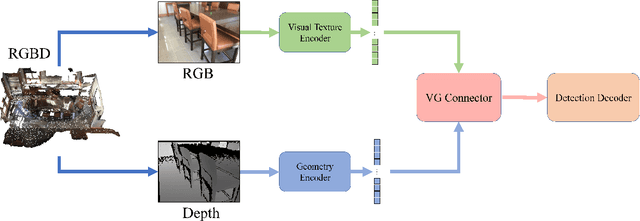
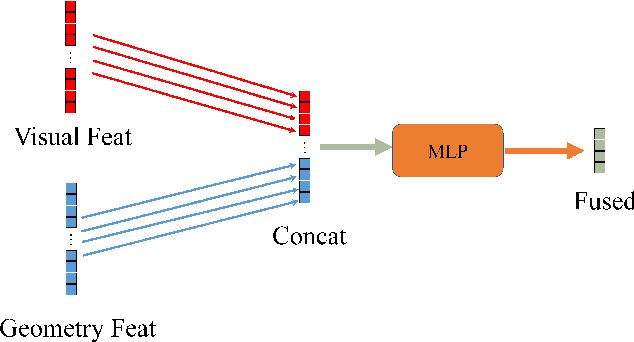
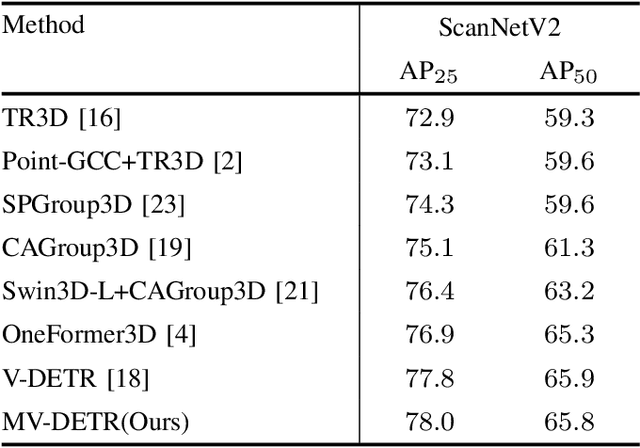
We introduce a novel MV-DETR pipeline which is effective while efficient transformer based detection method. Given input RGBD data, we notice that there are super strong pretraining weights for RGB data while less effective works for depth related data. First and foremost , we argue that geometry and texture cues are both of vital importance while could be encoded separately. Secondly, we find that visual texture feature is relatively hard to extract compared with geometry feature in 3d space. Unfortunately, single RGBD dataset with thousands of data is not enough for training an discriminating filter for visual texture feature extraction. Last but certainly not the least, we designed a lightweight VG module consists of a visual textual encoder, a geometry encoder and a VG connector. Compared with previous state of the art works like V-DETR, gains from pretrained visual encoder could be seen. Extensive experiments on ScanNetV2 dataset shows the effectiveness of our method. It is worth mentioned that our method achieve 78\% AP which create new state of the art on ScanNetv2 benchmark.