 Add to Chrome
 Add to Firefox
 Add to Edge
MBD: A Model-Based Debiasing Framework Across User, Content, and Model Dimensions
Mar 15, 2026
Modern recommendation systems rank candidates by aggregating multiple behavioral signals through a value model. However, many commonly used signals are inherently affected by heterogeneous biases. For example, watch time naturally favors long-form content, loop rate favors short - form content, and comment probability favors videos over images. Such biases introduce two critical issues: (1) value model scores may be systematically misaligned with users' relative preferences - for instance, a seemingly low absolute like probability may represent exceptionally strong interest for a user who rarely engages; and (2) changes in value modeling rules can trigger abrupt and undesirable ecosystem shifts. In this work, we ask a fundamental question: can biased behavioral signals be systematically transformed into unbiased signals, under a user - defined notion of ``unbiasedness'', that are both personalized and adaptive? We propose a general, model-based debiasing (MBD) framework that addresses this challenge by augmenting it with distributional modeling. By conditioning on a flexible subset of features (partial feature set), we explicitly estimate the contextual mean and variance of the engagement distribution for arbitrary cohorts (e.g., specific video lengths or user regions) directly alongside the main prediction. This integration allows the framework to convert biased raw signals into unbiased representations, enabling the construction of higher-level, calibrated signals (such as percentiles or z - scores) suitable for the value model. Importantly, the definition of unbiasedness is flexible and controllable, allowing the system to adapt to different personalization objectives and modeling preferences. Crucially, this is implemented as a lightweight, built-in branch of the existing MTML ranking model, requiring no separate serving infrastructure.

Multi-Probe Zero Collision Hash (MPZCH): Mitigating Embedding Collisions and Enhancing Model Freshness in Large-Scale Recommenders
Feb 19, 2026Embedding tables are critical components of large-scale recommendation systems, facilitating the efficient mapping of high-cardinality categorical features into dense vector representations. However, as the volume of unique IDs expands, traditional hash-based indexing methods suffer from collisions that degrade model performance and personalization quality. We present Multi-Probe Zero Collision Hash (MPZCH), a novel indexing mechanism based on linear probing that effectively mitigates embedding collisions. With reasonable table sizing, it often eliminates these collisions entirely while maintaining production-scale efficiency. MPZCH utilizes auxiliary tensors and high-performance CUDA kernels to implement configurable probing and active eviction policies. By retiring obsolete IDs and resetting reassigned slots, MPZCH prevents the stale embedding inheritance typical of hash-based methods, ensuring new features learn effectively from scratch. Despite its collision-mitigation overhead, the system maintains training QPS and inference latency comparable to existing methods. Rigorous online experiments demonstrate that MPZCH achieves zero collisions for user embeddings and significantly improves item embedding freshness and quality. The solution has been released within the open-source TorchRec library for the broader community.
Orthogonal Approximate Message Passing Algorithms for Rectangular Spiked Matrix Models with Rotationally Invariant Noise
Feb 03, 2026We propose an orthogonal approximate message passing (OAMP) algorithm for signal estimation in the rectangular spiked matrix model with general rotationally invariant (RI) noise. We establish a rigorous state evolution that exactly characterizes the high-dimensional dynamics of the algorithm. Building on this framework, we derive an optimal variant of OAMP that minimizes the predicted mean-squared error at each iteration. For the special case of i.i.d. Gaussian noise, the fixed point of the proposed OAMP algorithm coincides with that of the standard AMP algorithm. For general RI noise models, we conjecture that the optimal OAMP algorithm is statistically optimal within a broad class of iterative methods, and achieves Bayes-optimal performance in certain regimes.
Orthogonal Approximate Message Passing with Optimal Spectral Initializations for Rectangular Spiked Matrix Models
Dec 22, 2025We propose an orthogonal approximate message passing (OAMP) algorithm for signal estimation in the rectangular spiked matrix model with general rotationally invariant (RI) noise. We establish a rigorous state evolution that precisely characterizes the algorithm's high-dimensional dynamics and enables the construction of iteration-wise optimal denoisers. Within this framework, we accommodate spectral initializations under minimal assumptions on the empirical noise spectrum. In the rectangular setting, where a single rank-one component typically generates multiple informative outliers, we further propose a procedure for combining these outliers under mild non-Gaussian signal assumptions. For general RI noise models, the predicted performance of the proposed optimal OAMP algorithm agrees with replica-symmetric predictions for the associated Bayes-optimal estimator, and we conjecture that it is statistically optimal within a broad class of iterative estimation methods.
Unifying AMP Algorithms for Rotationally-Invariant Models
Dec 02, 2024This paper presents a unified framework for constructing Approximate Message Passing (AMP) algorithms for rotationally-invariant models. By employing a general iterative algorithm template and reducing it to long-memory Orthogonal AMP (OAMP), we systematically derive the correct Onsager terms of AMP algorithms. This approach allows us to rederive an AMP algorithm introduced by Fan and Opper et al., while shedding new light on the role of free cumulants of the spectral law. The free cumulants arise naturally from a recursive centering operation, potentially of independent interest beyond the scope of AMP. To illustrate the flexibility of our framework, we introduce two novel AMP variants and apply them to estimation in spiked models.
Optimality of Approximate Message Passing Algorithms for Spiked Matrix Models with Rotationally Invariant Noise
May 28, 2024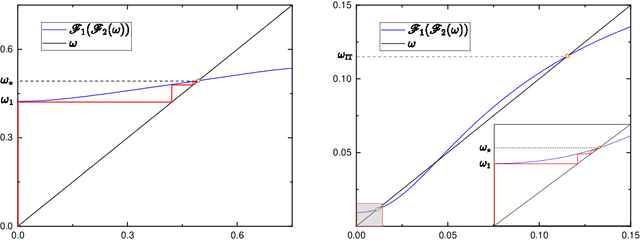
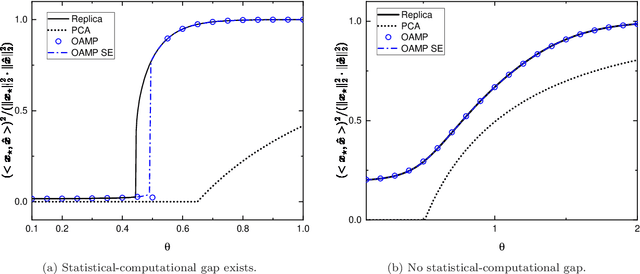
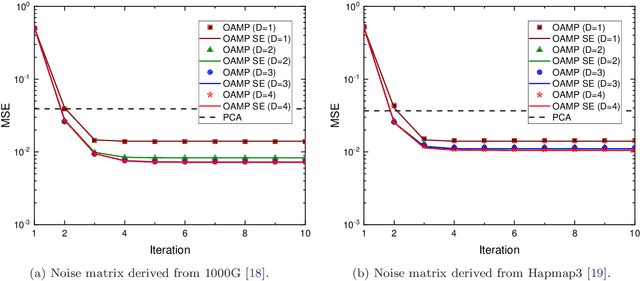
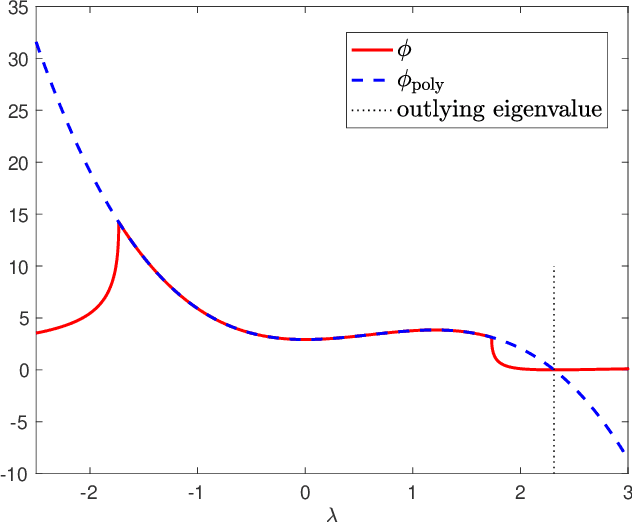
We study the problem of estimating a rank one signal matrix from an observed matrix generated by corrupting the signal with additive rotationally invariant noise. We develop a new class of approximate message-passing algorithms for this problem and provide a simple and concise characterization of their dynamics in the high-dimensional limit. At each iteration, these algorithms exploit prior knowledge about the noise structure by applying a non-linear matrix denoiser to the eigenvalues of the observed matrix and prior information regarding the signal structure by applying a non-linear iterate denoiser to the previous iterates generated by the algorithm. We exploit our result on the dynamics of these algorithms to derive the optimal choices for the matrix and iterate denoisers. We show that the resulting algorithm achieves the smallest possible asymptotic estimation error among a broad class of iterative algorithms under a fixed iteration budget.