 Add to Chrome
 Add to Firefox
 Add to Edge
LADY: Linear Attention for Autonomous Driving Efficiency without Transformers
Dec 18, 2025
End-to-end paradigms have demonstrated great potential for autonomous driving. Additionally, most existing methods are built upon Transformer architectures. However, transformers incur a quadratic attention cost, limiting their ability to model long spatial and temporal sequences-particularly on resource-constrained edge platforms. As autonomous driving inherently demands efficient temporal modeling, this challenge severely limits their deployment and real-time performance. Recently, linear attention mechanisms have gained increasing attention due to their superior spatiotemporal complexity. However, existing linear attention architectures are limited to self-attention, lacking support for cross-modal and cross-temporal interactions-both crucial for autonomous driving. In this work, we propose LADY, the first fully linear attention-based generative model for end-to-end autonomous driving. LADY enables fusion of long-range temporal context at inference with constant computational and memory costs, regardless of the history length of camera and LiDAR features. Additionally, we introduce a lightweight linear cross-attention mechanism that enables effective cross-modal information exchange. Experiments on the NAVSIM and Bench2Drive benchmarks demonstrate that LADY achieves state-of-the-art performance with constant-time and memory complexity, offering improved planning performance and significantly reduced computational cost. Additionally, the model has been deployed and validated on edge devices, demonstrating its practicality in resource-limited scenarios.

FusionAD: Multi-modality Fusion for Prediction and Planning Tasks of Autonomous Driving
Aug 14, 2023

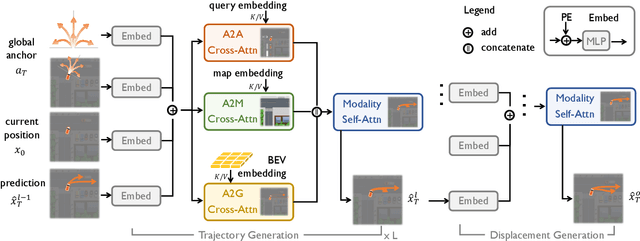
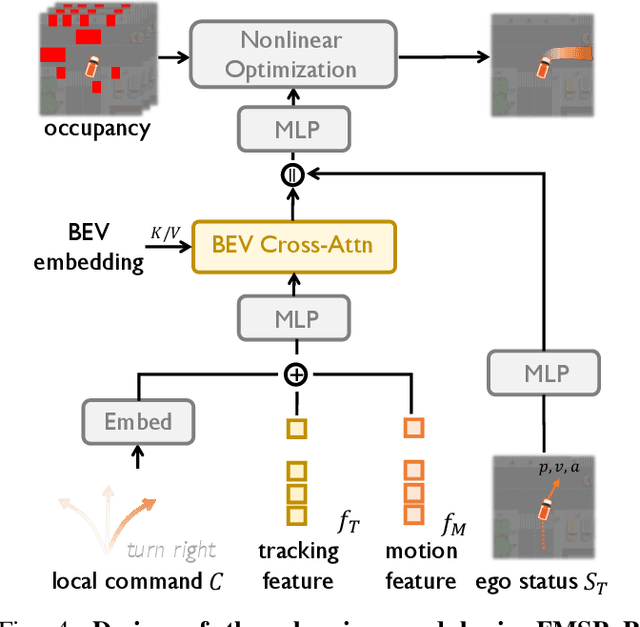
Building a multi-modality multi-task neural network toward accurate and robust performance is a de-facto standard in perception task of autonomous driving. However, leveraging such data from multiple sensors to jointly optimize the prediction and planning tasks remains largely unexplored. In this paper, we present FusionAD, to the best of our knowledge, the first unified framework that fuse the information from two most critical sensors, camera and LiDAR, goes beyond perception task. Concretely, we first build a transformer based multi-modality fusion network to effectively produce fusion based features. In constrast to camera-based end-to-end method UniAD, we then establish a fusion aided modality-aware prediction and status-aware planning modules, dubbed FMSPnP that take advantages of multi-modality features. We conduct extensive experiments on commonly used benchmark nuScenes dataset, our FusionAD achieves state-of-the-art performance and surpassing baselines on average 15% on perception tasks like detection and tracking, 10% on occupancy prediction accuracy, reducing prediction error from 0.708 to 0.389 in ADE score and reduces the collision rate from 0.31% to only 0.12%.