 Add to Chrome
 Add to Firefox
 Add to Edge
SlimPer: Make Personalization Model Slim and Smart
Jul 14, 2026
Transformer-style architectures are increasingly adopted for industrial recommendation systems, yet they inherit a design premise misaligned with the task: generative models rely on per-token autoregressive prediction, which justifies maintaining large intermediate tensors that scale with sequence length. In contrast, recommendation systems produce a single set of relevance scores for each <user, item> pair without token-level supervision. Leveraging this observation, we propose SlimPer, which reformulates personalized ranking as iterative refinement of a compact, unified <user, item> knowledge base. At each layer, the model selectively queries raw multi-modal user-side tokens, computes explicit relevance matching scores, and refines the knowledge base, all in O(N) per-layer cost with a fixed-size intermediate representation. As a result, model depth is decoupled from user history length, enabling deeper relevance understanding without proportional growth in compute or memory; request-only optimization further trims memory by sharing a single copy of user-side tokens across all candidate items. SlimPer unifies sparse, dense, and sequence features within a single backbone and provides inherent interpretability through its attention mechanism. Deployed on Instagram Reels and Feed, SlimPer yields measurable improvements in user engagement while streamlining the overall system and enabling effective modeling of 10k+ fine-grained user history events.

MBD: A Model-Based Debiasing Framework Across User, Content, and Model Dimensions
Mar 15, 2026Modern recommendation systems rank candidates by aggregating multiple behavioral signals through a value model. However, many commonly used signals are inherently affected by heterogeneous biases. For example, watch time naturally favors long-form content, loop rate favors short - form content, and comment probability favors videos over images. Such biases introduce two critical issues: (1) value model scores may be systematically misaligned with users' relative preferences - for instance, a seemingly low absolute like probability may represent exceptionally strong interest for a user who rarely engages; and (2) changes in value modeling rules can trigger abrupt and undesirable ecosystem shifts. In this work, we ask a fundamental question: can biased behavioral signals be systematically transformed into unbiased signals, under a user - defined notion of ``unbiasedness'', that are both personalized and adaptive? We propose a general, model-based debiasing (MBD) framework that addresses this challenge by augmenting it with distributional modeling. By conditioning on a flexible subset of features (partial feature set), we explicitly estimate the contextual mean and variance of the engagement distribution for arbitrary cohorts (e.g., specific video lengths or user regions) directly alongside the main prediction. This integration allows the framework to convert biased raw signals into unbiased representations, enabling the construction of higher-level, calibrated signals (such as percentiles or z - scores) suitable for the value model. Importantly, the definition of unbiasedness is flexible and controllable, allowing the system to adapt to different personalization objectives and modeling preferences. Crucially, this is implemented as a lightweight, built-in branch of the existing MTML ranking model, requiring no separate serving infrastructure.
A Performance Guarantee for Spectral Clustering
Jul 10, 2020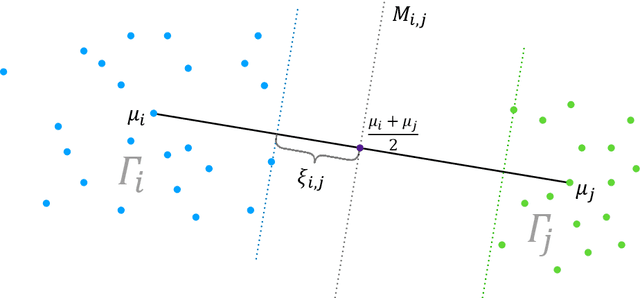
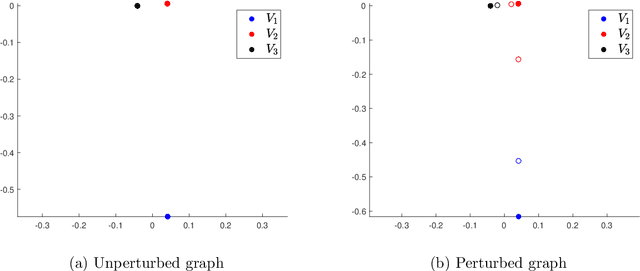
The two-step spectral clustering method, which consists of the Laplacian eigenmap and a rounding step, is a widely used method for graph partitioning. It can be seen as a natural relaxation to the NP-hard minimum ratio cut problem. In this paper we study the central question: when is spectral clustering able to find the global solution to the minimum ratio cut problem? First we provide a condition that naturally depends on the intra- and inter-cluster connectivities of a given partition under which we may certify that this partition is the solution to the minimum ratio cut problem. Then we develop a deterministic two-to-infinity norm perturbation bound for the the invariant subspace of the graph Laplacian that corresponds to the $k$ smallest eigenvalues. Finally by combining these two results we give a condition under which spectral clustering is guaranteed to output the global solution to the minimum ratio cut problem, which serves as a performance guarantee for spectral clustering.
Strong Consistency, Graph Laplacians, and the Stochastic Block Model
Apr 21, 2020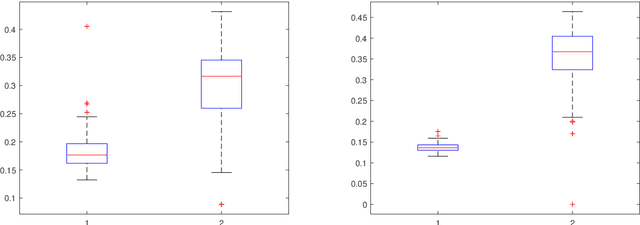
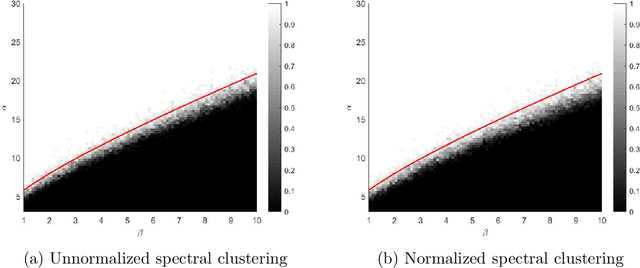
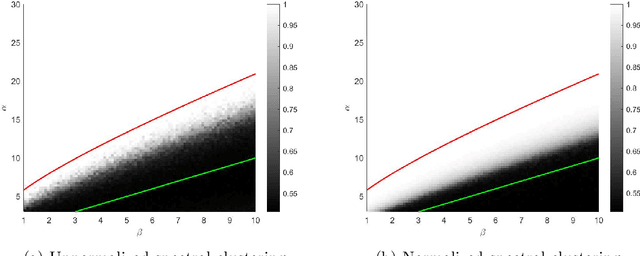
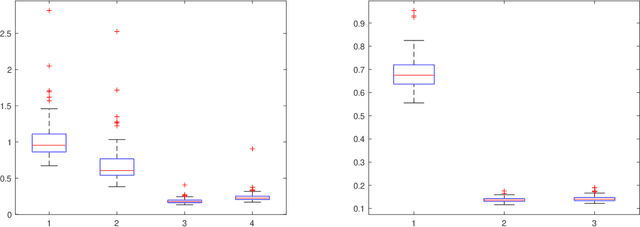
Spectral clustering has become one of the most popular algorithms in data clustering and community detection. We study the performance of classical two-step spectral clustering via the graph Laplacian to learn the stochastic block model. Our aim is to answer the following question: when is spectral clustering via the graph Laplacian able to achieve strong consistency, i.e., the exact recovery of the underlying hidden communities? Our work provides an entrywise analysis (an $\ell_{\infty}$-norm perturbation bound) of the Fielder eigenvector of both the unnormalized and the normalized Laplacian associated with the adjacency matrix sampled from the stochastic block model. We prove that spectral clustering is able to achieve exact recovery of the planted community structure under conditions that match the information-theoretic limits.