 Add to Chrome
 Add to Firefox
 Add to Edge
Can Prompt Learning Benefit Radiology Report Generation?
Aug 30, 2023
Radiology report generation aims to automatically provide clinically meaningful descriptions of radiology images such as MRI and X-ray. Although great success has been achieved in natural scene image captioning tasks, radiology report generation remains challenging and requires prior medical knowledge. In this paper, we propose PromptRRG, a method that utilizes prompt learning to activate a pretrained model and incorporate prior knowledge. Since prompt learning for radiology report generation has not been explored before, we begin with investigating prompt designs and categorise them based on varying levels of knowledge: common, domain-specific and disease-enriched prompts. Additionally, we propose an automatic prompt learning mechanism to alleviate the burden of manual prompt engineering. This is the first work to systematically examine the effectiveness of prompt learning for radiology report generation. Experimental results on the largest radiology report generation benchmark, MIMIC-CXR, demonstrate that our proposed method achieves state-of-the-art performance. Code will be available upon the acceptance.

JiangJun: Mastering Xiangqi by Tackling Non-Transitivity in Two-Player Zero-Sum Games
Aug 09, 2023

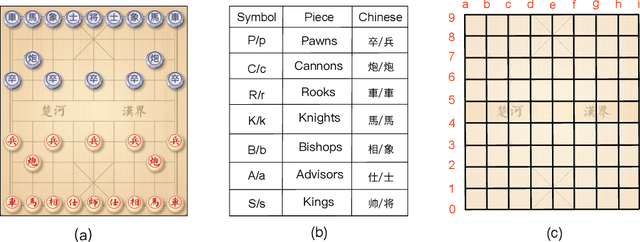

This paper presents an empirical exploration of non-transitivity in perfect-information games, specifically focusing on Xiangqi, a traditional Chinese board game comparable in game-tree complexity to chess and shogi. By analyzing over 10,000 records of human Xiangqi play, we highlight the existence of both transitive and non-transitive elements within the game's strategic structure. To address non-transitivity, we introduce the JiangJun algorithm, an innovative combination of Monte-Carlo Tree Search (MCTS) and Policy Space Response Oracles (PSRO) designed to approximate a Nash equilibrium. We evaluate the algorithm empirically using a WeChat mini program and achieve a Master level with a 99.41\% win rate against human players. The algorithm's effectiveness in overcoming non-transitivity is confirmed by a plethora of metrics, such as relative population performance and visualization results. Our project site is available at \url{https://sites.google.com/view/jiangjun-site/}.
Replace Scoring with Arrangement: A Contextual Set-to-Arrangement Framework for Learning-to-Rank
Aug 05, 2023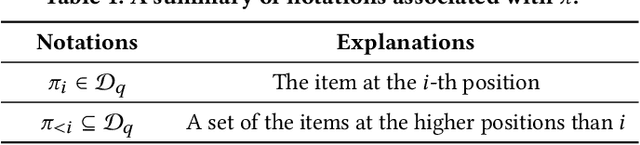

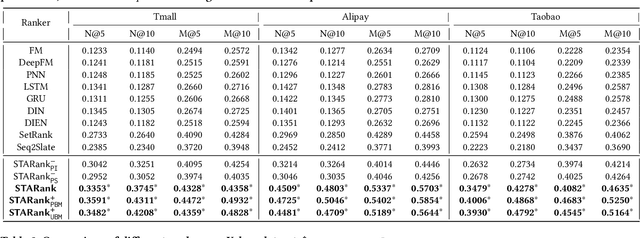

Learning-to-rank is a core technique in the top-N recommendation task, where an ideal ranker would be a mapping from an item set to an arrangement (a.k.a. permutation). Most existing solutions fall in the paradigm of probabilistic ranking principle (PRP), i.e., first score each item in the candidate set and then perform a sort operation to generate the top ranking list. However, these approaches neglect the contextual dependence among candidate items during individual scoring, and the sort operation is non-differentiable. To bypass the above issues, we propose Set-To-Arrangement Ranking (STARank), a new framework directly generates the permutations of the candidate items without the need for individually scoring and sort operations; and is end-to-end differentiable. As a result, STARank can operate when only the ground-truth permutations are accessible without requiring access to the ground-truth relevance scores for items. For this purpose, STARank first reads the candidate items in the context of the user browsing history, whose representations are fed into a Plackett-Luce module to arrange the given items into a list. To effectively utilize the given ground-truth permutations for supervising STARank, we leverage the internal consistency property of Plackett-Luce models to derive a computationally efficient list-wise loss. Experimental comparisons against 9 the state-of-the-art methods on 2 learning-to-rank benchmark datasets and 3 top-N real-world recommendation datasets demonstrate the superiority of STARank in terms of conventional ranking metrics. Notice that these ranking metrics do not consider the effects of the contextual dependence among the items in the list, we design a new family of simulation-based ranking metrics, where existing metrics can be regarded as special cases. STARank can consistently achieve better performance in terms of PBM and UBM simulation-based metrics.
Dynamic Token-Pass Transformers for Semantic Segmentation
Aug 03, 2023Vision transformers (ViT) usually extract features via forwarding all the tokens in the self-attention layers from top to toe. In this paper, we introduce dynamic token-pass vision transformers (DoViT) for semantic segmentation, which can adaptively reduce the inference cost for images with different complexity. DoViT gradually stops partial easy tokens from self-attention calculation and keeps the hard tokens forwarding until meeting the stopping criteria. We employ lightweight auxiliary heads to make the token-pass decision and divide the tokens into keeping/stopping parts. With a token separate calculation, the self-attention layers are speeded up with sparse tokens and still work friendly with hardware. A token reconstruction module is built to collect and reset the grouped tokens to their original position in the sequence, which is necessary to predict correct semantic masks. We conduct extensive experiments on two common semantic segmentation tasks, and demonstrate that our method greatly reduces about 40% $\sim$ 60% FLOPs and the drop of mIoU is within 0.8% for various segmentation transformers. The throughput and inference speed of ViT-L/B are increased to more than 2$\times$ on Cityscapes.
HyperFed: Hyperbolic Prototypes Exploration with Consistent Aggregation for Non-IID Data in Federated Learning
Jul 26, 2023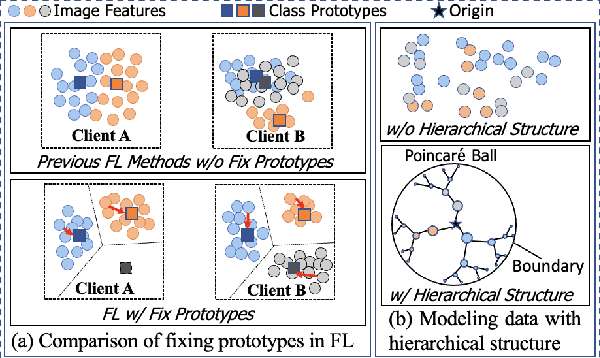
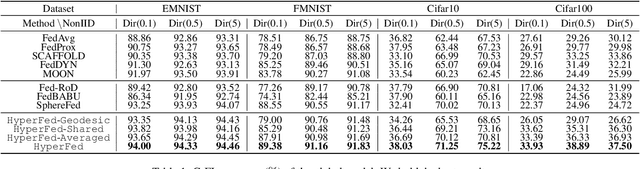
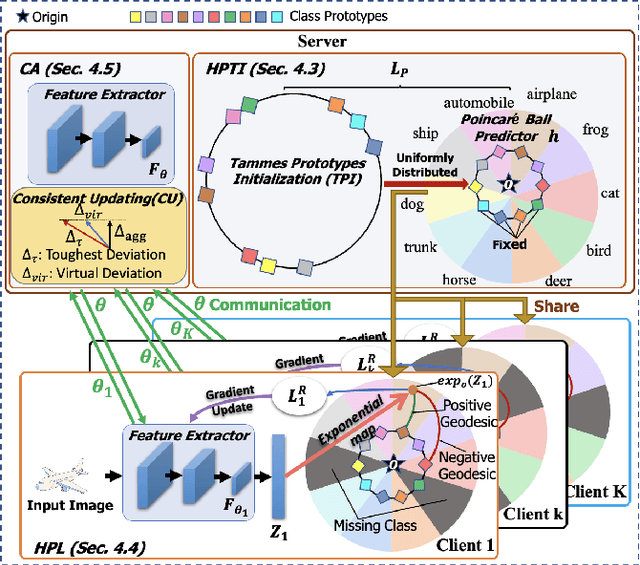
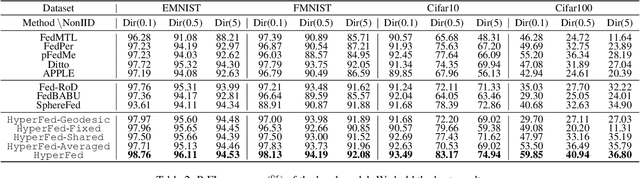
Federated learning (FL) collaboratively models user data in a decentralized way. However, in the real world, non-identical and independent data distributions (non-IID) among clients hinder the performance of FL due to three issues, i.e., (1) the class statistics shifting, (2) the insufficient hierarchical information utilization, and (3) the inconsistency in aggregating clients. To address the above issues, we propose HyperFed which contains three main modules, i.e., hyperbolic prototype Tammes initialization (HPTI), hyperbolic prototype learning (HPL), and consistent aggregation (CA). Firstly, HPTI in the server constructs uniformly distributed and fixed class prototypes, and shares them with clients to match class statistics, further guiding consistent feature representation for local clients. Secondly, HPL in each client captures the hierarchical information in local data with the supervision of shared class prototypes in the hyperbolic model space. Additionally, CA in the server mitigates the impact of the inconsistent deviations from clients to server. Extensive studies of four datasets prove that HyperFed is effective in enhancing the performance of FL under the non-IID set.
A Siamese-based Verification System for Open-set Architecture Attribution of Synthetic Images
Jul 19, 2023Despite the wide variety of methods developed for synthetic image attribution, most of them can only attribute images generated by models or architectures included in the training set and do not work with unknown architectures, hindering their applicability in real-world scenarios. In this paper, we propose a verification framework that relies on a Siamese Network to address the problem of open-set attribution of synthetic images to the architecture that generated them. We consider two different settings. In the first setting, the system determines whether two images have been produced by the same generative architecture or not. In the second setting, the system verifies a claim about the architecture used to generate a synthetic image, utilizing one or multiple reference images generated by the claimed architecture. The main strength of the proposed system is its ability to operate in both closed and open-set scenarios so that the input images, either the query and reference images, can belong to the architectures considered during training or not. Experimental evaluations encompassing various generative architectures such as GANs, diffusion models, and transformers, focusing on synthetic face image generation, confirm the excellent performance of our method in both closed and open-set settings, as well as its strong generalization capabilities.
Multi-Scale Prototypical Transformer for Whole Slide Image Classification
Jul 05, 2023Whole slide image (WSI) classification is an essential task in computational pathology. Despite the recent advances in multiple instance learning (MIL) for WSI classification, accurate classification of WSIs remains challenging due to the extreme imbalance between the positive and negative instances in bags, and the complicated pre-processing to fuse multi-scale information of WSI. To this end, we propose a novel multi-scale prototypical Transformer (MSPT) for WSI classification, which includes a prototypical Transformer (PT) module and a multi-scale feature fusion module (MFFM). The PT is developed to reduce redundant instances in bags by integrating prototypical learning into the Transformer architecture. It substitutes all instances with cluster prototypes, which are then re-calibrated through the self-attention mechanism of the Trans-former. Thereafter, an MFFM is proposed to fuse the clustered prototypes of different scales, which employs MLP-Mixer to enhance the information communication between prototypes. The experimental results on two public WSI datasets demonstrate that the proposed MSPT outperforms all the compared algorithms, suggesting its potential applications.
Minimizing Age of Information for Mobile Edge Computing Systems: A Nested Index Approach
Jul 03, 2023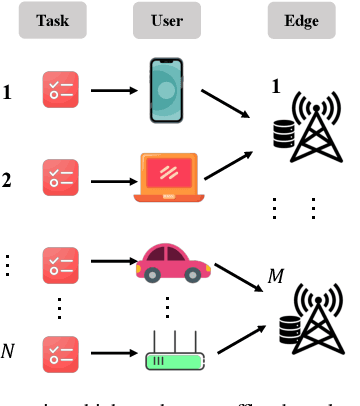
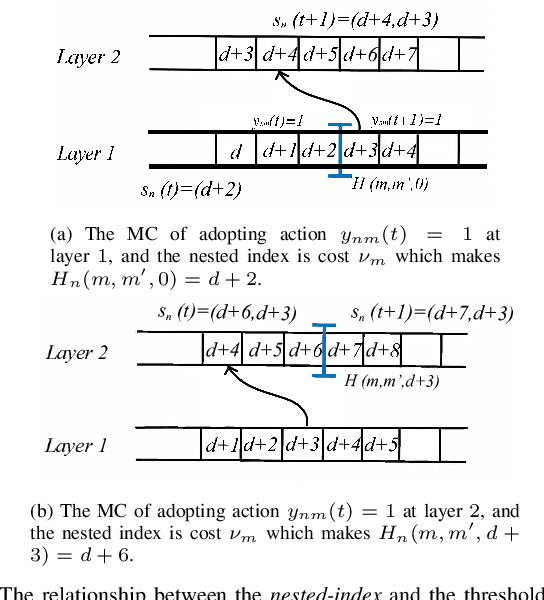
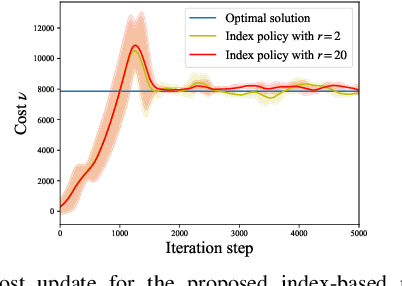
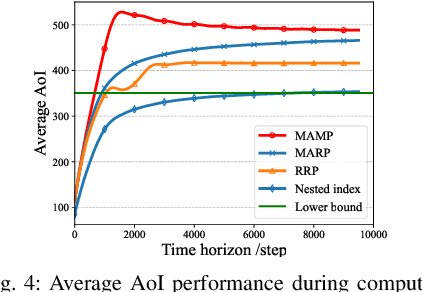
Exploiting the computational heterogeneity of mobile devices and edge nodes, mobile edge computation (MEC) provides an efficient approach to achieving real-time applications that are sensitive to information freshness, by offloading tasks from mobile devices to edge nodes. We use the metric Age-of-Information (AoI) to evaluate information freshness. An efficient solution to minimize the AoI for the MEC system with multiple users is non-trivial to obtain due to the random computing time. In this paper, we consider multiple users offloading tasks to heterogeneous edge servers in a MEC system. We first reformulate the problem as a Restless Multi-Arm-Bandit (RMAB) problem and establish a hierarchical Markov Decision Process (MDP) to characterize the updating of AoI for the MEC system. Based on the hierarchical MDP, we propose a nested index framework and design a nested index policy with provably asymptotic optimality. Finally, the closed form of the nested index is obtained, which enables the performance tradeoffs between computation complexity and accuracy. Our algorithm leads to an optimality gap reduction of up to 40%, compared to benchmarks. Our algorithm asymptotically approximates the lower bound as the system scalar gets large enough.
Large Sequence Models for Sequential Decision-Making: A Survey
Jun 24, 2023Transformer architectures have facilitated the development of large-scale and general-purpose sequence models for prediction tasks in natural language processing and computer vision, e.g., GPT-3 and Swin Transformer. Although originally designed for prediction problems, it is natural to inquire about their suitability for sequential decision-making and reinforcement learning problems, which are typically beset by long-standing issues involving sample efficiency, credit assignment, and partial observability. In recent years, sequence models, especially the Transformer, have attracted increasing interest in the RL communities, spawning numerous approaches with notable effectiveness and generalizability. This survey presents a comprehensive overview of recent works aimed at solving sequential decision-making tasks with sequence models such as the Transformer, by discussing the connection between sequential decision-making and sequence modeling, and categorizing them based on the way they utilize the Transformer. Moreover, this paper puts forth various potential avenues for future research intending to improve the effectiveness of large sequence models for sequential decision-making, encompassing theoretical foundations, network architectures, algorithms, and efficient training systems. As this article has been accepted by the Frontiers of Computer Science, here is an early version, and the most up-to-date version can be found at https://journal.hep.com.cn/fcs/EN/10.1007/s11704-023-2689-5
ChessGPT: Bridging Policy Learning and Language Modeling
Jun 15, 2023

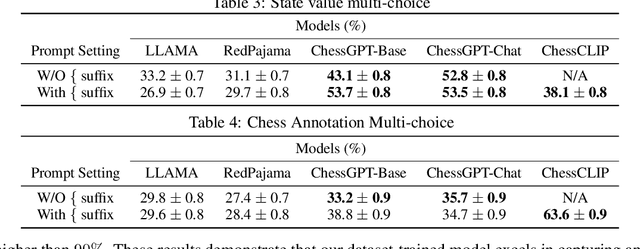

When solving decision-making tasks, humans typically depend on information from two key sources: (1) Historical policy data, which provides interaction replay from the environment, and (2) Analytical insights in natural language form, exposing the invaluable thought process or strategic considerations. Despite this, the majority of preceding research focuses on only one source: they either use historical replay exclusively to directly learn policy or value functions, or engaged in language model training utilizing mere language corpus. In this paper, we argue that a powerful autonomous agent should cover both sources. Thus, we propose ChessGPT, a GPT model bridging policy learning and language modeling by integrating data from these two sources in Chess games. Specifically, we build a large-scale game and language dataset related to chess. Leveraging the dataset, we showcase two model examples ChessCLIP and ChessGPT, integrating policy learning and language modeling. Finally, we propose a full evaluation framework for evaluating language model's chess ability. Experimental results validate our model and dataset's effectiveness. We open source our code, model, and dataset at https://github.com/waterhorse1/ChessGPT.