 Add to Chrome
 Add to Firefox
 Add to Edge
From AGI to ASI
Jun 10, 2026
Over the last decade, building human-level artificial general intelligence has moved from far-fetched speculation to being a concrete next-decade target for many of the largest AI organisations. Achieving this goal would have profound and far-reaching impacts on human society, which raises many complex questions for the decade ahead. This report investigates how AI itself might continue to develop in a post-AGI world along the continuum of machine intelligence. The endpoint of this continuum, Universal AI, is theoretically well understood, which provides some formal grounding for the main focus of this report: the transition from human-level AGI to artificial general superintelligence, which, intuitively, can be understood as a system that is more intelligent and cognitively capable than large organisations of humans. After characterizing ASI, the report discusses four potential pathways from AGI to ASI: scaling AGI, AI paradigm shifts, recursive improvement, and ASI emerging from large-scale multi-agent collectives. The report then discusses possible frictions and bottlenecks along these pathways. Determining whether the impact of these frictions will be negligible or substantial raises a number of concrete open research questions. Due to large uncertainties for predicting ASI progress, it cannot be ruled out that AI progress might continue to accelerate over the next years. This could imply that the image of a single transformative step change, caused by the introduction of human-level AGI into our society, could be inaccurate. More apt might be the prospect of a series of transformative societal changes caused by AI-enabled progress and breakthroughs across many areas of science and technology. Preparing for this prospect requires a massively interdisciplinary endeavour of global scope and interest.

Evaluating Cooperation in LLM Social Groups through Elected Leadership
Apr 13, 2026Governing common-pool resources requires agents to develop enduring strategies through cooperation and self-governance to avoid collective failure. While foundation models have shown potential for cooperation in these settings, existing multi-agent research provides little insight into whether structured leadership and election mechanisms can improve collective decision making. The lack of such a critical organizational feature ubiquitous in human society presents a significant shortcoming of the current methods. In this work we aim to directly address whether leadership and elections can support improved social welfare and cooperation through multi-agent simulation with LLMs. We present our open-source framework that simulates leadership through elected personas and candidate-driven agendas and carry out an empirical study of LLMs under controlled governance conditions. Our experiments demonstrate that having elected leadership improves social welfare scores by 55.4% and survival time by 128.6% across a range of high performing LLMs. Through the construction of an agent social graph we compute centrality metrics to assess the social influence of leader personas and also analyze rhetorical and cooperative tendencies revealed through a sentiment analysis on leader utterances. This work lays the foundation for further study of election mechanisms in multi-agent systems toward navigating complex social dilemmas.
A Theory of Appropriateness That Accounts for Norms of Rationality
Mar 14, 2026We propose a society-first theory of normative appropriateness where individuals, modeled as pre-trained actors with cognitive architectures analogous to Large Language Models (LLMs), generate behavior via predictive pattern completion. Our theory posits that individuals act by completing distributed symbolic patterns based on context, answering questions such as "What does a person such as I do in a situation such as this?". This sense-making mechanism provides a parsimonious account of the key features of human norms: their context-dependence, arbitrariness, automaticity, dynamism, and their support from social sanctioning. It challenges rational-choice theories of social norms by accounting for their key features without needing to exogenously posit scalar rewards or preference relations. By distinguishing between explicit norms, which we associate with in-context adaptation, and implicit norms, which we associate with long-term memory, the theory reconceptualizes several foundational ideas in cognitive science. In particular, it gives an alternative account to the data traditionally seen as supporting dual-process models, and it flips the role of rationality, allowing us to construe it as adherence to culturally-contingent justification standards.
Persona Generators: Generating Diverse Synthetic Personas at Scale
Feb 03, 2026Evaluating AI systems that interact with humans requires understanding their behavior across diverse user populations, but collecting representative human data is often expensive or infeasible, particularly for novel technologies or hypothetical future scenarios. Recent work in Generative Agent-Based Modeling has shown that large language models can simulate human-like synthetic personas with high fidelity, accurately reproducing the beliefs and behaviors of specific individuals. However, most approaches require detailed data about target populations and often prioritize density matching (replicating what is most probable) rather than support coverage (spanning what is possible), leaving long-tail behaviors underexplored. We introduce Persona Generators, functions that can produce diverse synthetic populations tailored to arbitrary contexts. We apply an iterative improvement loop based on AlphaEvolve, using large language models as mutation operators to refine our Persona Generator code over hundreds of iterations. The optimization process produces lightweight Persona Generators that can automatically expand small descriptions into populations of diverse synthetic personas that maximize coverage of opinions and preferences along relevant diversity axes. We demonstrate that evolved generators substantially outperform existing baselines across six diversity metrics on held-out contexts, producing populations that span rare trait combinations difficult to achieve in standard LLM outputs.
Generative AI collective behavior needs an interactionist paradigm
Jan 15, 2026In this article, we argue that understanding the collective behavior of agents based on large language models (LLMs) is an essential area of inquiry, with important implications in terms of risks and benefits, impacting us as a society at many levels. We claim that the distinctive nature of LLMs--namely, their initialization with extensive pre-trained knowledge and implicit social priors, together with their capability of adaptation through in-context learning--motivates the need for an interactionist paradigm consisting of alternative theoretical foundations, methodologies, and analytical tools, in order to systematically examine how prior knowledge and embedded values interact with social context to shape emergent phenomena in multi-agent generative AI systems. We propose and discuss four directions that we consider crucial for the development and deployment of LLM-based collectives, focusing on theory, methods, and trans-disciplinary dialogue.
A Pragmatic View of AI Personhood
Oct 30, 2025The emergence of agentic Artificial Intelligence (AI) is set to trigger a "Cambrian explosion" of new kinds of personhood. This paper proposes a pragmatic framework for navigating this diversification by treating personhood not as a metaphysical property to be discovered, but as a flexible bundle of obligations (rights and responsibilities) that societies confer upon entities for a variety of reasons, especially to solve concrete governance problems. We argue that this traditional bundle can be unbundled, creating bespoke solutions for different contexts. This will allow for the creation of practical tools -- such as facilitating AI contracting by creating a target "individual" that can be sanctioned -- without needing to resolve intractable debates about an AI's consciousness or rationality. We explore how individuals fit in to social roles and discuss the use of decentralized digital identity technology, examining both "personhood as a problem", where design choices can create "dark patterns" that exploit human social heuristics, and "personhood as a solution", where conferring a bundle of obligations is necessary to ensure accountability or prevent conflict. By rejecting foundationalist quests for a single, essential definition of personhood, this paper offers a more pragmatic and flexible way to think about integrating AI agents into our society.
Beyond the high score: Prosocial ability profiles of multi-agent populations
Sep 17, 2025The development and evaluation of social capabilities in AI agents require complex environments where competitive and cooperative behaviours naturally emerge. While game-theoretic properties can explain why certain teams or agent populations outperform others, more abstract behaviours, such as convention following, are harder to control in training and evaluation settings. The Melting Pot contest is a social AI evaluation suite designed to assess the cooperation capabilities of AI systems. In this paper, we apply a Bayesian approach known as Measurement Layouts to infer the capability profiles of multi-agent systems in the Melting Pot contest. We show that these capability profiles not only predict future performance within the Melting Pot suite but also reveal the underlying prosocial abilities of agents. Our analysis indicates that while higher prosocial capabilities sometimes correlate with better performance, this is not a universal trend-some lower-scoring agents exhibit stronger cooperation abilities. Furthermore, we find that top-performing contest submissions are more likely to achieve high scores in scenarios where prosocial capabilities are not required. These findings, together with reports that the contest winner used a hard-coded solution tailored to specific environments, suggest that at least one top-performing team may have optimised for conditions where cooperation was not necessary, potentially exploiting limitations in the evaluation framework. We provide recommendations for improving the annotation of cooperation demands and propose future research directions to account for biases introduced by different testing environments. Our results demonstrate that Measurement Layouts offer both strong predictive accuracy and actionable insights, contributing to a more transparent and generalisable approach to evaluating AI systems in complex social settings.
Societal and technological progress as sewing an ever-growing, ever-changing, patchy, and polychrome quilt
May 08, 2025Artificial Intelligence (AI) systems are increasingly placed in positions where their decisions have real consequences, e.g., moderating online spaces, conducting research, and advising on policy. Ensuring they operate in a safe and ethically acceptable fashion is thus critical. However, most solutions have been a form of one-size-fits-all "alignment". We are worried that such systems, which overlook enduring moral diversity, will spark resistance, erode trust, and destabilize our institutions. This paper traces the underlying problem to an often-unstated Axiom of Rational Convergence: the idea that under ideal conditions, rational agents will converge in the limit of conversation on a single ethics. Treating that premise as both optional and doubtful, we propose what we call the appropriateness framework: an alternative approach grounded in conflict theory, cultural evolution, multi-agent systems, and institutional economics. The appropriateness framework treats persistent disagreement as the normal case and designs for it by applying four principles: (1) contextual grounding, (2) community customization, (3) continual adaptation, and (4) polycentric governance. We argue here that adopting these design principles is a good way to shift the main alignment metaphor from moral unification to a more productive metaphor of conflict management, and that taking this step is both desirable and urgent.
SocialJax: An Evaluation Suite for Multi-agent Reinforcement Learning in Sequential Social Dilemmas
Mar 18, 2025Social dilemmas pose a significant challenge in the field of multi-agent reinforcement learning (MARL). Melting Pot is an extensive framework designed to evaluate social dilemma environments, providing an evaluation protocol that measures generalization to new social partners across various test scenarios. However, running reinforcement learning algorithms in the official Melting Pot environments demands substantial computational resources. In this paper, we introduce SocialJax, a suite of sequential social dilemma environments implemented in JAX. JAX is a high-performance numerical computing library for Python that enables significant improvements in the operational efficiency of SocialJax on GPUs and TPUs. Our experiments demonstrate that the training pipeline of SocialJax achieves a 50\texttimes{} speedup in real-time performance compared to Melting Pot's RLlib baselines. Additionally, we validate the effectiveness of baseline algorithms within the SocialJax environments. Finally, we use Schelling diagrams to verify the social dilemma properties of these environments, ensuring they accurately capture the dynamics of social dilemmas.
Multi-Agent Risks from Advanced AI
Feb 19, 2025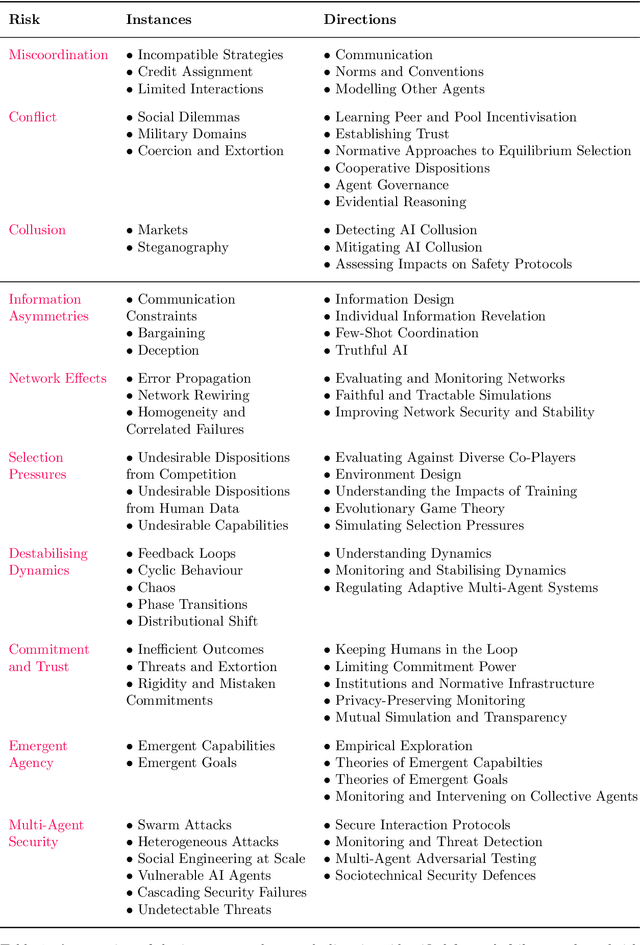
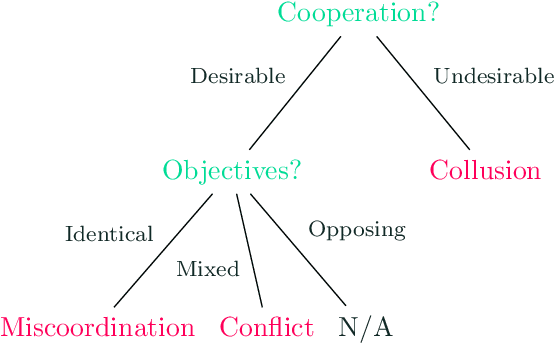
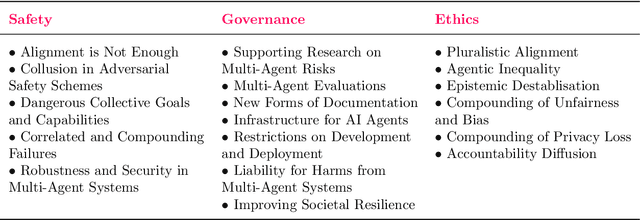

The rapid development of advanced AI agents and the imminent deployment of many instances of these agents will give rise to multi-agent systems of unprecedented complexity. These systems pose novel and under-explored risks. In this report, we provide a structured taxonomy of these risks by identifying three key failure modes (miscoordination, conflict, and collusion) based on agents' incentives, as well as seven key risk factors (information asymmetries, network effects, selection pressures, destabilising dynamics, commitment problems, emergent agency, and multi-agent security) that can underpin them. We highlight several important instances of each risk, as well as promising directions to help mitigate them. By anchoring our analysis in a range of real-world examples and experimental evidence, we illustrate the distinct challenges posed by multi-agent systems and their implications for the safety, governance, and ethics of advanced AI.