 Add to Chrome
 Add to Firefox
 Add to Edge
See the Emotion: A Facial Emoji Proxy Modeling for EEG Emotion Recognition
Jul 03, 2026
Despite the high accuracy of EEG-based emotion recognition, existing models remain opaque "black boxes", lacking semantic grounding between abstract neural features and human-interpretable states. In this paper, we reframe EEG explainability as a cross-modal generation task, shifting the paradigm from feature attribution to behavioral visualization. We introduce Facial Emoji Proxy Modeling, a novel framework that translates high-dimensional EEG signals into identity-anonymized facial emojis. Guided by the neuroscientific inspiration of neural-facial association, this approach grounds neural representations in the manifold of observable facial dynamics. Technically, our framework integrates FMENet, a specialized backbone modeling expression-relevant spatial synergies, and the Facial Emoji Learning Branch (FELB), which treats emoji reconstruction as a structured semantic regularizer. Extensive experiments on EAV and MMER benchmarks demonstrate that our method achieves state-of-the-art accuracy among EEG-only models. Crucially, it generates semantically faithful facial animations that provide a transparent, privacy-preserving window into the brain's emotional evolution, effectively allowing users to "see the emotion" directly from neural signals. Code is available at https://github.com/xian-sh/SeeEmotion

A Granularity-Aware EEG Feature Framework for Psychopathology Dimension Prediction
Jul 02, 2026Electroencephalography (EEG) offers a noninvasive approach for examining neurophysiological correlates of dimensional psychopathology, yet systematic evidence across EEG paradigms and feature granularities remains limited. Here, we develop a granularity-aware EEG feature pipeline that organizes multi-scale descriptors into global, regional, and channel levels. Using the Healthy Brain Network (HBN) cohort, we evaluate the prediction of four psychopathology dimensions: p-factor, internalizing, externalizing, and attention problems, across four EEG paradigms. Given the heterogeneity of pediatric psychopathology and the moderate reliability of questionnaire-derived scores, this setting represents a challenging feasibility test rather than a clinical screening scenario. Tree-based models and granularity-balanced feature selection showed promising improvements over conventional approaches in selected conditions, although effect sizes remained modest. Visualization of selected markers revealed dimension-specific spatial and spectral patterns that were broadly aligned with existing neurophysiological knowledge. An exploratory cross-dataset sanity check on the independent PEARL cohort suggested that the proposed selection principle remains technically feasible under protocol shifts, without claiming cross-dataset generalizability. Overall, multi-scale EEG features contain weak but detectable signals related to dimensional psychopathology, and granularity-aware selection may serve as a useful feature-reduction strategy for future EEG-based phenotyping studies.
Face-Guided Sentiment Boundary Enhancement for Weakly-Supervised Temporal Sentiment Localization
Mar 16, 2026Point-level weakly-supervised temporal sentiment localization (P-WTSL) aims to detect sentiment-relevant segments in untrimmed multimodal videos using timestamp sentiment annotations, which greatly reduces the costly frame-level labeling. To further tackle the challenges of imprecise sentiment boundaries in P-WTSL, we propose the Face-guided Sentiment Boundary Enhancement Network (\textbf{FSENet}), a unified framework that leverages fine-grained facial features to guide sentiment localization. Specifically, our approach \textit{first} introduces the Face-guided Sentiment Discovery (FSD) module, which integrates facial features into multimodal interaction via dual-branch modeling for effective sentiment stimuli clues; We \textit{then} propose the Point-aware Sentiment Semantics Contrast (PSSC) strategy to discriminate sentiment semantics of candidate points (frame-level) near annotation points via contrastive learning, thereby enhancing the model's ability to recognize sentiment boundaries. At \textit{last}, we design the Boundary-aware Sentiment Pseudo-label Generation (BSPG) approach to convert sparse point annotations into temporally smooth supervisory pseudo-labels. Extensive experiments and visualizations on the benchmark demonstrate the effectiveness of our framework, achieving state-of-the-art performance under full supervision, video-level, and point-level weak supervision, thereby showcasing the strong generalization ability of our FSENet across different annotation settings.
MOL-Mamba: Enhancing Molecular Representation with Structural & Electronic Insights
Dec 21, 2024


Molecular representation learning plays a crucial role in various downstream tasks, such as molecular property prediction and drug design. To accurately represent molecules, Graph Neural Networks (GNNs) and Graph Transformers (GTs) have shown potential in the realm of self-supervised pretraining. However, existing approaches often overlook the relationship between molecular structure and electronic information, as well as the internal semantic reasoning within molecules. This omission of fundamental chemical knowledge in graph semantics leads to incomplete molecular representations, missing the integration of structural and electronic data. To address these issues, we introduce MOL-Mamba, a framework that enhances molecular representation by combining structural and electronic insights. MOL-Mamba consists of an Atom & Fragment Mamba-Graph (MG) for hierarchical structural reasoning and a Mamba-Transformer (MT) fuser for integrating molecular structure and electronic correlation learning. Additionally, we propose a Structural Distribution Collaborative Training and E-semantic Fusion Training framework to further enhance molecular representation learning. Extensive experiments demonstrate that MOL-Mamba outperforms state-of-the-art baselines across eleven chemical-biological molecular datasets. Code is available at https://github.com/xian-sh/MOL-Mamba.
Towards Open-Vocabulary Audio-Visual Event Localization
Nov 18, 2024The Audio-Visual Event Localization (AVEL) task aims to temporally locate and classify video events that are both audible and visible. Most research in this field assumes a closed-set setting, which restricts these models' ability to handle test data containing event categories absent (unseen) during training. Recently, a few studies have explored AVEL in an open-set setting, enabling the recognition of unseen events as ``unknown'', but without providing category-specific semantics. In this paper, we advance the field by introducing the Open-Vocabulary Audio-Visual Event Localization (OV-AVEL) problem, which requires localizing audio-visual events and predicting explicit categories for both seen and unseen data at inference. To address this new task, we propose the OV-AVEBench dataset, comprising 24,800 videos across 67 real-life audio-visual scenes (seen:unseen = 46:21), each with manual segment-level annotation. We also establish three evaluation metrics for this task. Moreover, we investigate two baseline approaches, one training-free and one using a further fine-tuning paradigm. Specifically, we utilize the unified multimodal space from the pretrained ImageBind model to extract audio, visual, and textual (event classes) features. The training-free baseline then determines predictions by comparing the consistency of audio-text and visual-text feature similarities. The fine-tuning baseline incorporates lightweight temporal layers to encode temporal relations within the audio and visual modalities, using OV-AVEBench training data for model fine-tuning. We evaluate these baselines on the proposed OV-AVEBench dataset and discuss potential directions for future work in this new field.
RTF: Region-based Table Filling Method for Relational Triple Extraction
Apr 29, 2024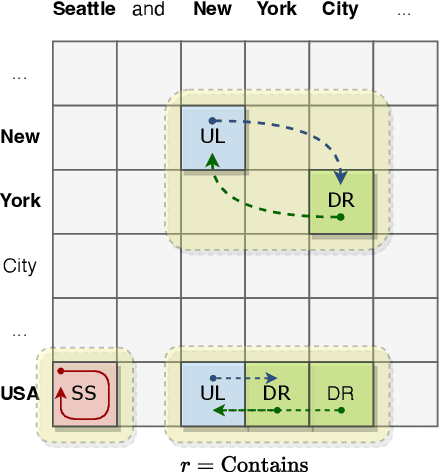
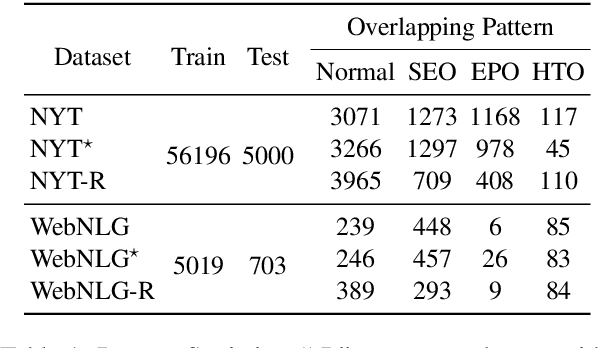
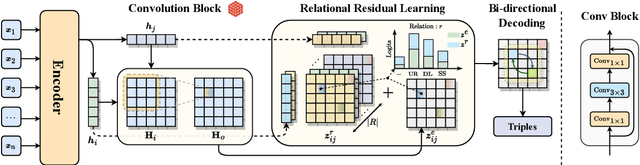
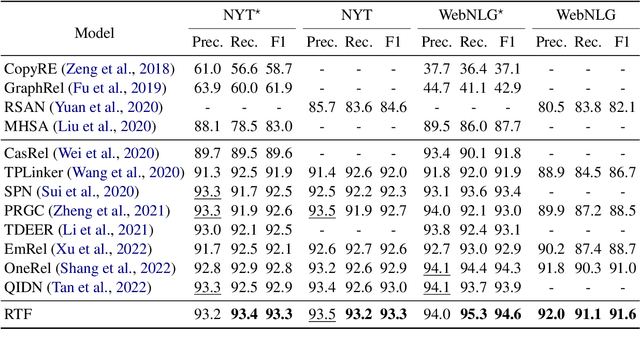
Relational triple extraction is crucial work for the automatic construction of knowledge graphs. Existing methods only construct shallow representations from a token or token pair-level. However, previous works ignore local spatial dependencies of relational triples, resulting in a weakness of entity pair boundary detection. To tackle this problem, we propose a novel Region-based Table Filling method (RTF). We devise a novel region-based tagging scheme and bi-directional decoding strategy, which regard each relational triple as a region on the relation-specific table, and identifies triples by determining two endpoints of each region. We also introduce convolution to construct region-level table representations from a spatial perspective which makes triples easier to be captured. In addition, we share partial tagging scores among different relations to improve learning efficiency of relation classifier. Experimental results show that our method achieves state-of-the-art with better generalization capability on three variants of two widely used benchmark datasets.
Unified Static and Dynamic Network: Efficient Temporal Filtering for Video Grounding
Mar 21, 2024

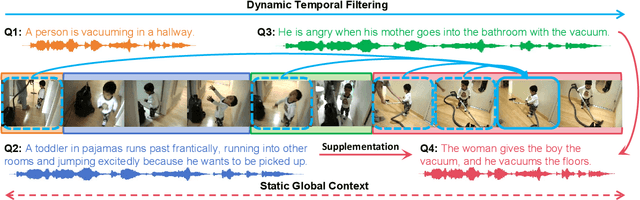

Inspired by the activity-silent and persistent activity mechanisms in human visual perception biology, we design a Unified Static and Dynamic Network (UniSDNet), to learn the semantic association between the video and text/audio queries in a cross-modal environment for efficient video grounding. For static modeling, we devise a novel residual structure (ResMLP) to boost the global comprehensive interaction between the video segments and queries, achieving more effective semantic enhancement/supplement. For dynamic modeling, we effectively exploit three characteristics of the persistent activity mechanism in our network design for a better video context comprehension. Specifically, we construct a diffusely connected video clip graph on the basis of 2D sparse temporal masking to reflect the "short-term effect" relationship. We innovatively consider the temporal distance and relevance as the joint "auxiliary evidence clues" and design a multi-kernel Temporal Gaussian Filter to expand the context clue into high-dimensional space, simulating the "complex visual perception", and then conduct element level filtering convolution operations on neighbour clip nodes in message passing stage for finally generating and ranking the candidate proposals. Our UniSDNet is applicable to both Natural Language Video Grounding (NLVG) and Spoken Language Video Grounding (SLVG) tasks. Our UniSDNet achieves SOTA performance on three widely used datasets for NLVG, as well as three datasets for SLVG, e.g., reporting new records at 38.88% R@1,IoU@0.7 on ActivityNet Captions and 40.26% R@1,IoU@0.5 on TACoS. To facilitate this field, we collect two new datasets (Charades-STA Speech and TACoS Speech) for SLVG task. Meanwhile, the inference speed of our UniSDNet is 1.56$\times$ faster than the strong multi-query benchmark. Code is available at: https://github.com/xian-sh/UniSDNet.