 Add to Chrome
 Add to Firefox
 Add to Edge
R2S-EGO: Dual-Proxy Refinement for Sparse-Capture Real-to-Sim
Aug 07, 2026
Real-to-sim (R2S) depends on scene representations that render observations along robot ego trajectories, yet dense multi-view capture limits per-environment real-image capture-count efficiency, and sparse human capture can leave behavior-scoped robot views under-supported. Camera-controlled synthesis can fill missing views, but its use in R2S requires behavior-admissible queries and capture-anchored structural conditioning. We present R2S-EGO, which couples a simulator-derived robot proxy that represents the behavior-scoped executable query domain with a capture-anchored geometry proxy that supplies scene-specific structural conditions. Within this domain, fixed- budget selection targets current support deficits for which geometry support is available. The generated observations are assimilated as pseudo-observations to refine the visual asset, while real captures remain anchors. The fused geometry proxy also supplies the scene collision surface, which is refreshed between rounds. Together, these updates refine the existing simulation scene while its robot dynamics and control stack stay fixed. Across 48 frozen Unitree G1 ego views in three Replica scenes, six-view R2S-EGO reaches 19.062 dB PSNR, compared with 14.226 dB for the strongest reported R2S baseline. Across five paired policy-training seeds, R2S-EGO achieves 82.5% +/- 6.8% real-G1 sitting success, compared with 10.0% +/- 10.5% for GaussGym.

A Granularity-Aware EEG Feature Framework for Psychopathology Dimension Prediction
Jul 02, 2026Electroencephalography (EEG) offers a noninvasive approach for examining neurophysiological correlates of dimensional psychopathology, yet systematic evidence across EEG paradigms and feature granularities remains limited. Here, we develop a granularity-aware EEG feature pipeline that organizes multi-scale descriptors into global, regional, and channel levels. Using the Healthy Brain Network (HBN) cohort, we evaluate the prediction of four psychopathology dimensions: p-factor, internalizing, externalizing, and attention problems, across four EEG paradigms. Given the heterogeneity of pediatric psychopathology and the moderate reliability of questionnaire-derived scores, this setting represents a challenging feasibility test rather than a clinical screening scenario. Tree-based models and granularity-balanced feature selection showed promising improvements over conventional approaches in selected conditions, although effect sizes remained modest. Visualization of selected markers revealed dimension-specific spatial and spectral patterns that were broadly aligned with existing neurophysiological knowledge. An exploratory cross-dataset sanity check on the independent PEARL cohort suggested that the proposed selection principle remains technically feasible under protocol shifts, without claiming cross-dataset generalizability. Overall, multi-scale EEG features contain weak but detectable signals related to dimensional psychopathology, and granularity-aware selection may serve as a useful feature-reduction strategy for future EEG-based phenotyping studies.
Delayed-KD: Delayed Knowledge Distillation based CTC for Low-Latency Streaming ASR
May 28, 2025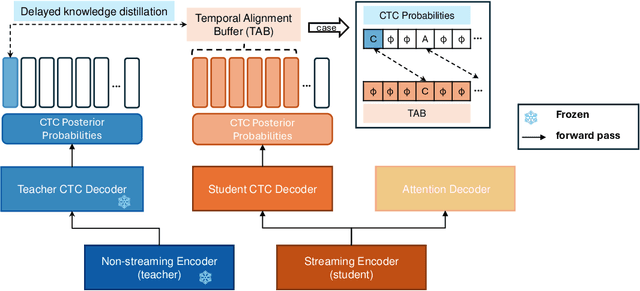
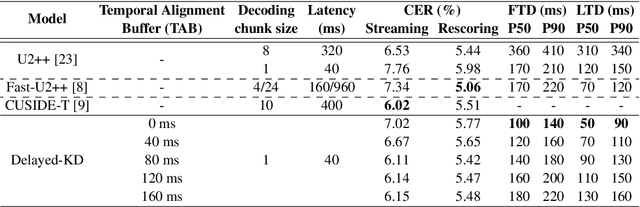
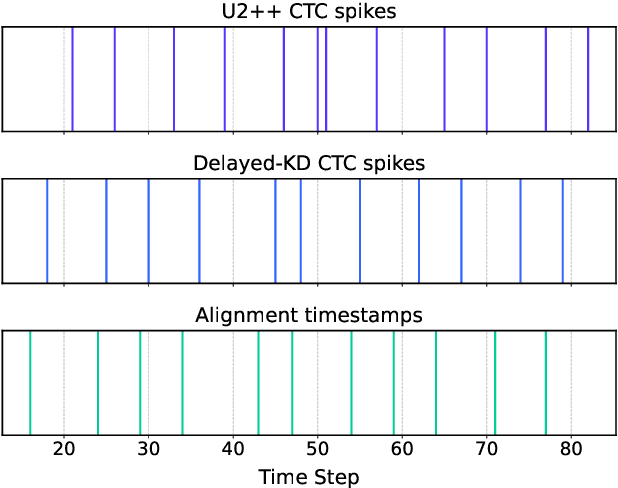
CTC-based streaming ASR has gained significant attention in real-world applications but faces two main challenges: accuracy degradation in small chunks and token emission latency. To mitigate these challenges, we propose Delayed-KD, which applies delayed knowledge distillation on CTC posterior probabilities from a non-streaming to a streaming model. Specifically, with a tiny chunk size, we introduce a Temporal Alignment Buffer (TAB) that defines a relative delay range compared to the non-streaming teacher model to align CTC outputs and mitigate non-blank token mismatches. Additionally, TAB enables fine-grained control over token emission delay. Experiments on 178-hour AISHELL-1 and 10,000-hour WenetSpeech Mandarin datasets show consistent superiority of Delayed-KD. Impressively, Delayed-KD at 40 ms latency achieves a lower character error rate (CER) of 5.42% on AISHELL-1, comparable to the competitive U2++ model running at 320 ms latency.