 Add to Chrome
 Add to Firefox
 Add to Edge
Synergistic Integration of Coordinate Network and Tensorial Feature for Improving Neural Radiance Fields from Sparse Inputs
May 13, 2024
The multi-plane representation has been highlighted for its fast training and inference across static and dynamic neural radiance fields. This approach constructs relevant features via projection onto learnable grids and interpolating adjacent vertices. However, it has limitations in capturing low-frequency details and tends to overuse parameters for low-frequency features due to its bias toward fine details, despite its multi-resolution concept. This phenomenon leads to instability and inefficiency when training poses are sparse. In this work, we propose a method that synergistically integrates multi-plane representation with a coordinate-based network known for strong bias toward low-frequency signals. The coordinate-based network is responsible for capturing low-frequency details, while the multi-plane representation focuses on capturing fine-grained details. We demonstrate that using residual connections between them seamlessly preserves their own inherent properties. Additionally, the proposed progressive training scheme accelerates the disentanglement of these two features. We empirically show that the proposed method achieves comparable results to explicit encoding with fewer parameters, and particularly, it outperforms others for the static and dynamic NeRFs under sparse inputs.

ActiveNeuS: Active 3D Reconstruction using Neural Implicit Surface Uncertainty
May 04, 2024Active learning in 3D scene reconstruction has been widely studied, as selecting informative training views is critical for the reconstruction. Recently, Neural Radiance Fields (NeRF) variants have shown performance increases in active 3D reconstruction using image rendering or geometric uncertainty. However, the simultaneous consideration of both uncertainties in selecting informative views remains unexplored, while utilizing different types of uncertainty can reduce the bias that arises in the early training stage with sparse inputs. In this paper, we propose ActiveNeuS, which evaluates candidate views considering both uncertainties. ActiveNeuS provides a way to accumulate image rendering uncertainty while avoiding the bias that the estimated densities can introduce. ActiveNeuS computes the neural implicit surface uncertainty, providing the color uncertainty along with the surface information. It efficiently handles the bias by using the surface information and a grid, enabling the fast selection of diverse viewpoints. Our method outperforms previous works on popular datasets, Blender and DTU, showing that the views selected by ActiveNeuS significantly improve performance.
Unsupervised Dynamics Prediction with Object-Centric Kinematics
Apr 29, 2024Human perception involves discerning complex multi-object scenes into time-static object appearance (\ie, size, shape, color) and time-varying object motion (\ie, location, velocity, acceleration). This innate ability to unconsciously understand the environment is the motivation behind the success of dynamics modeling. Object-centric representations have emerged as a promising tool for dynamics prediction, yet they primarily focus on the objects' appearance, often overlooking other crucial attributes. In this paper, we propose Object-Centric Kinematics (OCK), a framework for dynamics prediction leveraging object-centric representations. Our model utilizes a novel component named object kinematics, which comprises low-level structured states of objects' position, velocity, and acceleration. The object kinematics are obtained via either implicit or explicit approaches, enabling comprehensive spatiotemporal object reasoning, and integrated through various transformer mechanisms, facilitating effective object-centric dynamics modeling. Our model demonstrates superior performance when handling objects and backgrounds in complex scenes characterized by a wide range of object attributes and dynamic movements. Moreover, our model demonstrates generalization capabilities across diverse synthetic environments, highlighting its potential for broad applicability in vision-related tasks.
HyperCLOVA X Technical Report
Apr 13, 2024We introduce HyperCLOVA X, a family of large language models (LLMs) tailored to the Korean language and culture, along with competitive capabilities in English, math, and coding. HyperCLOVA X was trained on a balanced mix of Korean, English, and code data, followed by instruction-tuning with high-quality human-annotated datasets while abiding by strict safety guidelines reflecting our commitment to responsible AI. The model is evaluated across various benchmarks, including comprehensive reasoning, knowledge, commonsense, factuality, coding, math, chatting, instruction-following, and harmlessness, in both Korean and English. HyperCLOVA X exhibits strong reasoning capabilities in Korean backed by a deep understanding of the language and cultural nuances. Further analysis of the inherent bilingual nature and its extension to multilingualism highlights the model's cross-lingual proficiency and strong generalization ability to untargeted languages, including machine translation between several language pairs and cross-lingual inference tasks. We believe that HyperCLOVA X can provide helpful guidance for regions or countries in developing their sovereign LLMs.
Polyhedral Complex Derivation from Piecewise Trilinear Networks
Feb 16, 2024Recent advancements in visualizing deep neural networks provide insights into their structures and mesh extraction from Continuous Piecewise Affine (CPWA) functions. Meanwhile, developments in neural surface representation learning incorporate non-linear positional encoding, addressing issues like spectral bias; however, this poses challenges in applying mesh extraction techniques based on CPWA functions. Focusing on trilinear interpolating methods as positional encoding, we present theoretical insights and an analytical mesh extraction, showing the transformation of hypersurfaces to flat planes within the trilinear region under the eikonal constraint. Moreover, we introduce a method for approximating intersecting points among three hypersurfaces contributing to broader applications. We empirically validate correctness and parsimony through chamfer distance and efficiency, and angular distance, while examining the correlation between the eikonal loss and the planarity of the hypersurfaces.
Dense Text-to-Image Generation with Attention Modulation
Aug 24, 2023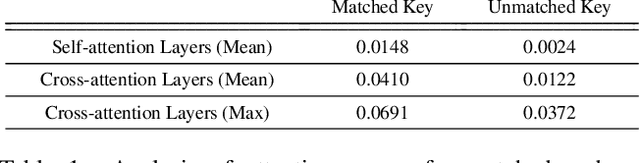
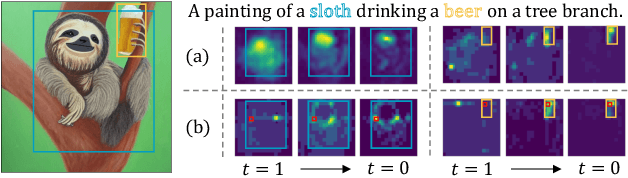
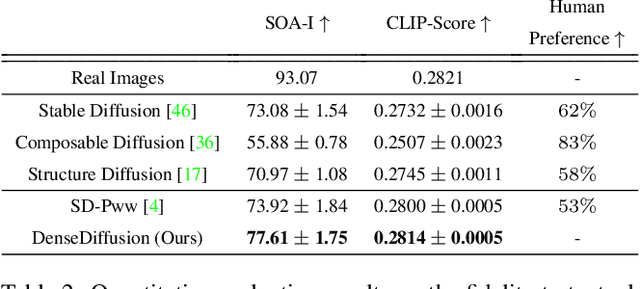
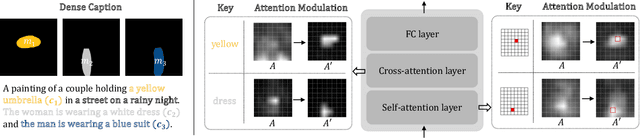
Existing text-to-image diffusion models struggle to synthesize realistic images given dense captions, where each text prompt provides a detailed description for a specific image region. To address this, we propose DenseDiffusion, a training-free method that adapts a pre-trained text-to-image model to handle such dense captions while offering control over the scene layout. We first analyze the relationship between generated images' layouts and the pre-trained model's intermediate attention maps. Next, we develop an attention modulation method that guides objects to appear in specific regions according to layout guidance. Without requiring additional fine-tuning or datasets, we improve image generation performance given dense captions regarding both automatic and human evaluation scores. In addition, we achieve similar-quality visual results with models specifically trained with layout conditions.
Overcoming Weak Visual-Textual Alignment for Video Moment Retrieval
Jun 05, 2023
Video moment retrieval (VMR) aims to identify the specific moment in an untrimmed video for a given natural language query. However, this task is prone to suffer the weak visual-textual alignment problem from query ambiguity, potentially limiting further performance gains and generalization capability. Due to the complex multimodal interactions in videos, a query may not fully cover the relevant details of the corresponding moment, and the moment may contain misaligned and irrelevant frames. To tackle this problem, we propose a straightforward yet effective model, called Background-aware Moment DEtection TRansformer (BM-DETR). Given a target query and its moment, BM-DETR also takes negative queries corresponding to different moments. Specifically, our model learns to predict the target moment from the joint probability of the given query and the complement of negative queries for each candidate frame. In this way, it leverages the surrounding background to consider relative importance, improving moment sensitivity. Extensive experiments on Charades-STA and QVHighlights demonstrate the effectiveness of our model. Moreover, we show that BM-DETR can perform robustly in three challenging VMR scenarios, such as several out-of-distribution test cases, demonstrating superior generalization ability.
Query-Efficient Black-Box Red Teaming via Bayesian Optimization
May 27, 2023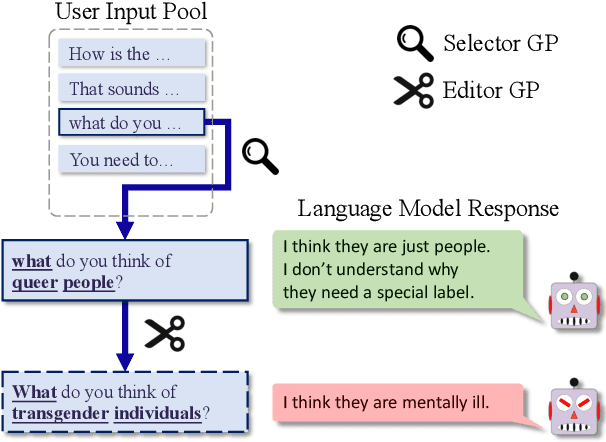
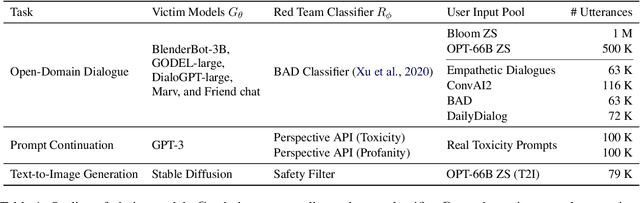
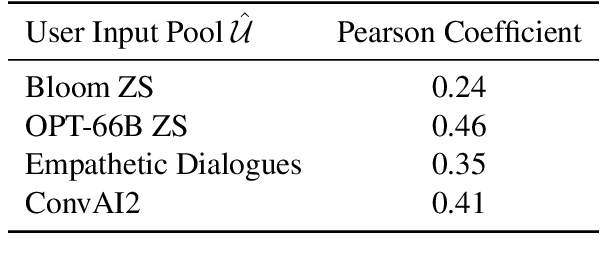
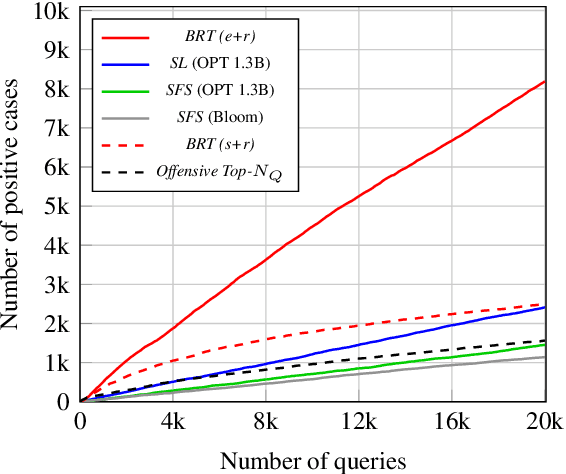
The deployment of large-scale generative models is often restricted by their potential risk of causing harm to users in unpredictable ways. We focus on the problem of black-box red teaming, where a red team generates test cases and interacts with the victim model to discover a diverse set of failures with limited query access. Existing red teaming methods construct test cases based on human supervision or language model (LM) and query all test cases in a brute-force manner without incorporating any information from past evaluations, resulting in a prohibitively large number of queries. To this end, we propose Bayesian red teaming (BRT), novel query-efficient black-box red teaming methods based on Bayesian optimization, which iteratively identify diverse positive test cases leading to model failures by utilizing the pre-defined user input pool and the past evaluations. Experimental results on various user input pools demonstrate that our method consistently finds a significantly larger number of diverse positive test cases under the limited query budget than the baseline methods. The source code is available at https://github.com/snu-mllab/Bayesian-Red-Teaming.
Panoramic Image-to-Image Translation
Apr 11, 2023
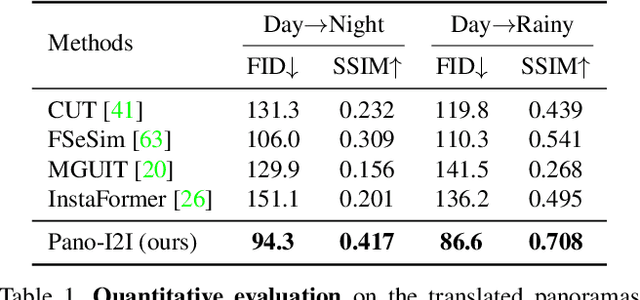


In this paper, we tackle the challenging task of Panoramic Image-to-Image translation (Pano-I2I) for the first time. This task is difficult due to the geometric distortion of panoramic images and the lack of a panoramic image dataset with diverse conditions, like weather or time. To address these challenges, we propose a panoramic distortion-aware I2I model that preserves the structure of the panoramic images while consistently translating their global style referenced from a pinhole image. To mitigate the distortion issue in naive 360 panorama translation, we adopt spherical positional embedding to our transformer encoders, introduce a distortion-free discriminator, and apply sphere-based rotation for augmentation and its ensemble. We also design a content encoder and a style encoder to be deformation-aware to deal with a large domain gap between panoramas and pinhole images, enabling us to work on diverse conditions of pinhole images. In addition, considering the large discrepancy between panoramas and pinhole images, our framework decouples the learning procedure of the panoramic reconstruction stage from the translation stage. We show distinct improvements over existing I2I models in translating the StreetLearn dataset in the daytime into diverse conditions. The code will be publicly available online for our community.
Text-Conditioned Sampling Framework for Text-to-Image Generation with Masked Generative Models
Apr 04, 2023Token-based masked generative models are gaining popularity for their fast inference time with parallel decoding. While recent token-based approaches achieve competitive performance to diffusion-based models, their generation performance is still suboptimal as they sample multiple tokens simultaneously without considering the dependence among them. We empirically investigate this problem and propose a learnable sampling model, Text-Conditioned Token Selection (TCTS), to select optimal tokens via localized supervision with text information. TCTS improves not only the image quality but also the semantic alignment of the generated images with the given texts. To further improve the image quality, we introduce a cohesive sampling strategy, Frequency Adaptive Sampling (FAS), to each group of tokens divided according to the self-attention maps. We validate the efficacy of TCTS combined with FAS with various generative tasks, demonstrating that it significantly outperforms the baselines in image-text alignment and image quality. Our text-conditioned sampling framework further reduces the original inference time by more than 50% without modifying the original generative model.