 Add to Chrome
 Add to Firefox
 Add to Edge
ArtSplat: Feed-Forward Articulated 3D Gaussian Splatting from Sparse Multi-State Uncalibrated Views
May 23, 2026
Articulated object reconstruction from sparse-view images is an ill-posed problem that requires simultaneous inference of geometry and underlying articulation structure. Existing methods for articulated object reconstruction based on NeRF and 3D Gaussian Splatting (3DGS) typically rely on dense views or strong priors (e.g., depth maps, joint types, predefined number of joints) and require costly per-object optimization. In this paper, we propose ArtSplat, the first feed-forward framework for articulated 3D Gaussian Splatting. It reconstructs both geometry and joint parameters from sparse multi-view images across multiple articulation states in a single forward pass. To address the challenges of single-pass articulated reconstruction, we introduce a per-pixel joint map representation that enables the integration of joint parameter estimation into the feed-forward pipeline. We further propose a Cross-State Attention (CSA) mechanism with state tokens, which effectively captures discrete motion across input states. Experiments on 68 articulated objects from PartNet-Mobility, including both single- and multi-joint configurations, demonstrate that ArtSplat achieves competitive performance in both geometry and joint estimation, while being over 400 times faster than baselines.

Factorized Multi-Resolution HashGrid for Efficient Neural Radiance Fields: Execution on Edge-Devices
Apr 03, 2026We introduce Fact-Hash, a novel parameter-encoding method for training on-device neural radiance fields. Neural Radiance Fields (NeRF) have proven pivotal in 3D representations, but their applications are limited due to large computational resources. On-device training can open large application fields, providing strength in communication limitations, privacy concerns, and fast adaptation to a frequently changing scene. However, challenges such as limited resources (GPU memory, storage, and power) impede their deployment. To handle this, we introduce Fact-Hash, a novel parameter-encoding merging Tensor Factorization and Hash-encoding techniques. This integration offers two benefits: the use of rich high-resolution features and the few-shot robustness. In Fact-Hash, we project 3D coordinates into multiple lower-dimensional forms (2D or 1D) before applying the hash function and then aggregate them into a single feature. Comparative evaluations against state-of-the-art methods demonstrate Fact-Hash's superior memory efficiency, preserving quality and rendering speed. Fact-Hash saves memory usage by over one-third while maintaining the PSNR values compared to previous encoding methods. The on-device experiment validates the superiority of Fact-Hash compared to alternative positional encoding methods in computational efficiency and energy consumption. These findings highlight Fact-Hash as a promising solution to improve feature grid representation, address memory constraints, and improve quality in various applications. Project page: https://facthash.github.io/
* Accepted for publication in IEEE Robotics and Automation Letters (RA-L)
Relaxed Rigidity with Ray-based Grouping for Dynamic Gaussian Splatting
Mar 27, 2026The reconstruction of dynamic 3D scenes using 3D Gaussian Splatting has shown significant promise. A key challenge, however, remains in modeling realistic motion, as most methods fail to align the motion of Gaussians with real-world physical dynamics. This misalignment is particularly problematic for monocular video datasets, where failing to maintain coherent motion undermines local geometric structure, ultimately leading to degraded reconstruction quality. Consequently, many state-of-the-art approaches rely heavily on external priors, such as optical flow or 2D tracks, to enforce temporal coherence. In this work, we propose a novel method to explicitly preserve the local geometric structure of Gaussians across time in 4D scenes. Our core idea is to introduce a view-space ray grouping strategy that clusters Gaussians intersected by the same ray, considering only those whose $α$-blending weights exceed a threshold. We then apply constraints to these groups to maintain a consistent spatial distribution, effectively preserving their local geometry. This approach enforces a more physically plausible motion model by ensuring that local geometry remains stable over time, eliminating the reliance on external guidance. We demonstrate the efficacy of our method by integrating it into two distinct baseline models. Extensive experiments on challenging monocular datasets show that our approach significantly outperforms existing methods, achieving superior temporal consistency and reconstruction quality.
Grounding World Simulation Models in a Real-World Metropolis
Mar 16, 2026What if a world simulation model could render not an imagined environment but a city that actually exists? Prior generative world models synthesize visually plausible yet artificial environments by imagining all content. We present Seoul World Model (SWM), a city-scale world model grounded in the real city of Seoul. SWM anchors autoregressive video generation through retrieval-augmented conditioning on nearby street-view images. However, this design introduces several challenges, including temporal misalignment between retrieved references and the dynamic target scene, limited trajectory diversity and data sparsity from vehicle-mounted captures at sparse intervals. We address these challenges through cross-temporal pairing, a large-scale synthetic dataset enabling diverse camera trajectories, and a view interpolation pipeline that synthesizes coherent training videos from sparse street-view images. We further introduce a Virtual Lookahead Sink to stabilize long-horizon generation by continuously re-grounding each chunk to a retrieved image at a future location. We evaluate SWM against recent video world models across three cities: Seoul, Busan, and Ann Arbor. SWM outperforms existing methods in generating spatially faithful, temporally consistent, long-horizon videos grounded in actual urban environments over trajectories reaching hundreds of meters, while supporting diverse camera movements and text-prompted scenario variations.
Aligned Novel View Image and Geometry Synthesis via Cross-modal Attention Instillation
Jun 13, 2025We introduce a diffusion-based framework that performs aligned novel view image and geometry generation via a warping-and-inpainting methodology. Unlike prior methods that require dense posed images or pose-embedded generative models limited to in-domain views, our method leverages off-the-shelf geometry predictors to predict partial geometries viewed from reference images, and formulates novel-view synthesis as an inpainting task for both image and geometry. To ensure accurate alignment between generated images and geometry, we propose cross-modal attention distillation, where attention maps from the image diffusion branch are injected into a parallel geometry diffusion branch during both training and inference. This multi-task approach achieves synergistic effects, facilitating geometrically robust image synthesis as well as well-defined geometry prediction. We further introduce proximity-based mesh conditioning to integrate depth and normal cues, interpolating between point cloud and filtering erroneously predicted geometry from influencing the generation process. Empirically, our method achieves high-fidelity extrapolative view synthesis on both image and geometry across a range of unseen scenes, delivers competitive reconstruction quality under interpolation settings, and produces geometrically aligned colored point clouds for comprehensive 3D completion. Project page is available at https://cvlab-kaist.github.io/MoAI.
DECOR:Decomposition and Projection of Text Embeddings for Text-to-Image Customization
Dec 12, 2024Text-to-image (T2I) models can effectively capture the content or style of reference images to perform high-quality customization. A representative technique for this is fine-tuning using low-rank adaptations (LoRA), which enables efficient model customization with reference images. However, fine-tuning with a limited number of reference images often leads to overfitting, resulting in issues such as prompt misalignment or content leakage. These issues prevent the model from accurately following the input prompt or generating undesired objects during inference. To address this problem, we examine the text embeddings that guide the diffusion model during inference. This study decomposes the text embedding matrix and conducts a component analysis to understand the embedding space geometry and identify the cause of overfitting. Based on this, we propose DECOR, which projects text embeddings onto a vector space orthogonal to undesired token vectors, thereby reducing the influence of unwanted semantics in the text embeddings. Experimental results demonstrate that DECOR outperforms state-of-the-art customization models and achieves Pareto frontier performance across text and visual alignment evaluation metrics. Furthermore, it generates images more faithful to the input prompts, showcasing its effectiveness in addressing overfitting and enhancing text-to-image customization.
A Simple Remedy for Dataset Bias via Self-Influence: A Mislabeled Sample Perspective
Nov 01, 2024Learning generalized models from biased data is an important undertaking toward fairness in deep learning. To address this issue, recent studies attempt to identify and leverage bias-conflicting samples free from spurious correlations without prior knowledge of bias or an unbiased set. However, spurious correlation remains an ongoing challenge, primarily due to the difficulty in precisely detecting these samples. In this paper, inspired by the similarities between mislabeled samples and bias-conflicting samples, we approach this challenge from a novel perspective of mislabeled sample detection. Specifically, we delve into Influence Function, one of the standard methods for mislabeled sample detection, for identifying bias-conflicting samples and propose a simple yet effective remedy for biased models by leveraging them. Through comprehensive analysis and experiments on diverse datasets, we demonstrate that our new perspective can boost the precision of detection and rectify biased models effectively. Furthermore, our approach is complementary to existing methods, showing performance improvement even when applied to models that have already undergone recent debiasing techniques.
Text2Chart31: Instruction Tuning for Chart Generation with Automatic Feedback
Oct 05, 2024


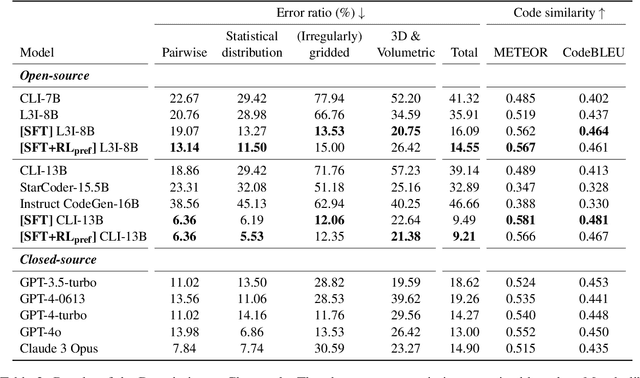
Large language models (LLMs) have demonstrated strong capabilities across various language tasks, notably through instruction-tuning methods. However, LLMs face challenges in visualizing complex, real-world data through charts and plots. Firstly, existing datasets rarely cover a full range of chart types, such as 3D, volumetric, and gridded charts. Secondly, supervised fine-tuning methods do not fully leverage the intricate relationships within rich datasets, including text, code, and figures. To address these challenges, we propose a hierarchical pipeline and a new dataset for chart generation. Our dataset, Text2Chart31, includes 31 unique plot types referring to the Matplotlib library, with 11.1K tuples of descriptions, code, data tables, and plots. Moreover, we introduce a reinforcement learning-based instruction tuning technique for chart generation tasks without requiring human feedback. Our experiments show that this approach significantly enhances the model performance, enabling smaller models to outperform larger open-source models and be comparable to state-of-the-art proprietary models in data visualization tasks. We make the code and dataset available at https://github.com/fatemehpesaran310/Text2Chart31.
Effective Rank Analysis and Regularization for Enhanced 3D Gaussian Splatting
Jun 18, 2024
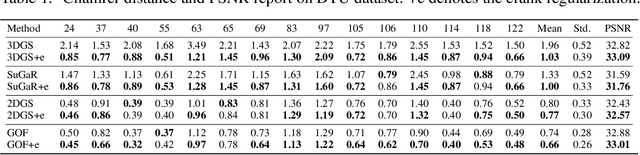
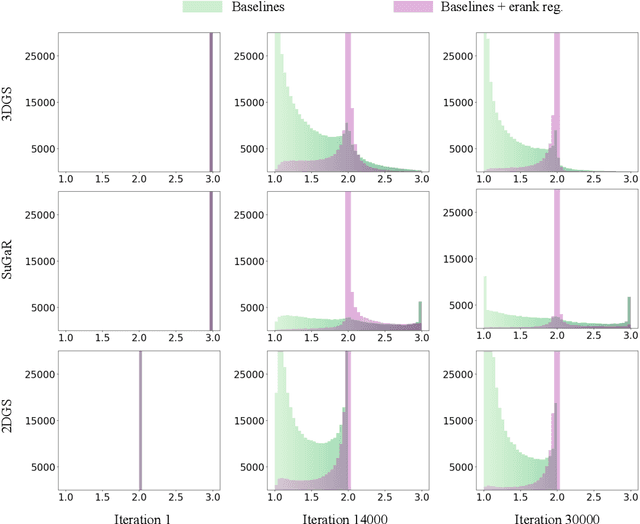

3D reconstruction from multi-view images is one of the fundamental challenges in computer vision and graphics. Recently, 3D Gaussian Splatting (3DGS) has emerged as a promising technique capable of real-time rendering with high-quality 3D reconstruction. This method utilizes 3D Gaussian representation and tile-based splatting techniques, bypassing the expensive neural field querying. Despite its potential, 3DGS encounters challenges, including needle-like artifacts, suboptimal geometries, and inaccurate normals, due to the Gaussians converging into anisotropic Gaussians with one dominant variance. We propose using effective rank analysis to examine the shape statistics of 3D Gaussian primitives, and identify the Gaussians indeed converge into needle-like shapes with the effective rank 1. To address this, we introduce effective rank as a regularization, which constrains the structure of the Gaussians. Our new regularization method enhances normal and geometry reconstruction while reducing needle-like artifacts. The approach can be integrated as an add-on module to other 3DGS variants, improving their quality without compromising visual fidelity.
PruNeRF: Segment-Centric Dataset Pruning via 3D Spatial Consistency
Jun 02, 2024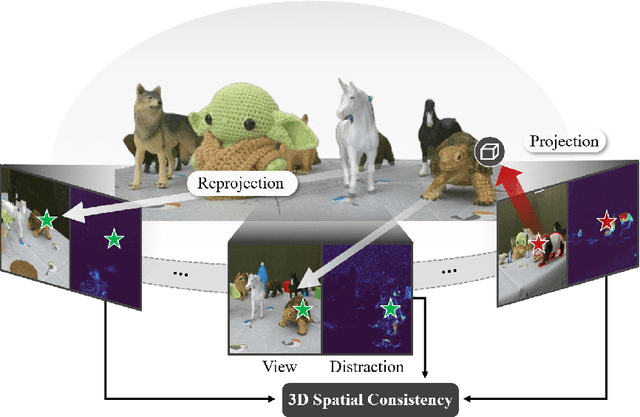
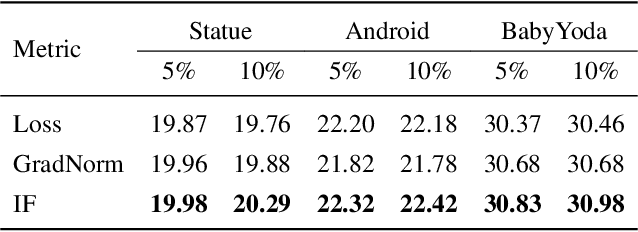
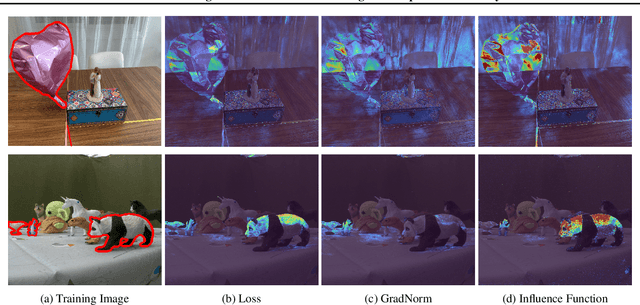
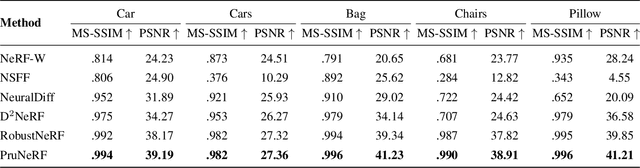
Neural Radiance Fields (NeRF) have shown remarkable performance in learning 3D scenes. However, NeRF exhibits vulnerability when confronted with distractors in the training images -- unexpected objects are present only within specific views, such as moving entities like pedestrians or birds. Excluding distractors during dataset construction is a straightforward solution, but without prior knowledge of their types and quantities, it becomes prohibitively expensive. In this paper, we propose PruNeRF, a segment-centric dataset pruning framework via 3D spatial consistency, that effectively identifies and prunes the distractors. We first examine existing metrics for measuring pixel-wise distraction and introduce Influence Functions for more accurate measurements. Then, we assess 3D spatial consistency using a depth-based reprojection technique to obtain 3D-aware distraction. Furthermore, we incorporate segmentation for pixel-to-segment refinement, enabling more precise identification. Our experiments on benchmark datasets demonstrate that PruNeRF consistently outperforms state-of-the-art methods in robustness against distractors.