 Add to Chrome
 Add to Firefox
 Add to Edge
Towards Generalizable Autonomous Penetration Testing via Domain Randomization and Meta-Reinforcement Learning
Dec 05, 2024
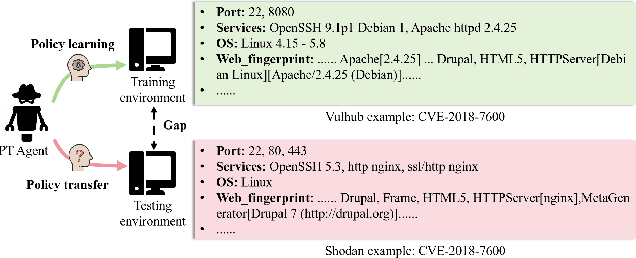
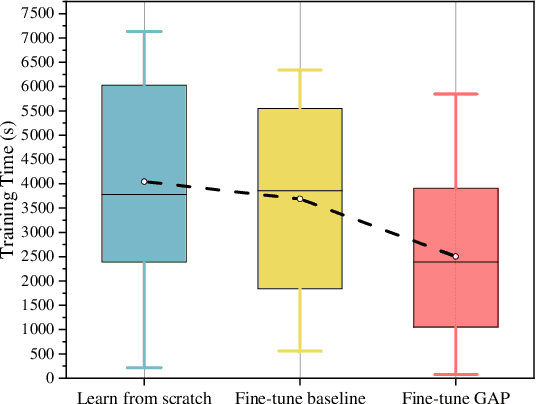
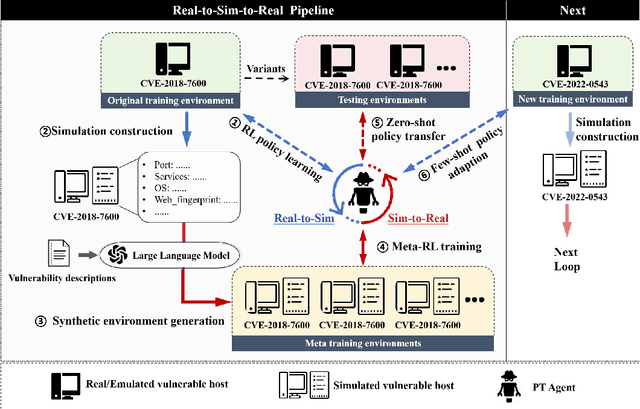
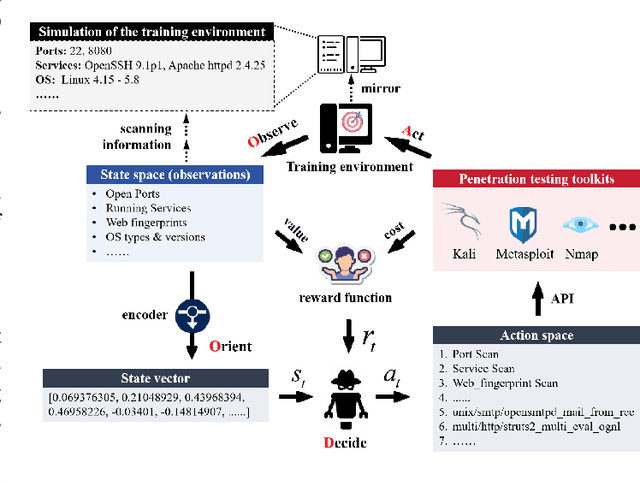
With increasing numbers of vulnerabilities exposed on the internet, autonomous penetration testing (pentesting) has emerged as an emerging research area, while reinforcement learning (RL) is a natural fit for studying autonomous pentesting. Previous research in RL-based autonomous pentesting mainly focused on enhancing agents' learning efficacy within abstract simulated training environments. They overlooked the applicability and generalization requirements of deploying agents' policies in real-world environments that differ substantially from their training settings. In contrast, for the first time, we shift focus to the pentesting agents' ability to generalize across unseen real environments. For this purpose, we propose a Generalizable Autonomous Pentesting framework (namely GAP) for training agents capable of drawing inferences from one to another -- a key requirement for the broad application of autonomous pentesting and a hallmark of human intelligence. GAP introduces a Real-to-Sim-to-Real pipeline with two key methods: domain randomization and meta-RL learning. Specifically, we are among the first to apply domain randomization in autonomous pentesting and propose a large language model-powered domain randomization method for synthetic environment generation. We further apply meta-RL to improve the agents' generalization ability in unseen environments by leveraging the synthetic environments. The combination of these two methods can effectively bridge the generalization gap and improve policy adaptation performance. Experiments are conducted on various vulnerable virtual machines, with results showing that GAP can (a) enable policy learning in unknown real environments, (b) achieve zero-shot policy transfer in similar environments, and (c) realize rapid policy adaptation in dissimilar environments.

RelayGS: Reconstructing Dynamic Scenes with Large-Scale and Complex Motions via Relay Gaussians
Dec 03, 2024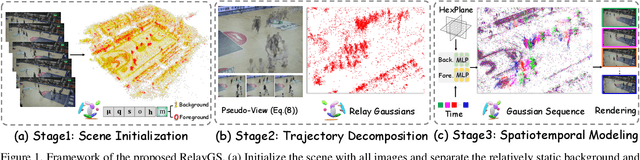
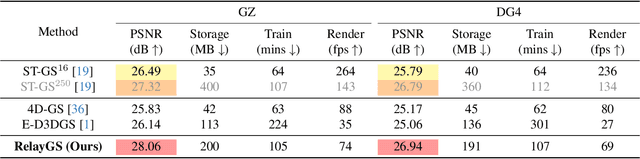
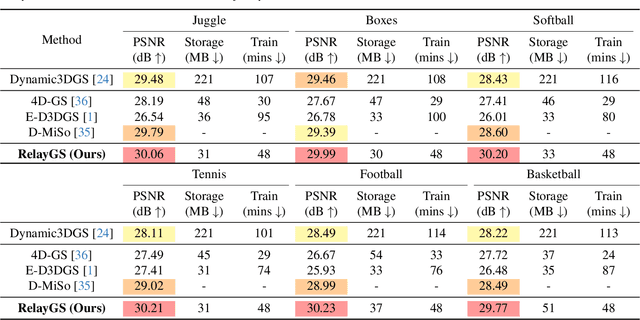

Reconstructing dynamic scenes with large-scale and complex motions remains a significant challenge. Recent techniques like Neural Radiance Fields and 3D Gaussian Splatting (3DGS) have shown promise but still struggle with scenes involving substantial movement. This paper proposes RelayGS, a novel method based on 3DGS, specifically designed to represent and reconstruct highly dynamic scenes. Our RelayGS learns a complete 4D representation with canonical 3D Gaussians and a compact motion field, consisting of three stages. First, we learn a fundamental 3DGS from all frames, ignoring temporal scene variations, and use a learnable mask to separate the highly dynamic foreground from the minimally moving background. Second, we replicate multiple copies of the decoupled foreground Gaussians from the first stage, each corresponding to a temporal segment, and optimize them using pseudo-views constructed from multiple frames within each segment. These Gaussians, termed Relay Gaussians, act as explicit relay nodes, simplifying and breaking down large-scale motion trajectories into smaller, manageable segments. Finally, we jointly learn the scene's temporal motion and refine the canonical Gaussians learned from the first two stages. We conduct thorough experiments on two dynamic scene datasets featuring large and complex motions, where our RelayGS outperforms state-of-the-arts by more than 1 dB in PSNR, and successfully reconstructs real-world basketball game scenes in a much more complete and coherent manner, whereas previous methods usually struggle to capture the complex motion of players. Code will be publicly available at https://github.com/gqk/RelayGS
FreeCodec: A disentangled neural speech codec with fewer tokens
Dec 02, 2024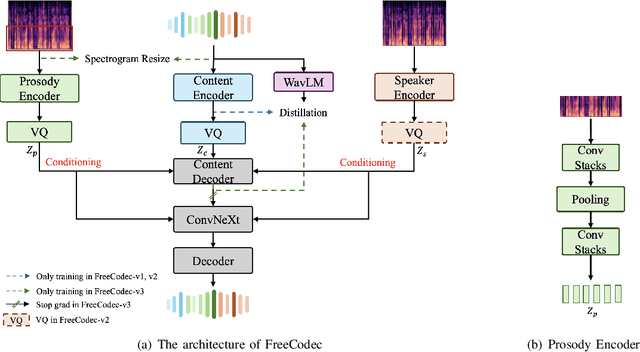
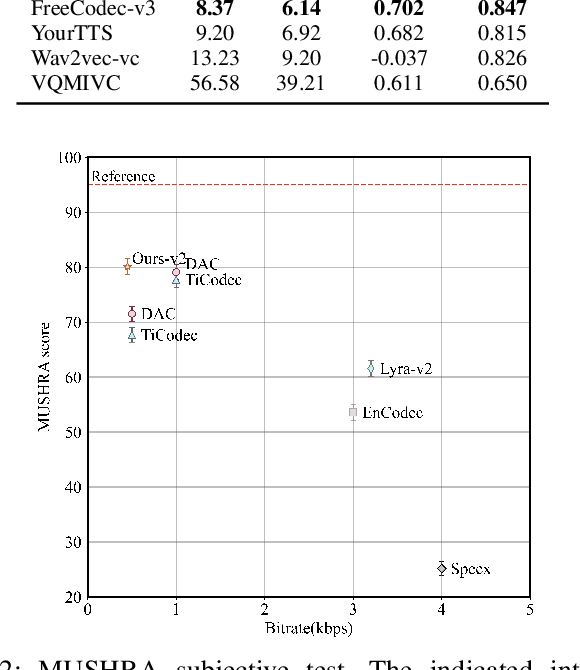
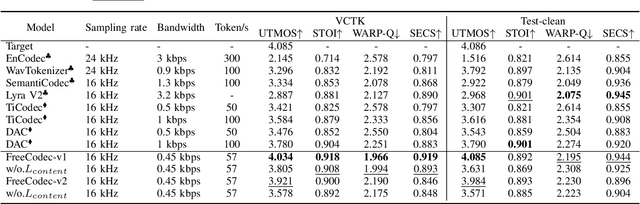
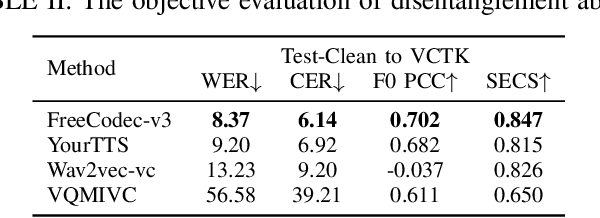
Neural speech codecs have gained great attention for their outstanding reconstruction with discrete token representations. It is a crucial component in generative tasks such as speech coding and large language models (LLM). However, most works based on residual vector quantization perform worse with fewer tokens due to low coding efficiency for modeling complex coupled information. In this paper, we propose a neural speech codec named FreeCodec which employs a more effective encoding framework by decomposing intrinsic properties of speech into different components: 1) a global vector is extracted as the timbre information, 2) a prosody encoder with a long stride level is used to model the prosody information, 3) the content information is from a content encoder. Using different training strategies, FreeCodec achieves state-of-the-art performance in reconstruction and disentanglement scenarios. Results from subjective and objective experiments demonstrate that our framework outperforms existing methods.
Adversarial Diffusion Compression for Real-World Image Super-Resolution
Nov 20, 2024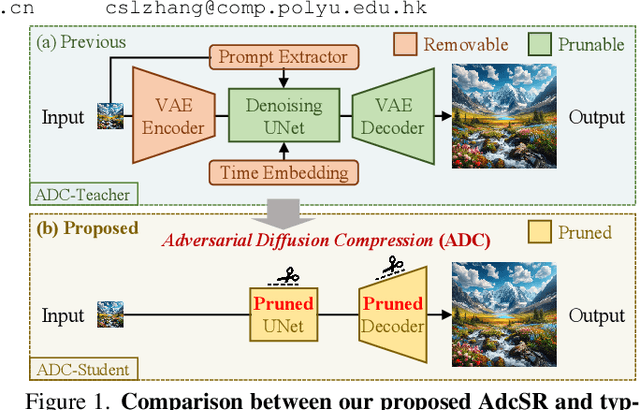
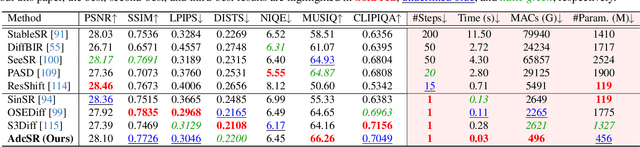
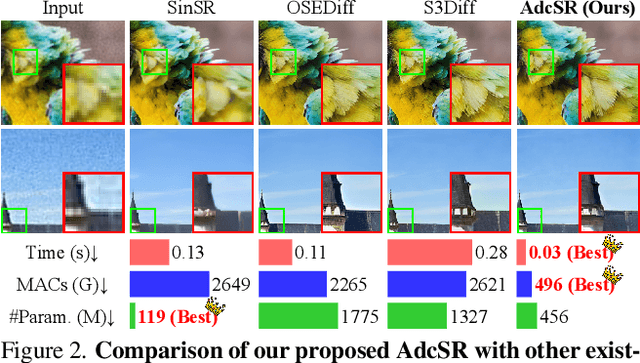
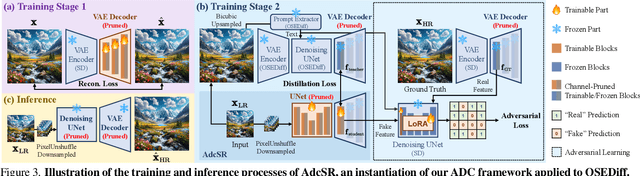
Real-world image super-resolution (Real-ISR) aims to reconstruct high-resolution images from low-resolution inputs degraded by complex, unknown processes. While many Stable Diffusion (SD)-based Real-ISR methods have achieved remarkable success, their slow, multi-step inference hinders practical deployment. Recent SD-based one-step networks like OSEDiff and S3Diff alleviate this issue but still incur high computational costs due to their reliance on large pretrained SD models. This paper proposes a novel Real-ISR method, AdcSR, by distilling the one-step diffusion network OSEDiff into a streamlined diffusion-GAN model under our Adversarial Diffusion Compression (ADC) framework. We meticulously examine the modules of OSEDiff, categorizing them into two types: (1) Removable (VAE encoder, prompt extractor, text encoder, etc.) and (2) Prunable (denoising UNet and VAE decoder). Since direct removal and pruning can degrade the model's generation capability, we pretrain our pruned VAE decoder to restore its ability to decode images and employ adversarial distillation to compensate for performance loss. This ADC-based diffusion-GAN hybrid design effectively reduces complexity by 73% in inference time, 78% in computation, and 74% in parameters, while preserving the model's generation capability. Experiments manifest that our proposed AdcSR achieves competitive recovery quality on both synthetic and real-world datasets, offering up to 9.3$\times$ speedup over previous one-step diffusion-based methods. Code and models will be made available.
Self-Supervised Conditional Distribution Learning on Graphs
Nov 20, 2024Graph contrastive learning (GCL) has shown promising performance in semisupervised graph classification. However, existing studies still encounter significant challenges in GCL. First, successive layers in graph neural network (GNN) tend to produce more similar node embeddings, while GCL aims to increase the dissimilarity between negative pairs of node embeddings. This inevitably results in a conflict between the message-passing mechanism of GNNs and the contrastive learning of negative pairs via intraviews. Second, leveraging the diversity and quantity of data provided by graph-structured data augmentations while preserving intrinsic semantic information is challenging. In this paper, we propose a self-supervised conditional distribution learning (SSCDL) method designed to learn graph representations from graph-structured data for semisupervised graph classification. Specifically, we present an end-to-end graph representation learning model to align the conditional distributions of weakly and strongly augmented features over the original features. This alignment effectively reduces the risk of disrupting intrinsic semantic information through graph-structured data augmentation. To avoid conflict between the message-passing mechanism and contrastive learning of negative pairs, positive pairs of node representations are retained for measuring the similarity between the original features and the corresponding weakly augmented features. Extensive experiments with several benchmark graph datasets demonstrate the effectiveness of the proposed SSCDL method.
Technical Report: Enhancing LLM Reasoning with Reward-guided Tree Search
Nov 18, 2024

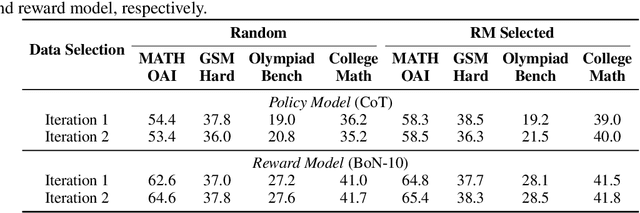

Recently, test-time scaling has garnered significant attention from the research community, largely due to the substantial advancements of the o1 model released by OpenAI. By allocating more computational resources during the inference phase, large language models~(LLMs) can extensively explore the solution space by generating more thought tokens or diverse solutions, thereby producing more accurate responses. However, developing an o1-like reasoning approach is challenging, and researchers have been making various attempts to advance this open area of research. In this paper, we present a preliminary exploration into enhancing the reasoning abilities of LLMs through reward-guided tree search algorithms. This framework is implemented by integrating the policy model, reward model, and search algorithm. It is primarily constructed around a tree search algorithm, where the policy model navigates a dynamically expanding tree guided by a specially trained reward model. We thoroughly explore various design considerations necessary for implementing this framework and provide a detailed report of the technical aspects. To assess the effectiveness of our approach, we focus on mathematical reasoning tasks and conduct extensive evaluations on four challenging datasets, significantly enhancing the reasoning abilities of LLMs.
HiCoM: Hierarchical Coherent Motion for Streamable Dynamic Scene with 3D Gaussian Splatting
Nov 12, 2024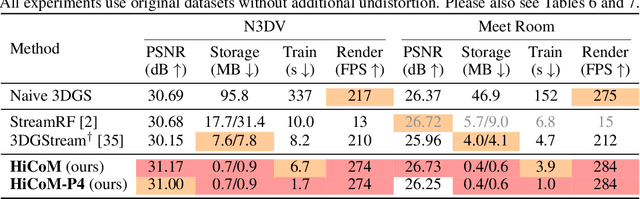
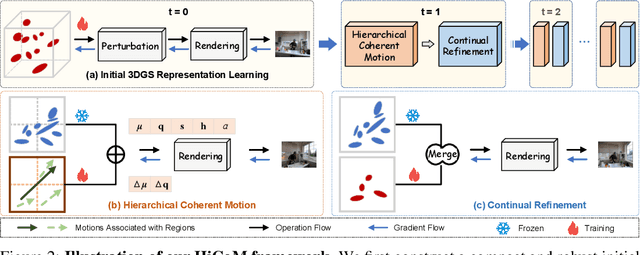
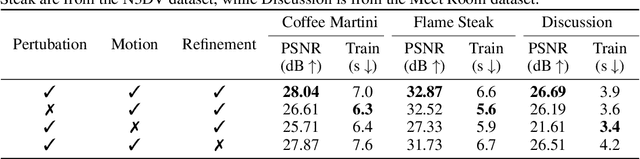
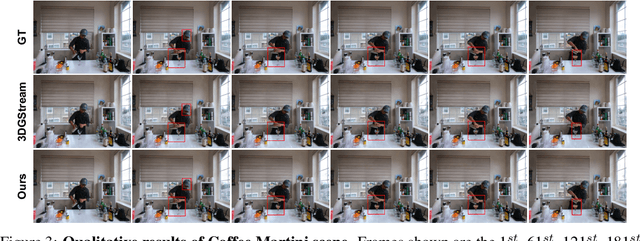
The online reconstruction of dynamic scenes from multi-view streaming videos faces significant challenges in training, rendering and storage efficiency. Harnessing superior learning speed and real-time rendering capabilities, 3D Gaussian Splatting (3DGS) has recently demonstrated considerable potential in this field. However, 3DGS can be inefficient in terms of storage and prone to overfitting by excessively growing Gaussians, particularly with limited views. This paper proposes an efficient framework, dubbed HiCoM, with three key components. First, we construct a compact and robust initial 3DGS representation using a perturbation smoothing strategy. Next, we introduce a Hierarchical Coherent Motion mechanism that leverages the inherent non-uniform distribution and local consistency of 3D Gaussians to swiftly and accurately learn motions across frames. Finally, we continually refine the 3DGS with additional Gaussians, which are later merged into the initial 3DGS to maintain consistency with the evolving scene. To preserve a compact representation, an equivalent number of low-opacity Gaussians that minimally impact the representation are removed before processing subsequent frames. Extensive experiments conducted on two widely used datasets show that our framework improves learning efficiency of the state-of-the-art methods by about $20\%$ and reduces the data storage by $85\%$, achieving competitive free-viewpoint video synthesis quality but with higher robustness and stability. Moreover, by parallel learning multiple frames simultaneously, our HiCoM decreases the average training wall time to $<2$ seconds per frame with negligible performance degradation, substantially boosting real-world applicability and responsiveness.
An Efficient Hierarchical Preconditioner-Learner Architecture for Reconstructing Multi-scale Basis Functions of High-dimensional Subsurface Fluid Flow
Nov 01, 2024Modeling subsurface fluid flow in porous media is crucial for applications such as oil and gas exploration. However, the inherent heterogeneity and multi-scale characteristics of these systems pose significant challenges in accurately reconstructing fluid flow behaviors. To address this issue, we proposed Fourier Preconditioner-based Hierarchical Multiscale Net (FP-HMsNet), an efficient hierarchical preconditioner-learner architecture that combines Fourier Neural Operators (FNO) with multi-scale neural networks to reconstruct multi-scale basis functions of high-dimensional subsurface fluid flow. Using a dataset comprising 102,757 training samples, 34,252 validation samples, and 34,254 test samples, we ensured the reliability and generalization capability of the model. Experimental results showed that FP-HMsNet achieved an MSE of 0.0036, an MAE of 0.0375, and an R2 of 0.9716 on the testing set, significantly outperforming existing models and demonstrating exceptional accuracy and generalization ability. Additionally, robustness tests revealed that the model maintained stability under various levels of noise interference. Ablation studies confirmed the critical contribution of the preconditioner and multi-scale pathways to the model's performance. Compared to current models, FP-HMsNet not only achieved lower errors and higher accuracy but also demonstrated faster convergence and improved computational efficiency, establishing itself as the state-of-the-art (SOTA) approach. This model offers a novel method for efficient and accurate subsurface fluid flow modeling, with promising potential for more complex real-world applications.
The D-Subspace Algorithm for Online Learning over Distributed Networks
Oct 26, 2024This material introduces the D-Subspace algorithm derived on the basis of the centralized algorithm [1], which originally addresses parameter estimation problems under a subspace constraint.
Standardizing Generative Face Video Compression using Supplemental Enhancement Information
Oct 19, 2024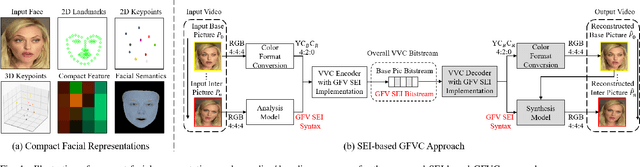
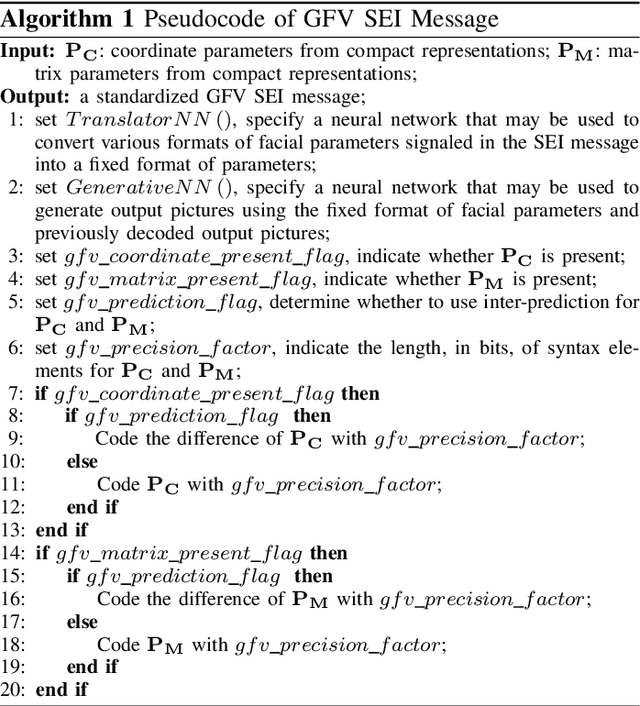
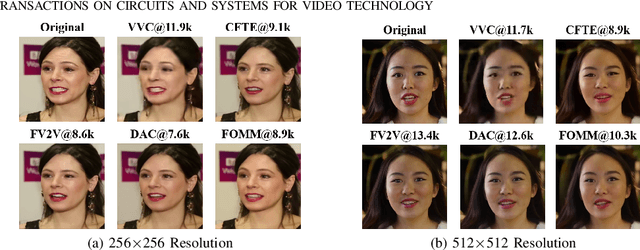
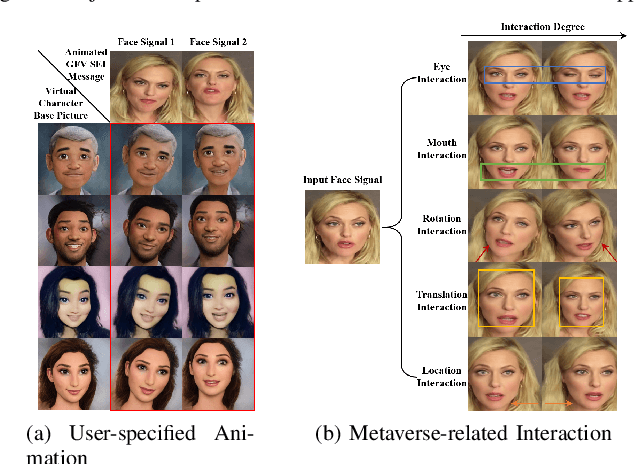
This paper proposes a Generative Face Video Compression (GFVC) approach using Supplemental Enhancement Information (SEI), where a series of compact spatial and temporal representations of a face video signal (i.e., 2D/3D key-points, facial semantics and compact features) can be coded using SEI message and inserted into the coded video bitstream. At the time of writing, the proposed GFVC approach is an official "technology under consideration" (TuC) for standardization by the Joint Video Experts Team (JVET) of ISO/IEC JVT 1/SC 29 and ITU-T SG16. To the best of the authors' knowledge, the JVET work on the proposed SEI-based GFVC approach is the first standardization activity for generative video compression. The proposed SEI approach has not only advanced the reconstruction quality of early-day Model-Based Coding (MBC) via the state-of-the-art generative technique, but also established a new SEI definition for future GFVC applications and deployment. Experimental results illustrate that the proposed SEI-based GFVC approach can achieve remarkable rate-distortion performance compared with the latest Versatile Video Coding (VVC) standard, whilst also potentially enabling a wide variety of functionalities including user-specified animation/filtering and metaverse-related applications.