 Add to Chrome
 Add to Firefox
 Add to Edge
DiffPack: A Torsional Diffusion Model for Autoregressive Protein Side-Chain Packing
Jun 01, 2023
Proteins play a critical role in carrying out biological functions, and their 3D structures are essential in determining their functions. Accurately predicting the conformation of protein side-chains given their backbones is important for applications in protein structure prediction, design and protein-protein interactions. Traditional methods are computationally intensive and have limited accuracy, while existing machine learning methods treat the problem as a regression task and overlook the restrictions imposed by the constant covalent bond lengths and angles. In this work, we present DiffPack, a torsional diffusion model that learns the joint distribution of side-chain torsional angles, the only degrees of freedom in side-chain packing, by diffusing and denoising on the torsional space. To avoid issues arising from simultaneous perturbation of all four torsional angles, we propose autoregressively generating the four torsional angles from \c{hi}1 to \c{hi}4 and training diffusion models for each torsional angle. We evaluate the method on several benchmarks for protein side-chain packing and show that our method achieves improvements of 11.9% and 13.5% in angle accuracy on CASP13 and CASP14, respectively, with a significantly smaller model size (60x fewer parameters). Additionally, we show the effectiveness of our method in enhancing side-chain predictions in the AlphaFold2 model. Code will be available upon the accept.

A Group Symmetric Stochastic Differential Equation Model for Molecule Multi-modal Pretraining
May 28, 2023Molecule pretraining has quickly become the go-to schema to boost the performance of AI-based drug discovery. Naturally, molecules can be represented as 2D topological graphs or 3D geometric point clouds. Although most existing pertaining methods focus on merely the single modality, recent research has shown that maximizing the mutual information (MI) between such two modalities enhances the molecule representation ability. Meanwhile, existing molecule multi-modal pretraining approaches approximate MI based on the representation space encoded from the topology and geometry, thus resulting in the loss of critical structural information of molecules. To address this issue, we propose MoleculeSDE. MoleculeSDE leverages group symmetric (e.g., SE(3)-equivariant and reflection-antisymmetric) stochastic differential equation models to generate the 3D geometries from 2D topologies, and vice versa, directly in the input space. It not only obtains tighter MI bound but also enables prosperous downstream tasks than the previous work. By comparing with 17 pretraining baselines, we empirically verify that MoleculeSDE can learn an expressive representation with state-of-the-art performance on 26 out of 32 downstream tasks.
CP$^3$: Channel Pruning Plug-in for Point-based Networks
Mar 23, 2023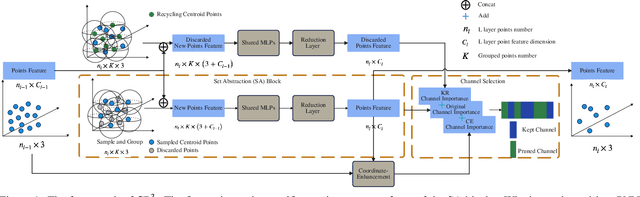
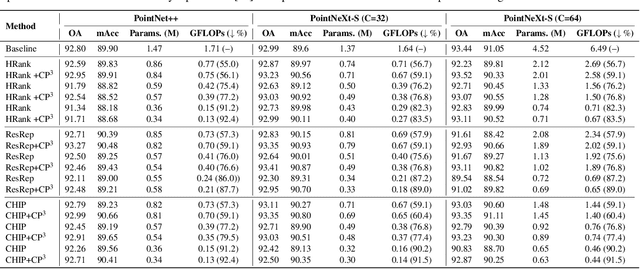
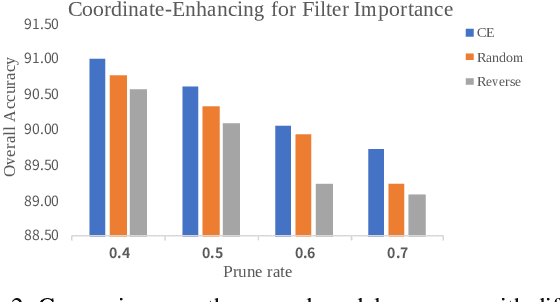
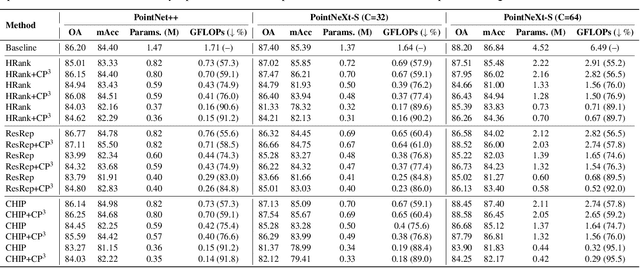
Channel pruning can effectively reduce both computational cost and memory footprint of the original network while keeping a comparable accuracy performance. Though great success has been achieved in channel pruning for 2D image-based convolutional networks (CNNs), existing works seldom extend the channel pruning methods to 3D point-based neural networks (PNNs). Directly implementing the 2D CNN channel pruning methods to PNNs undermine the performance of PNNs because of the different representations of 2D images and 3D point clouds as well as the network architecture disparity. In this paper, we proposed CP$^3$, which is a Channel Pruning Plug-in for Point-based network. CP$^3$ is elaborately designed to leverage the characteristics of point clouds and PNNs in order to enable 2D channel pruning methods for PNNs. Specifically, it presents a coordinate-enhanced channel importance metric to reflect the correlation between dimensional information and individual channel features, and it recycles the discarded points in PNN's sampling process and reconsiders their potentially-exclusive information to enhance the robustness of channel pruning. Experiments on various PNN architectures show that CP$^3$ constantly improves state-of-the-art 2D CNN pruning approaches on different point cloud tasks. For instance, our compressed PointNeXt-S on ScanObjectNN achieves an accuracy of 88.52% with a pruning rate of 57.8%, outperforming the baseline pruning methods with an accuracy gain of 1.94%.
CMG-Net: An End-to-End Contact-Based Multi-Finger Dexterous Grasping Network
Mar 23, 2023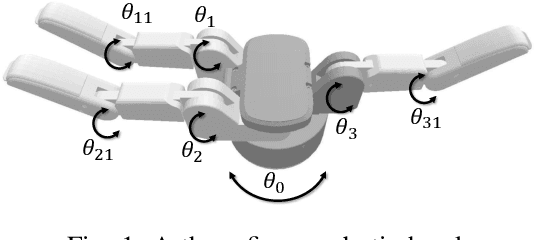
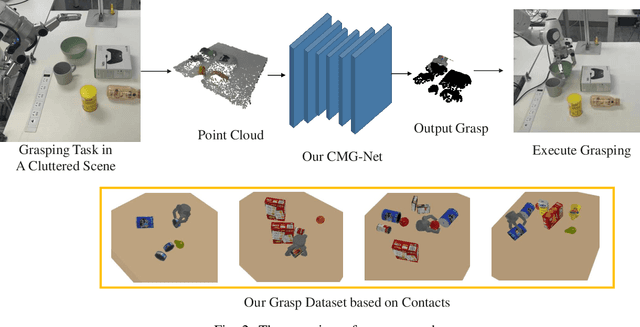
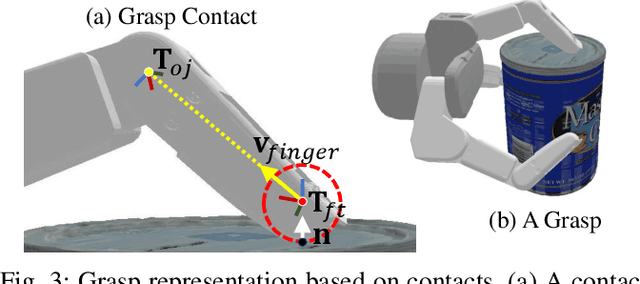
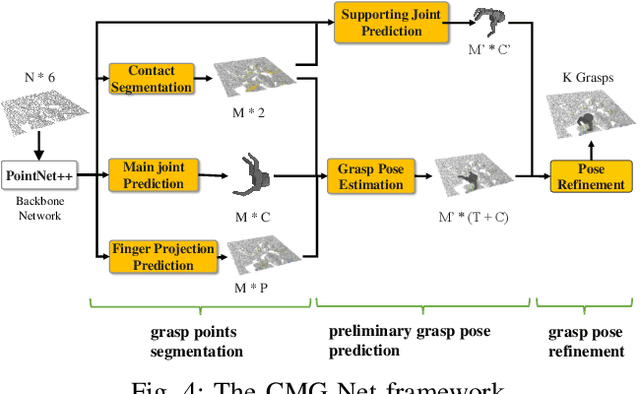
In this paper, we propose a novel representation for grasping using contacts between multi-finger robotic hands and objects to be manipulated. This representation significantly reduces the prediction dimensions and accelerates the learning process. We present an effective end-to-end network, CMG-Net, for grasping unknown objects in a cluttered environment by efficiently predicting multi-finger grasp poses and hand configurations from a single-shot point cloud. Moreover, we create a synthetic grasp dataset that consists of five thousand cluttered scenes, 80 object categories, and 20 million annotations. We perform a comprehensive empirical study and demonstrate the effectiveness of our grasping representation and CMG-Net. Our work significantly outperforms the state-of-the-art for three-finger robotic hands. We also demonstrate that the model trained using synthetic data performs very well for real robots.
Prioritized Planning for Target-Oriented Manipulation via Hierarchical Stacking Relationship Prediction
Mar 14, 2023In scenarios involving the grasping of multiple targets, the learning of stacking relationships between objects is fundamental for robots to execute safely and efficiently. However, current methods lack subdivision for the hierarchy of stacking relationship types. In scenes where objects are mostly stacked in an orderly manner, they are incapable of performing human-like and high-efficient grasping decisions. This paper proposes a perception-planning method to distinguish different stacking types between objects and generate prioritized manipulation order decisions based on given target designations. We utilize a Hierarchical Stacking Relationship Network (HSRN) to discriminate the hierarchy of stacking and generate a refined Stacking Relationship Tree (SRT) for relationship description. Considering that objects with high stacking stability can be grasped together if necessary, we introduce an elaborate decision-making planner based on the Partially Observable Markov Decision Process (POMDP), which leverages observations and generates the least grasp-consuming decision chain with robustness and is suitable for simultaneously specifying multiple targets. To verify our work, we set the scene to the dining table and augment the REGRAD dataset with a set of common tableware models for network training. Experiments show that our method effectively generates grasping decisions that conform to human requirements, and improves the implementation efficiency compared with existing methods on the basis of guaranteeing the success rate.
Enhancing Protein Language Models with Structure-based Encoder and Pre-training
Mar 11, 2023Protein language models (PLMs) pre-trained on large-scale protein sequence corpora have achieved impressive performance on various downstream protein understanding tasks. Despite the ability to implicitly capture inter-residue contact information, transformer-based PLMs cannot encode protein structures explicitly for better structure-aware protein representations. Besides, the power of pre-training on available protein structures has not been explored for improving these PLMs, though structures are important to determine functions. To tackle these limitations, in this work, we enhance the PLMs with structure-based encoder and pre-training. We first explore feasible model architectures to combine the advantages of a state-of-the-art PLM (i.e., ESM-1b1) and a state-of-the-art protein structure encoder (i.e., GearNet). We empirically verify the ESM-GearNet that connects two encoders in a series way as the most effective combination model. To further improve the effectiveness of ESM-GearNet, we pre-train it on massive unlabeled protein structures with contrastive learning, which aligns representations of co-occurring subsequences so as to capture their biological correlation. Extensive experiments on EC and GO protein function prediction benchmarks demonstrate the superiority of ESM-GearNet over previous PLMs and structure encoders, and clear performance gains are further achieved by structure-based pre-training upon ESM-GearNet. Our implementation is available at https://github.com/DeepGraphLearning/GearNet.
A Text-guided Protein Design Framework
Feb 09, 2023


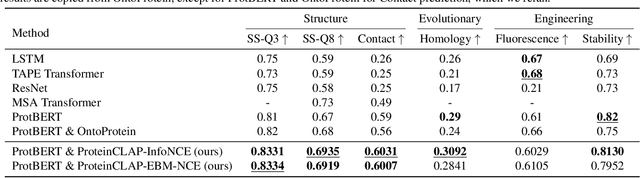
Current AI-assisted protein design mainly utilizes protein sequential and structural information. Meanwhile, there exists tremendous knowledge curated by humans in the text format describing proteins' high-level properties. Yet, whether the incorporation of such text data can help protein design tasks has not been explored. To bridge this gap, we propose ProteinDT, a multi-modal framework that leverages textual descriptions for protein design. ProteinDT consists of three subsequent steps: ProteinCLAP that aligns the representation of two modalities, a facilitator that generates the protein representation from the text modality, and a decoder that generates the protein sequences from the representation. To train ProteinDT, we construct a large dataset, SwissProtCLAP, with 441K text and protein pairs. We empirically verify the effectiveness of ProteinDT from three aspects: (1) consistently superior performance on four out of six protein property prediction benchmarks; (2) over 90% accuracy for text-guided protein generation; and (3) promising results for zero-shot text-guided protein editing.
Physics-Inspired Protein Encoder Pre-Training via Siamese Sequence-Structure Diffusion Trajectory Prediction
Jan 28, 2023Pre-training methods on proteins are recently gaining interest, leveraging either protein sequences or structures, while modeling their joint energy landscape is largely unexplored. In this work, inspired by the success of denoising diffusion models, we propose the DiffPreT approach to pre-train a protein encoder by sequence-structure multimodal diffusion modeling. DiffPreT guides the encoder to recover the native protein sequences and structures from the perturbed ones along the multimodal diffusion trajectory, which acquires the joint distribution of sequences and structures. Considering the essential protein conformational variations, we enhance DiffPreT by a physics-inspired method called Siamese Diffusion Trajectory Prediction (SiamDiff) to capture the correlation between different conformers of a protein. SiamDiff attains this goal by maximizing the mutual information between representations of diffusion trajectories of structurally-correlated conformers. We study the effectiveness of DiffPreT and SiamDiff on both atom- and residue-level structure-based protein understanding tasks. Experimental results show that the performance of DiffPreT is consistently competitive on all tasks, and SiamDiff achieves new state-of-the-art performance, considering the mean ranks on all tasks. The source code will be released upon acceptance.
ProtST: Multi-Modality Learning of Protein Sequences and Biomedical Texts
Jan 28, 2023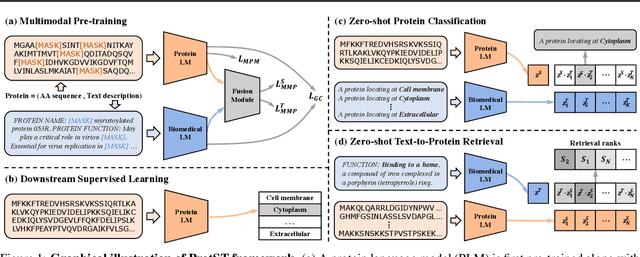


Current protein language models (PLMs) learn protein representations mainly based on their sequences, thereby well capturing co-evolutionary information, but they are unable to explicitly acquire protein functions, which is the end goal of protein representation learning. Fortunately, for many proteins, their textual property descriptions are available, where their various functions are also described. Motivated by this fact, we first build the ProtDescribe dataset to augment protein sequences with text descriptions of their functions and other important properties. Based on this dataset, we propose the ProtST framework to enhance Protein Sequence pre-training and understanding by biomedical Texts. During pre-training, we design three types of tasks, i.e., unimodal mask prediction, multimodal representation alignment and multimodal mask prediction, to enhance a PLM with protein property information with different granularities and, at the same time, preserve the PLM's original representation power. On downstream tasks, ProtST enables both supervised learning and zero-shot prediction. We verify the superiority of ProtST-induced PLMs over previous ones on diverse representation learning benchmarks. Under the zero-shot setting, we show the effectiveness of ProtST on zero-shot protein classification, and ProtST also enables functional protein retrieval from a large-scale database without any function annotation.
Towards Long-Term Time-Series Forecasting: Feature, Pattern, and Distribution
Jan 05, 2023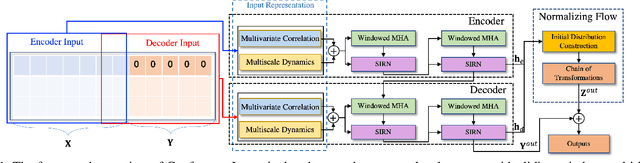
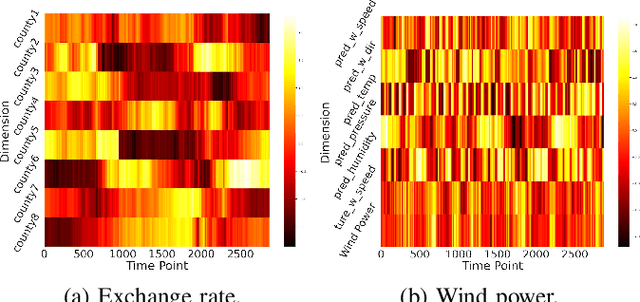
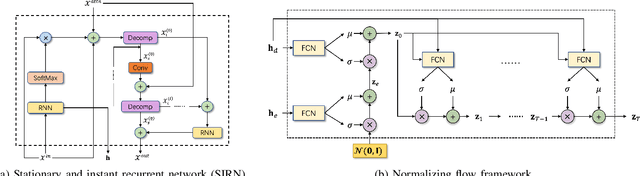
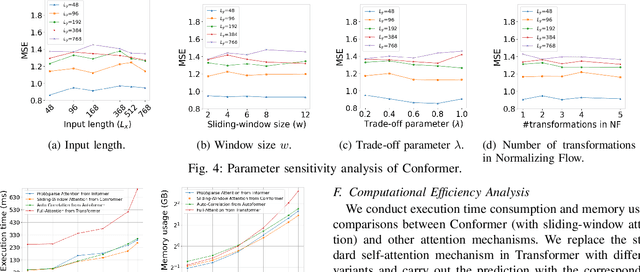
Long-term time-series forecasting (LTTF) has become a pressing demand in many applications, such as wind power supply planning. Transformer models have been adopted to deliver high prediction capacity because of the high computational self-attention mechanism. Though one could lower the complexity of Transformers by inducing the sparsity in point-wise self-attentions for LTTF, the limited information utilization prohibits the model from exploring the complex dependencies comprehensively. To this end, we propose an efficient Transformerbased model, named Conformer, which differentiates itself from existing methods for LTTF in three aspects: (i) an encoder-decoder architecture incorporating a linear complexity without sacrificing information utilization is proposed on top of sliding-window attention and Stationary and Instant Recurrent Network (SIRN); (ii) a module derived from the normalizing flow is devised to further improve the information utilization by inferring the outputs with the latent variables in SIRN directly; (iii) the inter-series correlation and temporal dynamics in time-series data are modeled explicitly to fuel the downstream self-attention mechanism. Extensive experiments on seven real-world datasets demonstrate that Conformer outperforms the state-of-the-art methods on LTTF and generates reliable prediction results with uncertainty quantification.